Kim Yong-beom: "The state should open the AI market and then step back... Access to AI is a basic right"
- Input
- 2026-07-21 14:36:38
- Updated
- 2026-07-21 14:36:38
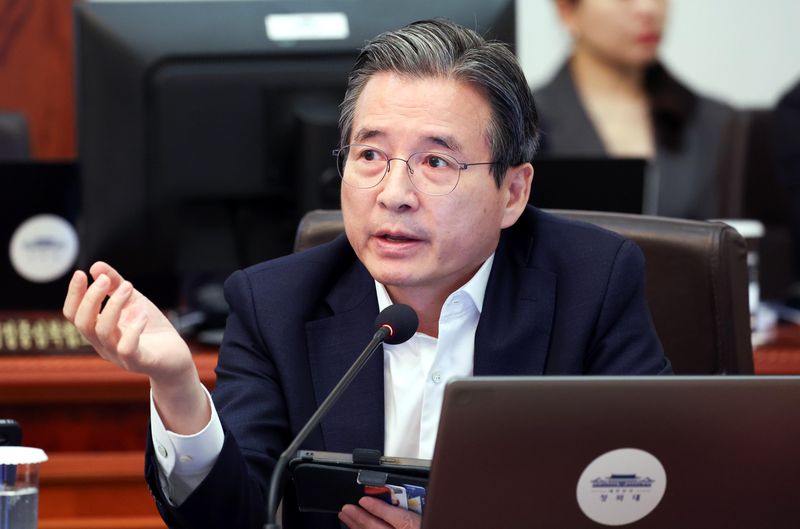
[Financial News] Kim Yong-beom, Chief Presidential Secretary for Policy at the Blue House, said on the 21st that "the state in the AI era is neither a state that produces nor a state that controls," adding that it is "a state that organizes the market."
In a Facebook post titled 'In the AI Era, the State Organizes the Market,' Kim said, "The state does not replace the market. It only helps it cross the thresholds it cannot overcome on its own, then steps back."
Kim described the current AI market as a "small market" where individuals subscribe to chatbots. He said the real market is where AI helps doctors with treatment, enters classrooms, and processes civil complaints at government offices. "That vast market has not yet opened in earnest," he added.
He went on to note, "If we leave it entirely to the market, no one moves first." He explained that hospitals wait for regulations to be eased, regulators wait for successful examples, and companies wait for clear demand to emerge.
He said that, taken individually, these are rational decisions, but together they cause a market that should be opening to come to a standstill. "It is more accurate to say that the market is locked than to say it is empty," he added.
Kim stressed that making, selling, and using AI should remain in the market's hands, while the state should only connect the scattered conditions needed to open the locked door.
On the government's 'AI for Everyone' initiative, he said it is "a project where the state steps directly into this space." The plan is to provide Korean-made AI free of charge to the public to build demand and accumulate data, while supporting private-sector service development through AI agents that help people apply for public services and through the opening of public data.
Regarding public AI agents, he said the state would first shoulder the risks of initial adoption, which individual hospitals or companies would find difficult to bear alone, and create use cases, data, and trust in the public sector. "This is the side that truly opens the market," he said.
Kim also said guaranteeing access to AI is a role of the state. He stated that since AI has become a force that determines individual opportunity and growth, it is the state's job to ensure that no citizen is excluded at the door. "Access to AI must now be seen as a basic right," he said.
He added, "Just as primary education and public health are not provided because they are profitable, but because they are basic rights, AI should be treated the same way." He said guaranteeing a minimum level of computing power for all citizens is different from welfare that simply distributes cash.
However, he warned that "a state that connects the market can easily turn into a state that clings to specific companies." He said it must always remain open to new participants, make them compete on performance, and step aside once the market begins to function on its own.
Kim emphasized, "If the state settles in as the biggest customer, the market will once again become tied to the state." He added that the state should be the referee that designs the field, not the biggest player on it.
He concluded by saying that the problem is not a lack of ingredients, but that they are scattered. "In the AI era, what the state must do is not make the beads, but thread them together," he said.
[email protected] Sung Seok-woo Reporter