"Operating profit surged 2,740%, but why aren't semiconductor companies hiring more?" Employment rose just 0.6% — here's why
- Input
- 2026-07-21 15:24:05
- Updated
- 2026-07-21 15:24:05

[Financial News] A recent analysis has drawn attention by showing that large companies' sales and operating profits have posted double-digit growth over the past three years, while employment has remained virtually flat.
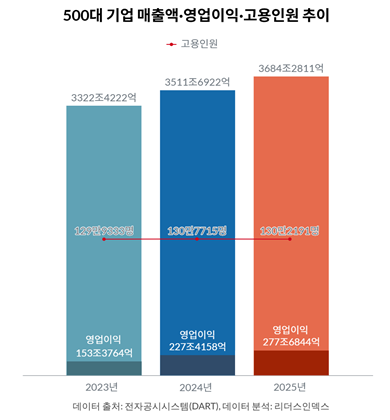
On the 21st, Leaders Index Corporate Analysis Institute said it analyzed 282 of the top 500 companies by sales, comparing revenue, operating profit, and employment trends for fiscal years 2023 through 2025. The firms' combined operating profit rose by 124.308 trillion won, or 81.0%, from 153.3764 trillion won to 277.6844 trillion won.
Revenue also increased by 361.8589 trillion won, or 10.9%, from 3,322.4222 trillion won in 2023 to 3,684.2811 trillion won last year. But employment rose by only 2,858 people, or 0.2%, from 1,299,333 at the end of 2023 to 1,302,191 at the end of last year.
Among these figures, operating profit stands out the most. Looking at profit growth by industry, one sector is especially notable: IT, electrical and electronics.
Revenue and operating profit in the IT, electrical and electronics sector rose 34.4% and 2,740.5%, respectively, driven by the performance of Samsung Electronics and SK hynix. Operating profit alone increased by 95.367 trillion won, accounting for 76.7% of the total.
The problem is that this boom had only a minimal impact on employment. Operating profit in the IT, electrical and electronics sector surged nearly 28-fold in two years, but employment increased by just 1,727 people, or 0.6%, from 268,330 to 270,057. That means only 18 jobs were created for every 100 billion won increase in operating profit.
The gap becomes even clearer when compared with the shipbuilding, machinery, and defense sector over the same period. In that sector, employment rose by 10,629 when operating profit increased by 7.661 trillion won. That works out to about 1,387 jobs per 100 billion won in profit, roughly 77 times the semiconductor figure. The pharmaceutical and biotech sector also created about 1,200 jobs per 100 billion won in profit.
Is semiconductors the main culprit behind 'growth without jobs'? Even Samsung Electronics and SK hynix, which hired the most, could not change the picture
Profits in the semiconductor industry come not from labor input but from memory prices and equipment, so the sector does not generate many jobs. Fab plants worth tens of trillions of won are highly automated, and AI-driven capital expenditure flows into machines rather than people. In other words, even when profits soar, the industry's job-creation coefficient remains structurally low.
For that reason, semiconductors have high productivity and value added, but their employment-creation effect is relatively limited. In an analysis released on the 5th based on economic outlooks from the Korea Development Institute (KDI) and the Bank of Korea, this year's employment elasticity was also estimated to remain at 0.24.
Employment elasticity is an indicator of how much jobs increase as the economy grows. The analysis suggested that as artificial intelligence (AI) replaces more jobs, the semiconductor industry, which is driving economic growth, has weak job-creation power. Economic growth is forecast to more than double from last year's 1.1%, but the employment growth rate is expected to fall further, making growth without jobs increasingly evident.
Paradoxically, the company that added the most jobs during this period was Samsung Electronics, with 4,077, followed by SK hynix with 2,484. However, declines at LG Display, which is classified in the same sector and cut 3,361 jobs (-12.1%), LG Innotek, which cut 1,601 jobs (-11.6%), and LG Electronics, which cut 967 jobs (-2.8%), weighed on the sector's overall employment gain.
In other words, Samsung Electronics and SK hynix added 6,561 jobs, but that was offset by the 5,929 jobs lost at LG Display, LG Innotek, and LG Electronics. The semiconductor side hired, while display and electronics companies cut staff. As a result, even amid a record boom, the sector's net employment gain was only 1,727.
Employment follows sales, not profit
Another pattern confirmed in this analysis is that employment moves with sales, not operating profit. In other words, companies do not hire simply because they are making money; they hire when workloads increase.
Automobiles, steel, secondary batteries, and transportation increased hiring as sales rose, even though operating profit fell. By contrast, telecom, retail, food and beverage, banking, and securities companies cut jobs as sales declined or grew by only single digits, regardless of changes in operating profit.
The decline in employment was especially clear in domestic-demand sectors. KT Corporation saw revenue jump 7.1% and operating profit surge 49.7%, but it cut employment by 25.5%, or 5,036 people. KT&G Corporation also increased sales and profit by 12.2% and 15.1%, respectively, but reduced its workforce by 10.1%.
[email protected] Kim Hee-sun Reporter