Next Year's Budget Plan to Exceed 800 Trillion Won, with 50 Trillion Won in Spending Reallocation and Additional Semiconductor Tax Revenue
- Input
- 2026-07-21 11:28:43
- Updated
- 2026-07-21 11:28:43
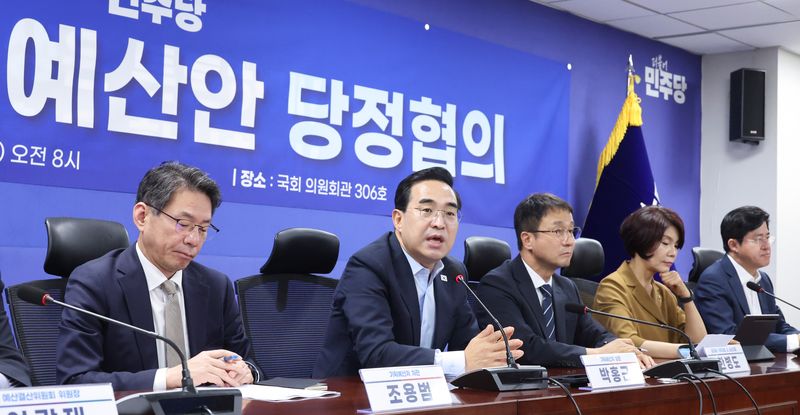
[Financial News] The Lee Jae Myung administration's first fully prepared budget for next year is expected to exceed 800 trillion won. The government plans to set a record-high budget by adding extra tax revenue from the semiconductor boom and 50 trillion won in spending adjustments by the Ministry of Planning and Budget.
The Ministry of Planning and Budget, along with the Democratic Party of Korea's floor leadership, members of the National Assembly's Special Committee on Budget and Accounts, and Minister Park Hong-keun, held a ruling party-government consultation on next year's budget bill at the National Assembly Members' Office Building on the 21st and announced the plan. Such consultations are usually held in August, when budget drafting is completed, but the ministry requested the meeting to reflect the ruling party's views in the process.
Acting DPK leader and floor leader Han Byung-do said at the meeting, "Next year's budget will be set at a record-high 800 trillion won plus alpha, and national tax revenue is also expected to exceed 500 trillion won, marking an all-time high."
Fiscal spending will focus on three major mega projects, including the 800 trillion won Southwest Semiconductor Cluster. The government and ruling party aim to support future industries such as semiconductors while also driving region-led growth. Under the Special Act on Mega Regulatory Free Zones, they plan to expand infrastructure, ease regulations, and provide fiscal and tax support to develop industries in non-capital regions. Budget will also be allocated to expand large-scale housing supply.
The main reason the government can prepare a budget of more than 800 trillion won and promise bold investment is the additional tax revenue from the semiconductor boom. Earlier, the government and ruling party proposed creating a Future Response Fund based on the extra revenue to finance the mega projects. Minister Park said at the consultation, "We will turn the extra tax revenue from the semiconductor boom into a Future Response Fund and reinvest it in growth engines, young people, regional development, and education."
Another factor is that the Ministry of Planning and Budget is pursuing large-scale spending reallocation again in next year's budget process, following this year's budget. Minister Park stressed, "While preparing this year's budget, we adjusted 25 trillion won in discretionary spending and 2 trillion won in mandatory spending," adding, "Our goal is to carry out an additional 50 trillion won in spending restructuring."
The Democratic Party plans to strengthen support for livelihood stabilization in the National Assembly's budget review process as well. The party believes that although the overall economy is growing on the back of the semiconductor boom, the benefits are not reaching the public due to widening inequality. A major expansion of local currency issuance, one of President Lee Jae Myung's signature policies, is seen as the most likely approach.
Acting leader Han also promised at a floor strategy meeting the same day that, along with mega project investment, the party would "faithfully carry out the fiscal role needed to ease the immediate burden on people's livelihoods." Policy Committee Chairperson Han Jeoung-ae said, "Economic gains should not be concentrated in a few companies or social groups, but should flow through employment and domestic demand to create a virtuous cycle. We will actively deploy fiscal resources for region-led growth and to address polarization so that this becomes 'growth for everyone.'"
[email protected] Kim Yoon-ho Reporter