The Appropriate Size of Single-Stock Leveraged ETFs Is 550 Billion Won; Brokerage Analysts Say Normalization Will Take About Two Months
- Input
- 2026-07-21 10:45:49
- Updated
- 2026-07-21 10:45:49
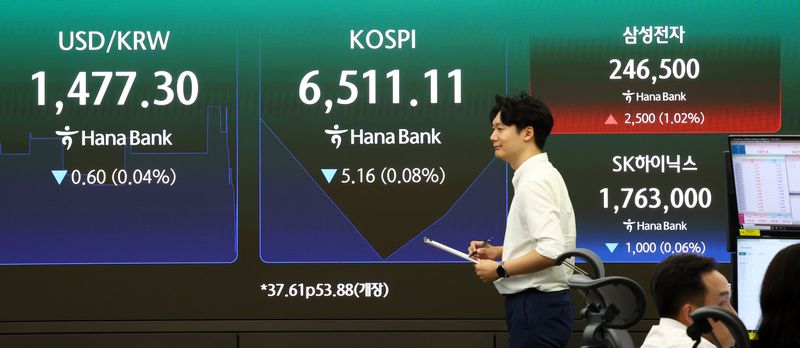
[Financial News] Analysts said the appropriate combined net asset size of single-stock leveraged exchange-traded funds (ETFs) tracking Samsung Electronics and SK hynix is about 550 billion won. If the current high-volatility market persists, it would take about 50 trading days, or roughly two months, for net assets to naturally shrink to that level.
According to the brokerage industry on the 21st, DB Securities estimated the appropriate combined assets under management (AUM) for single-stock leveraged ETFs at about 550 billion won. The figure was calculated using average daily trading value since the products launched at the end of May — 1.43 trillion won for SK hynix and 1.03 trillion won for Samsung Electronics — while applying a 9% closing-auction trading share, a 20% liquidity safety threshold and daily volatility of 4%.
Seol Tae-hyun, a researcher at DB Securities, said, "As the size of single-stock leveraged and inverse ETFs tied to Samsung Electronics and SK hynix has grown, the so-called 'Wag the Dog' phenomenon is amplifying market volatility." He explained that the term refers to a situation in which trading in derivatives or ETFs moves the price of the underlying asset instead. In other words, ETFs that are normally supposed to follow the underlying stocks are now influencing the share prices of Samsung Electronics and SK hynix in reverse.
Leveraged ETFs are designed to track a multiple of the underlying asset's daily return. To do that, fund managers must rebalance holdings whenever prices move to maintain the target leverage ratio. On days of sharp gains or losses, mechanical rebalancing orders worth hundreds of billions to trillions of won can pile up in the closing auction.
Seol noted that such orders can widen the gap in closing quotes and even cause the next day's opening price to move sharply in the opposite direction. He added that in Korea's market, where retail investors account for a large share and trading is concentrated in a few major semiconductor stocks such as Samsung Electronics and SK hynix, the risk of liquidity distortion may be greater than in overseas markets.
In fact, the share of closing-auction trading has risen noticeably since the listing of single-stock ETFs. Before listing, on days when stock prices moved more than 10%, the average closing-auction trading share was 6.6% for SK hynix and 5.3% for Samsung Electronics. Since June, when fund inflows began in earnest after listing, the figures have risen to 9.1% for SK hynix and 8.9% for Samsung Electronics.
Seol explained, "SK hynix, which has relatively shallow order-book depth for the underlying asset, has shown signs of reaching the market's liquidity absorption limit as ETF rebalancing orders flooded in all at once during periods of high volatility." He added, "If the current high-volatility environment continues, it will take about 50 trading days for volatility erosion to naturally bring single-stock ETFs down to the upper limit of their appropriate AUM."
[email protected] Choi Du-seon Reporter