If the Red Sea is blocked, Asia will suffer the most... oil prices seen at $120
- Input
- 2026-07-21 10:18:36
- Updated
- 2026-07-21 10:18:36
'Will the Hormuz detour route be blocked too?'
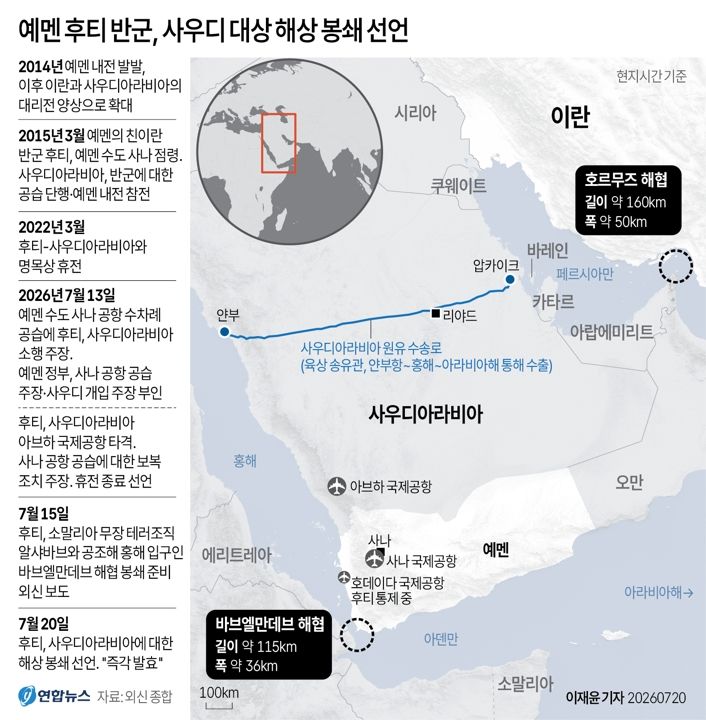
On the 20th local time, Yemen's pro-Iran Houthi rebels declared a maritime blockade against Saudi Arabia. They did not disclose how they would carry it out, but there is speculation that they may attack ships passing through the Bab-el-Mandeb Strait or try to block the route. The Bab-el-Mandeb Strait is a key maritime passage linking the Red Sea and the Gulf of Aden. If the Strait of Hormuz is the exit for crude oil from the Persian Gulf region, the Bab-el-Mandeb Strait is the gateway connecting the Red Sea and the Suez Canal. If this route is blocked, even crude oil that has been exported by bypassing Hormuz will find it difficult to reach the global market.
According to Reuters, after Iran partially blocked the Strait of Hormuz, Saudi Arabia chose to export crude oil produced at its eastern oil fields by sending it through the East-West Crude Oil Pipeline to Yanbu Port on the Red Sea coast. Recently, crude oil exports from Yanbu Port have averaged 4 million barrels per day, more than four times higher than a year earlier. Oil traffic passing through the Bab-el-Mandeb Strait has also risen to 7.4 million barrels per day, or about 7% of global crude production. In effect, the Red Sea has served as an alternative export route to the Strait of Hormuz.
Oil prices warning of $120... "Asia's supply chain will take a direct hit"
International oil prices could break above $100 per barrel in the short term. On this day, September Brent crude oil settled at $89.22 per barrel, up $1.12, or 1.27%, from the previous session. August WTI also closed at $83.23 per barrel, up $0.74, or 0.90%. As tensions escalated with the United States and Iran exchanging attacks, international oil prices have jumped about 20% so far this month.
John Paisie, CEO of consulting firm Stratas Advisors, told Reuters that "international oil prices could rise back above $115 to $120 per barrel, and shipping costs and marine insurance premiums will also increase as vessels take longer routes around the Cape Route off the Cape of Good Hope."
In particular, Noam Raydan, a senior researcher at The Washington Institute for Near East Policy, told The New York Times (NYT) that "Asia could suffer the biggest damage." He said this is because most crude oil and petroleum products shipped from Yanbu Port on the Red Sea coast are headed to refineries in India, Singapore, Japan, South Korea, and China.
Matt Smith, head of commodity research at energy analytics firm Kpler, said tanker detours around the Cape of Good Hope could delay crude oil arrivals at Asian refiners by about a month. He added that "the shock in the first month will be enormous, and the biggest damage will be to Saudi crude oil exports."
The market estimates that more than 3 million barrels per day of Saudi crude oil currently exported to Asia via the Red Sea will have to take a much longer detour. According to Kpler, Saudi Arabia has exported an average of more than 4.5 million barrels per day of crude oil and petroleum products through Yanbu Port since April, and about 70% of that volume has gone to Asia.
[email protected] Reporter Lee Byung-chul Reporter