KOSPI Falls from 9,000 to 6,000, but Brokers Are Confident It Will Rebound at Month-End
- Input
- 2026-07-21 08:55:48
- Updated
- 2026-07-21 08:55:48
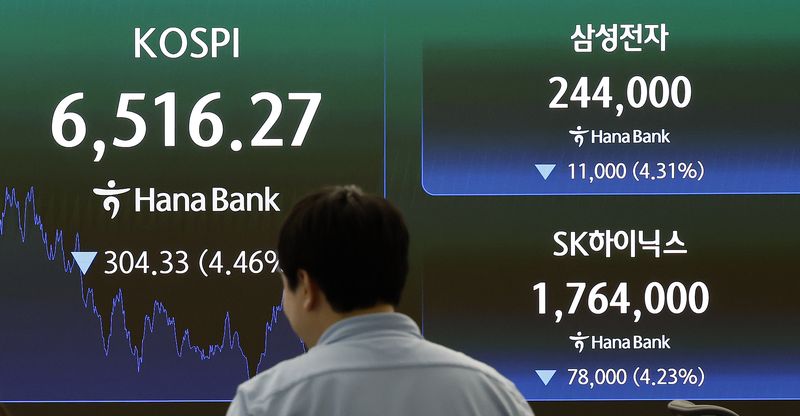
[Financial News] The KOSPI hit 9,000 points at 9,114.55 on the 22nd of last month, but it plunged 28.51% to 6,516.27 in just one month. In the securities industry, a drop of more than 20% from a peak is considered a bear market. Even so, local brokerages are arguing that the market will rebound by the end of this month. They cite two reasons: the global macro environment is improving, and foreign selling in the domestic stock market is easing.
"The stock market is currently taking a hydration break"
Kang Hyun-gi, a researcher at DB Securities Co., Ltd., compared the stock market on the 21st to a soccer match briefly paused for players to hydrate. He said the conditions for a global stock market rally are still in place, but the sharp gains seen up to recently are creating friction.
Kang identified the relationship between nominal GDP growth and the benchmark interest rate as a key variable determining the stock market's trend. When nominal GDP growth, which reflects average investment returns, exceeds the benchmark rate, which represents the cost of investment, stock gains are supported. Conversely, when it falls below the benchmark rate, downward pressure increases.
The current nominal GDP growth rate in the United States stands at 6.1% year on year, above the benchmark rate of 3.75%. Kang said, "The dot-com bubble and the housing market bubble also ended after nominal GDP growth fell below the benchmark rate," adding, "Based on current consensus, we should be thinking about the point at which the two indicators meet sometime after mid-2027."
"The worst bottom since the financial crisis and COVID-19"
Byun Jun-ho, a researcher at IBK Securities, explained that "the KOSPI's 20-day and 60-day divergence ratios are currently 83 and 84, respectively, based on 6,500 points, which puts them in an empirically bottomed-out range, except during the financial crisis and the COVID-19 crisis."
He said the market would likely form a short-term bottom around the 6,500 level, then move into a rebound phase as it digests Big Tech earnings in the United States and the FOMC. However, he added that risk management is needed because foreign investors may resume profit-taking sales during the rebound process in August and September.
According to Byun, foreign net selling since the beginning of the year has reached 160 trillion won, reflecting an unprecedented and powerful wave of selling driven by the surge in large-cap stocks. The average net selling ratio to market capitalization stands at 3.1%, the largest since the 2008 financial crisis, when it reached 4.6%.
Byun said, "There is no need to view the current market as being in a fundamentals-deterioration phase on the scale of the financial crisis." He added that foreign selling is likely to gradually ease as much of the bad news, including concerns over AI and semiconductor peak-out risks and the Iran crisis, has already been priced in.
He also forecast that additional selling pressure will likely become increasingly limited and that the market will enter a renewed rebound phase by the end of July.
Foreign flows and overheated semiconductors remain concerns
Still, he said uncertainty surrounding foreign investor flows is likely to persist in the medium to long term. Byun explained that while AI and the semiconductor industry remain structurally strong, investment growth and earnings growth could slow next year. He noted that AI capital expenditures by U.S. hyperscalers will continue, but the growth rate is expected to fall from about 80% this year to around 30% next year, which could give foreign investors a reason to lock in profits.
There are also calls for short-term overheating in semiconductor stocks to cool off. According to U.S. investor Stan Weinstein's four-stage theory of stock prices, market leaders generally move along their 30-week moving average. When prices drift too far from that average, a natural correction can occur. Samsung Electronics and SK hynix are seen as fitting that pattern recently.
There is also a possibility that Chinese AI companies offering high-performance, low-cost services could weaken the position of U.S. AI firms. On the other hand, competition between U.S. and Chinese companies could spill over into a race to expand AI infrastructure investment in both countries, creating both upside and downside factors for semiconductor stocks.
Kang emphasized that semiconductor stocks need to be checked to see whether they are forming a bottom while holding above the 30-week moving average. If prices rebound above that average after a correction, it can be seen as a pause in an ongoing uptrend and a chance to buy again.
He said, "When South Korea's semiconductor stocks form a bottom above their own 30-week moving average and then rebound, investors can look for a re-entry opportunity." He added, "However, if the leading stocks fall below the 30-week moving average, risk management is necessary because the uptrend could be damaged."
[email protected] Han Young-joon Reporter