KOSDAQ Hit by a 'Trading Cliff'... Less Than 5 Trillion Won Traded a Day Across 1,800 Stocks [Why Are Markets Falling?]
- Input
- 2026-07-21 06:00:00
- Updated
- 2026-07-21 06:00:00
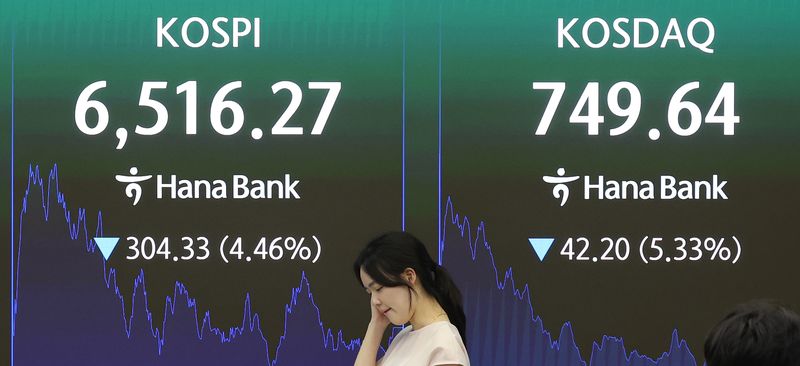
[Financial News] Liquidity in the KOSDAQ market is cooling rapidly. Daily trading value has fallen below 5 trillion won, and trading volume and turnover have also dropped to about half their previous levels. Analysts say this is more than a simple stock-price correction, as market liquidity itself is shrinking quickly.
According to the Korea Exchange on the 21st, KOSDAQ trading value on the 20th came to 483.23 billion won. It remained below 5 trillion won for a second straight session, following 472.04 billion won on the previous trading day, the 16th.
Trading has also slowed sharply over the past month. Trading value, which stood at 10.7046 trillion won on June 19, had fallen 54.9% as of the previous day. The decline appears to reflect a simultaneous contraction in both funds flowing into the market and investors' trading participation.
KOSDAQ fell 22.4% from 966.59 on the 19th of last month to 749.64 on the 20th, while market capitalization dropped 22.6% over the same period, from 542.7977 trillion won to 420.1535 trillion won. The decline in trading value was more than twice as steep as the falls in the index and market cap, showing that trading activity has cooled faster than prices.
On May 27, when single-stock leveraged exchange-traded funds (ETFs) tied to Samsung Electronics and SK hynix were listed, KOSDAQ trading value stood at 15.2784 trillion won. By the 20th, it had fallen by 10.4461 trillion won, marking a 68.4% decline.
Daily trading volume dropped 57.0%, from more than 1.229 million shares at the time of the single-stock leveraged ETF launch to about 528,000 shares. Turnover for listed shares fell from 2.51% to 1.14%, while market-cap turnover also dropped from 2.41% to 1.15%, both to less than half their previous levels.
The average trading value over the past five sessions also came to 602.01 billion won, less than half of the 1.27416 trillion won average recorded in the five sessions immediately after the single-stock leveraged product was launched.
As trading has declined, market liquidity has weakened rapidly. When buying demand thins out, even a small amount of selling can cause sharp price swings. If sluggish trading continues, weaker investor sentiment and higher volatility could combine to accelerate capital outflows, observers said.
Jae-hong Yoon, a researcher at Mirae Asset Securities, analyzed that "KOSDAQ has suffered its biggest relative underperformance since the market opened, compared with KOSPI, due to earnings improvements centered on large semiconductor stocks and concentrated fund flows, and it is reacting more sensitively to declines as average daily trading value has also plunged."
He said, "This downturn differs from past sharp selloffs in that individual investors are continuing to pull back." He added, "If regulations on single-stock leveraged ETFs are implemented, the concentration of funds may ease to some extent. Additional measures to revitalize KOSDAQ should also be pursued in parallel for investor sentiment to recover."
[email protected] Choi Du-seon Reporter