Regulators to Extend Overseas ETF Rules to Curb Capital Outflows, but Return to Domestic Market Remains Uncertain [Aftermath of Leverage Measures]
- Input
- 2026-07-20 18:30:37
- Updated
- 2026-07-20 18:30:37
According to the financial industry on the 20th, the Financial Services Commission (FSC) plans to raise the initial deposit requirement for single-stock leveraged ETFs and ETNs in both Korea and overseas from 10 million won to 30 million won in cash. Previously, stocks or ETFs held by investors were also recognized as deposits, but only cash will be accepted going forward. The rule will apply not only to new investors but also to existing investors when they make additional purchases.
An FSC official explained, "Single-stock leveraged products are high-risk instruments that do not provide diversification benefits, whether in Korea or abroad." The official added, "If stronger deposit rules were applied only to domestic products, a balloon effect could emerge in overseas products, so we decided to apply the same standard."
However, separate from efforts to curb capital shifts into overseas single-stock leveraged products, some say it remains unclear whether the measure will actually bring overseas investment demand back to Korea. Given that single-stock leveraged ETFs tied to Samsung Electronics and SK hynix were introduced to absorb some of the demand that had been flowing overseas into the domestic market, it remains to be seen whether the original goal will be realized.
One securities industry official said, "This measure is less about creating an incentive to bring overseas investment money back home and more about preventing additional capital outflows that could occur if stricter rules were applied only to domestic products." The official added, "Since the same standard will be applied to single-stock leveraged products in Korea and overseas, eliminating regulatory arbitrage, it is difficult to expect a meaningful return of funds to the domestic stock market."
There is also a view that overseas investment demand may shift to other foreign products rather than flow into the domestic market. Investors could choose overseas index- or sector-based leveraged ETFs that are not subject to the rules, or U.S. individual stocks.
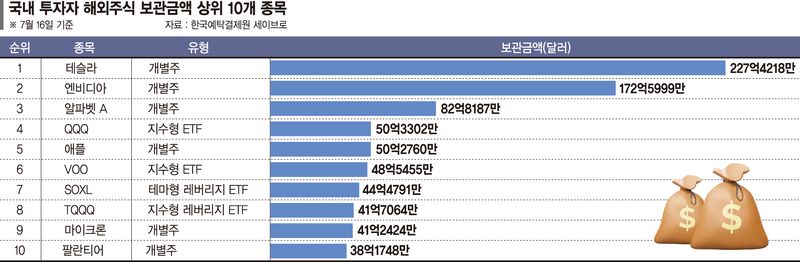
According to SEIBro, the securities information portal of Korea Securities Depository (KSD), as of the 16th, the top overseas stock custody holdings of domestic investors included QQQ, which tracks the Nasdaq-100 Index, ranked fourth with $5.03302 billion, and VOO, which tracks the S&P 500 Index, ranked sixth with $4.85455 billion. SOXL, a 3x leveraged ETF on the semiconductor index, and TQQQ, a 3x leveraged ETF on the Nasdaq-100 Index, ranked seventh and eighth with $4.44791 billion and $4.17064 billion, respectively. One asset management industry official said, "Applying the same standard to overseas products can reduce the balloon effect that may arise when only domestic products are regulated." The official added, "But overseas markets offer many alternative investment options, such as U.S. individual stocks and index- or sector-based ETFs, so the effect will be limited. It is unclear whether overseas investment demand will flow into the domestic market."
Some analysts also say capital movement ultimately depends on market stability and expected returns. From an investor's perspective, the key factor is not the strength of regulation, but which market offers the higher potential return.
One economics professor said, "Over the past month, KOSPI fell by more than 20%, while the declines in the U.S. S&P 500 and Nasdaq Index were much more limited." The professor added, "Investors decide where to put their money based on market stability and expected returns, not regulation."
[email protected] Bae Hangeul Reporter