KOSPI, the World’s Worst Performer Over the Past Month, at a Crossroads Between a Rebound and a Bear Market
- Input
- 2026-07-20 18:23:24
- Updated
- 2026-07-20 18:23:24
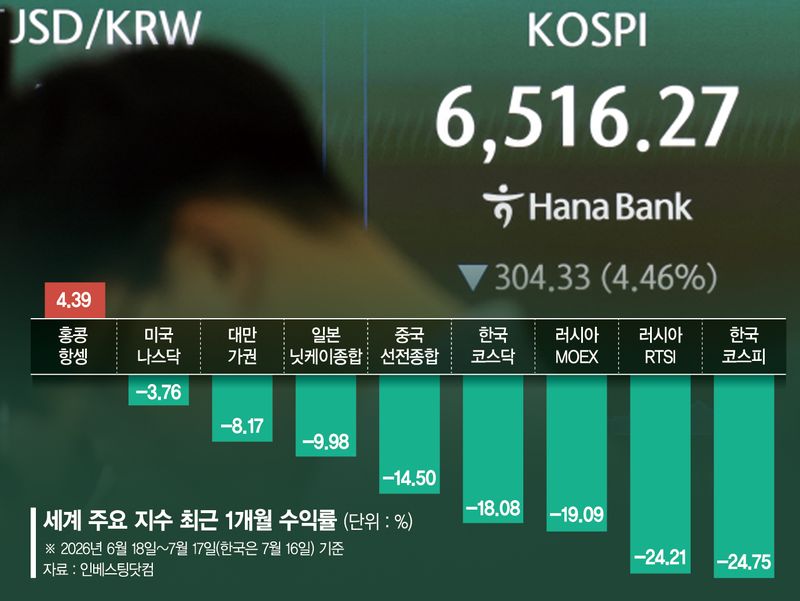
According to Investing.com on the 20th, the index that fell the most among major global benchmarks over the past month (June 18 to July 17, based on July 16 for Korea) was the KOSPI. It dropped 24.75% from 9,063.84 on June 18 to 6,820.60 on July 16. That is worse than Russia’s RTSI (-24.21%) and MOEX (-19.09%). If the KOSPI’s decline to 6,516.27 on the day is reflected, the loss deepens to 28.51%.
Returns across global stock markets have generally been weak over the past month. Even Hong Kong’s Hang Seng Index, the best performer among major markets, rose only 4.39% during the period. The Dow Jones Industrial Average (DJIA) gained just 1.13%, while the Standard & Poor's 500 Index (S&P 500) even fell 0.57%.
Technology-led markets, including the Nasdaq (-3.76%), posted steep declines. China’s Shenzhen Composite Index fell about 15% at -14.50%, while Japan’s Nikkei Composite Index (-9.98%) and Taiwan’s TAIEX (-8.17%) also lost nearly 10%. In particular, the Shenzhen Composite Index, Nikkei Composite Index and TAIEX all peaked on June 22 and then moved lower, showing a pattern similar to the KOSPI.
Cho Joon-gi, a researcher at SK Securities Co., Ltd., analyzed that "as geopolitical risks in the Middle East intensified and oil prices kept rising, selling pressure concentrated on semiconductor stocks spread to the U.S. market and others, deepening the losses."
Even so, the KOSPI’s recent slide has drawn shock abroad as well. Foreign media have taken a negative view, saying that "a market is generally considered to have entered a bear market when it falls more than 20% from a peak."
Alexander Redman, chief strategist at Hong Kong-based CLSA, said, "Korea is still the market where we have the largest overweight position in our portfolio, but I have started to reduce it." He added, "What worries me is that retail investors are in the driver’s seat. They use a lot of margin trading."
Analysts also say the market’s volatility has been amplified by the structure in which Samsung Electronics and SK hynix account for more than half of the KOSPI’s market capitalization. Another foreign outlet reported that "because Samsung Electronics and SK hynix have such large weights in the KOSPI, the impact of single-stock leveraged products on the index is greater than in other countries." By contrast, NVIDIA accounts for only about 7% of the S&P 500.
However, domestic securities firms say a rebound is still very possible. Although the market has fallen sharply over the past month, its year-to-date return stood at 54.63% as of the day, still ranking first in the world.
Cho said, "Korean stocks have become more attractive in terms of valuation because the recent decline has been excessive. It would not be surprising to see bargain hunting at any time." He added, "Big Tech earnings starting this week will be the turning point."
[email protected] Han Young-joon Reporter