'Sell-side circuit breaker' sends KOSPI down 4.46% to 6,516 [fn market close]
- Input
- 2026-07-20 16:29:45
- Updated
- 2026-07-20 16:29:45
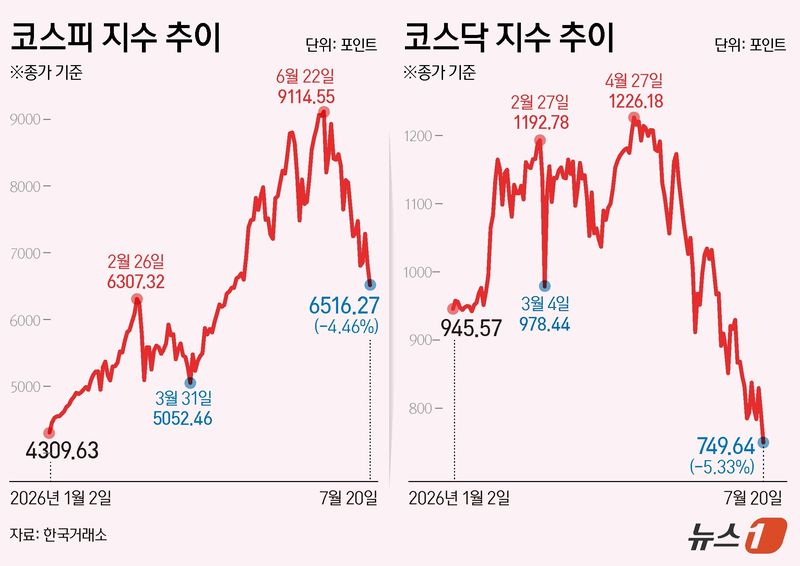
[Financial News] KOSPI fell more than 4% on the 20th and ended trading in the 6,500 range. As large-cap semiconductor stocks and single-stock leveraged products fell together, caution over the profitability of global artificial intelligence (AI) investment and concerns about energy supply disruptions from the Middle East weighed on investor sentiment. Sell-side circuit breakers were triggered repeatedly during the session in both the securities and KOSDAQ markets.
According to the Korea Exchange, KOSPI closed at 6,516.27, down 304.33 points, or 4.46%, from the previous session. It opened 2.60% lower at 6,643.58, then narrowed its losses to as much as 6,814.86 early in the session before falling again. At one point, it dropped to 6,472.80, down 5.10% from the previous day. KOSDAQ also plunged 42.20 points, or 5.33%, to finish at 749.64.
Samsung Electronics and SK hynix closed at 244,000 won and 1,764,000 won, down 4.31% and 4.23%, respectively. The two stocks recovered some of their early losses, but selling pressure returned later in the day and pushed them back into negative territory. On the previous trading day before the Constitution Day holiday, July 16, Samsung Electronics and SK hynix also tumbled 8.77% and 11.53%, respectively.
According to a related report by Mirae Asset Securities, the market capitalization of 16 domestic single-stock leveraged products rose 2.7 times from 4.4 trillion won on May 27 to 11.9 trillion won on the 15th of this month. Over the same period, Samsung Electronics and SK hynix's combined share of KOSPI market capitalization also expanded from 49% to 52%. Mirae Asset Securities said that as investment demand became concentrated in large-cap semiconductor stocks and leveraged products, the subsequent decline in share prices led to losses in leveraged products and position unwinding, which amplified market volatility.
A correction in global semiconductor stocks also added pressure to the domestic market. While the local market was closed on the 17th, the NASDAQ Composite Index and the Philadelphia Semiconductor Index in the United States fell 1.40% and 1.63%, respectively. Market attention is shifting from whether AI demand will continue to whether large-scale data centers and semiconductor capital expenditures can translate into future sales and profits.
Moonshot AI's newly unveiled 'Kimi K3' was also cited as a factor prompting a reassessment of the high valuations assigned to U.S. AI companies and the efficiency of AI investment. However, the spread of low-cost AI models does not necessarily mean a direct decline in semiconductor demand. As AI service usage increases, overall computing demand as well as demand for memory and storage devices could rise, so it is difficult to conclude that the long-term outlook for Korea's memory industry has been damaged.
Concerns over shipping disruptions in the Strait of Hormuz due to tensions in the Middle East were also seen as a key variable. If crude oil transport is disrupted, it could push up international oil prices, inflation and market interest rates, creating pressure on the Korean won and foreign investor flows.
The Korea Exchange activated sell-side circuit breakers at 10:52:54 a.m. in the KOSDAQ market and at 11:21:26 a.m. in the securities market, suspending the effect of program sell orders for five minutes.
The market is expected to be driven by earnings outlooks for Samsung Electronics and SK hynix, as well as AI capital expenditure plans from U.S. Big Tech. Kim Seok-hwan, a research analyst at Mirae Asset Securities, said, "So far, this looks more like a process of reducing leverage and adjusting elevated expectations than the start of a structural bear market." He added, "If earnings forecasts and AI investment plans are maintained, the likelihood of a major shift in the medium-term direction of the domestic market is not high."
[email protected] Kim Mi-hee Reporter