Why Did Samsung Electronics and SK hynix Plunge? "Stocks That Are Hard for Beginner Investors to Approach"
- Input
- 2026-07-20 14:09:09
- Updated
- 2026-07-20 14:09:09
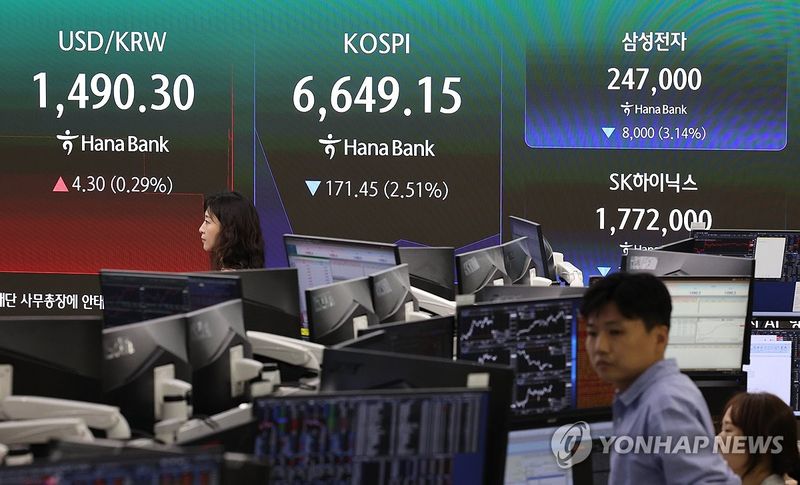
[Financial News] Despite strong earnings, major semiconductor stocks such as Samsung Electronics and SK hynix plunged sharply. Analysts say the drop reflects a “historical cycle” in which memory chip stocks move ahead of the broader industry trend.
On the 20th, Park Jong-hoon, head of the Knowledge Economy Research Institute, explained the forward-looking nature of memory chip stocks on his YouTube channel, "Park Jong-hoon's Knowledge One-Shot." He said, "Memory chip stocks tend to lead the cycle by about 18 to 24 months, which makes them difficult for beginner investors to approach," adding that "historically, there have been many cases where stock prices fell first even as expectations for strong earnings continued."
The historical cycle he referred to describes a pattern in which stock prices fall first when the industry is strong, then begin to rebound when the sector is seen as having hit bottom.
Samsung Electronics reported second-quarter operating profit of 8.94 trillion won on the 7th, beating the market consensus of 8.41 trillion won. Even so, its share price remains about 34% below its peak.
Park said investors should not focus only on current earnings, but also on how the industry is likely to change going forward.
In this regard, Park said, "Because the stock prices of cyclical industries like semiconductors usually lead by two to three years, future changes matter more than current earnings," and added, "Since HBM is a business-to-business (B2B) product, stock prices could fall more sharply if customers' investment conditions change."
He pointed to several variables that investors should monitor, including how much earnings have already been priced into stock values, whether investment capacity among High Bandwidth Memory customers will hold up, and whether market dominance can be maintained after the stock price decline. Park added, "We need to look at all of these at the same time: how many years of earnings are already reflected in the stock price, whether customers' investment capacity for High Bandwidth Memory will continue, and whether market dominance will remain even after the share price falls."
Park also said caution is needed toward the "this time is different" argument that is sometimes heard in the market. While expectations remain high for stronger margins from expanding HBM sales, he said the existing three-way dominance structure could be shaken as Chinese memory chipmakers catch up.
He said it is difficult to conclude that the memory chip cycle has changed based solely on growth expectations for HBM. "Rising non-cancelable long-term contracts and the outlook for HBM growth are both valid points, but that alone does not mean the cycle has changed," he said. "As China emerges as a new competitor, the existing oligopoly could also be destabilized."
Key events that could determine the direction of semiconductor stocks were also highlighted. These include SK hynix's second-quarter earnings release on the 24th, Micron's fourth-quarter gross margin performance in August and September, and the implementation of leverage regulations in the second half of the year.
Park stressed that investors should be wary of blind optimism. He said, "On Wall Street, the saying 'This time is different' is considered one of the most dangerous phrases," adding, "I hope memory semiconductors have moved beyond being a cyclical industry, but more than blind optimism, what is needed is a mindset of constant skepticism and verification."
[email protected] Han Seung-gon Reporter