Oil Prices Break Above $90... Ceasefire-Broken Iran War Shakes the Global Economy Again
- Input
- 2026-07-20 14:32:34
- Updated
- 2026-07-20 14:32:34
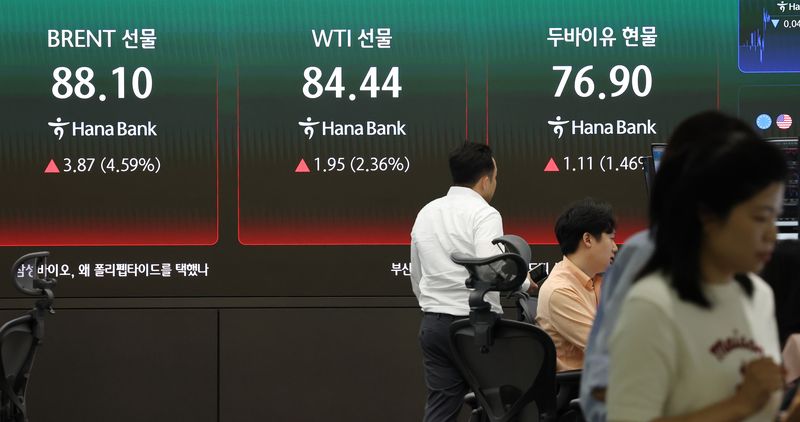
[Financial News] As tensions between the United States and Iran flared up again, international oil prices climbed above $90 per barrel for the first time in about a month. With tensions rising around the Strait of Hormuz, a key route for global crude transport, supply chains and inflation are once again under strain.
On the 19th local time, September Brent Crude Oil futures rose more than 3% intraday to $90.85 per barrel. It was the first time Brent Crude Oil had topped $90 since June 11. West Texas Intermediate crude oil (WTI) also traded above $85 per barrel.
Markets are increasingly worried that if military tensions around the Strait of Hormuz persist, disruptions to crude supply could become a reality. The strait is a strategic chokepoint through which a significant share of the world's seaborne crude oil passes. If supply concerns continue, not only oil but also petrochemical products and transportation costs could rise in tandem, adding fresh inflationary pressure to the global economy.
In particular, with the Federal Open Market Committee (FOMC) meeting approaching later this month, higher oil prices could also weigh on the Federal Reserve System's monetary policy.
The battlefield is also deteriorating again. The U.S. military carried out airstrikes against Iran for a ninth consecutive day on this day. CENTCOM said it struck military command facilities, air defense networks, and coastal surveillance sites for about three hours.
After watching the World Cup final, President of the United States Donald Trump told reporters, "We hit Iran hard again tonight," adding that the attack was "to honor the U.S. service members who were recently killed." He went on to claim, "Iran has lost almost everything militarily," and "we are controlling the Strait of Hormuz."
The United States has stepped up its retaliation after three U.S. soldiers were killed in separate attacks by Iran in Jordan and Iraq. The official death toll of U.S. troops in the war has now risen to 17.
Iran has also responded in kind. The Islamic Revolutionary Guard Corps (IRGC) claimed that two tankers attempting to pass through the Strait of Hormuz exploded, warning that "as long as the U.S. military's illegal intervention continues, the passage of oil and gas through the strait will not be safe."
The United Kingdom Maritime Trade Operations (UKMTO) also announced that it had received military information about a ship fire in waters near the Strait of Hormuz. However, the cause of the fire has not yet been confirmed.
Ceasefire and peace negotiations have effectively collapsed. The Wall Street Journal (WSJ) raised the possibility that mutual retaliation could spiral into a cycle of escalation, while Associated Press (AP) said the two countries are crossing each other's "red lines."
Markets expect that if military conflict around the Strait of Hormuz continues, a surge in energy prices and disruptions to logistics will persist for a prolonged period, deepening the biggest source of uncertainty for the global economy.
[email protected] Kim Kyung-min Reporter