"The Time for Secondary Batteries Will Come Again": Parts, Materials and Equipment Firms Join Forces Across the Board
- Input
- 2026-07-20 09:23:41
- Updated
- 2026-07-20 09:23:41
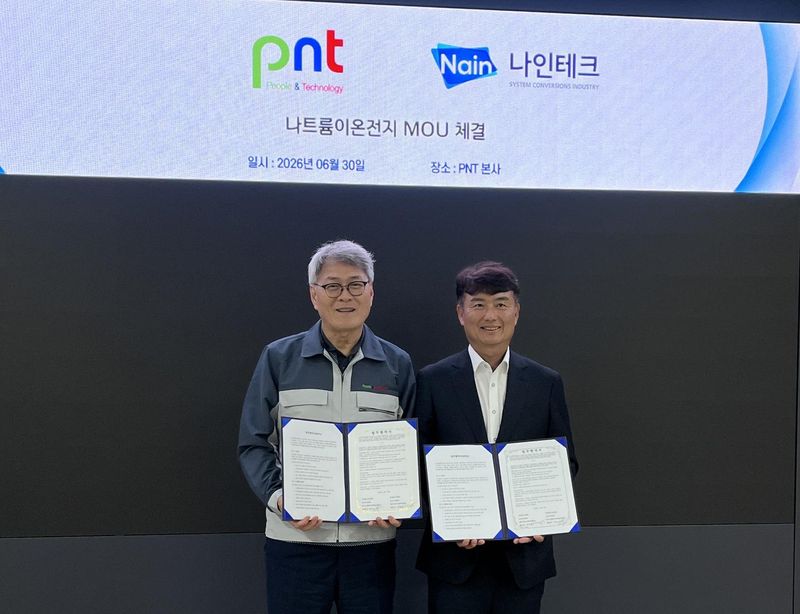
[Financial News] Companies in the secondary battery materials, parts and equipment sector are stepping up cooperation on all fronts. Their strategy is to actively respond to a market rebound expected from next year.
According to industry sources on the 20th, Naintech signed an agreement with PNT and will work to secure next-generation sodium-ion battery technology while building a pilot line. Under the deal, the two companies will jointly develop core sodium-ion battery technologies, establish a pilot line, and pursue mass-production verification and commercialization.
They also plan to cooperate in entering a range of application markets, including Energy Storage System (ESS), industrial storage systems and electric two-wheelers. In this process, Naintech will handle core sodium-ion battery technologies, electrode and cell design, and pilot line operation know-how. PNT will support pilot line construction and mass-production verification based on its electrode process and equipment capabilities.
Through this partnership, Naintech and PNT aim to preemptively build a domestic ecosystem for next-generation sodium-ion batteries. The companies plan to accelerate their expansion beyond the existing lithium-ion battery-centered business into next-generation secondary batteries.
A Naintech official said, "Together with PNT, we plan to pursue government research and development projects as well as commercialization at home and abroad," adding, "We will help speed up the commercialization of next-generation sodium-ion batteries and contribute to Korea's competitiveness in the next-generation secondary battery sector."
L&F Corp. has entered into a strategic agreement with CIS Chemical and is cooperating in the recycling of lithium iron phosphate (LFP) and nickel-cobalt-manganese (NCM) secondary batteries. CIS Chemical has recycling technology that can recover lithium carbonate at a rate of 98%.
First, L&F Corp. plans to secure post-processing volumes for LFP and NCM batteries by leveraging CIS Chemical's recycling capabilities. The two companies will jointly respond to demand in the secondary battery recycling market. They also agreed to pursue joint research and development in key technologies, including the development of high-purity mixed hydroxides to reduce cathode material costs, as well as LFP recycling and re-materialization technologies.
In addition, they plan to strengthen their recycling business for spent cathode materials and black mass in connection with its subsidiary JH Chemical Industry. They will also push ahead with cooperation on processing scrap from spent LFP cathode materials through its subsidiary L&F Plus. A L&F Corp. official stressed, "Through close cooperation with CIS Chemical, we will strengthen the competitiveness of our recycling supply chain and build a recycling value chain that can proactively respond to industry needs."
The reason secondary battery parts, materials and equipment firms are continuing to expand such partnerships is seen as a strategy to prepare for a full-scale recovery in demand from next year. Market research firm SNE Research expects the electric vehicle secondary battery market to grow by more than 10% annually, from $196 billion last year to $401 billion in 2030 and $616 billion in 2035.
An industry official said, "After inventory adjustments in both electric vehicles and secondary batteries continued this year, following last year, many companies in the secondary battery parts, materials and equipment sector are seeing negative earnings growth," adding, "However, as major automakers at home and abroad are expected to launch next-generation electric vehicle models from next year, demand for secondary batteries is also likely to recover." The official added, "Ahead of the market rebound, companies are expanding factories while cooperation among firms is also continuing."
[email protected] Kang Kyung-rae Reporter