"Find a Home and Sign the Contract Yourself" ... Real Estate Platforms Compete to Cut Brokerage Fees [Money Insight]
- Input
- 2026-07-20 06:54:04
- Updated
- 2026-07-20 06:54:04

The era of tightening your belt is over. This is an age in which people spend money and still make money.[Money Insight]will look into how that works.
[Financial News]#. A salaried worker in his 30s, identified as A, recently found a studio-style officetel in Yeouido, close to his company, by paying a jeonse deposit of 250 million won. For him, who had lived independently since entering college and had spent more than 10 years looking for a new home, this move was especially meaningful.He used a financial platform to check listings first, then went straight into a direct deal in order to save on the real estate brokerage fee, commonly known as the "brokerage fee." As a result, he saved as much as 1.1 million won in total, including a brokerage commission of 1 million won based on the 0.4% ceiling rate and value-added tax.
Like A, the way people search for homes is changing as real estate regulations and lending rules keep shifting. Instead of the old method of visiting an agency, checking listings, and signing a contract there, more users are now turning to financial, community, and education platforms to find properties, contact the other party directly, or review the contract process in an effort to cut fees.
Karrot's direct deals promise "zero brokerage fee" ... contract safety must be checked personally
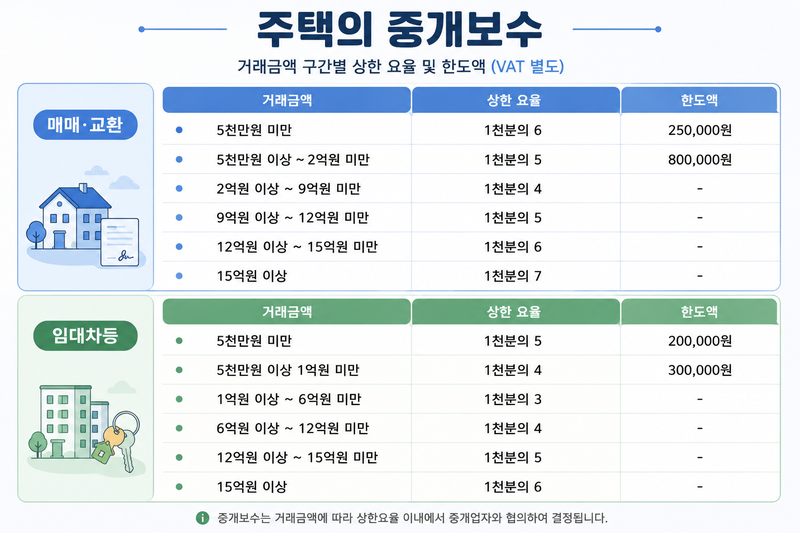
Under the current system, brokerage fees for home sales can be charged at up to 0.4% to 0.7%, depending on the transaction amount. For an apartment worth 500 million won, the maximum fee based on the ceiling rate would be 2 million won, and another 200,000 won in VAT would be added, bringing the total to 2.2 million won. In practice, however, the final amount can be negotiated with a licensed real estate agent within the upper limit.
The service that most directly reduces brokerage costs is Karrot Real Estate's direct-deal feature. Homeowners or tenants can post listings themselves, chat with the other party, and sign a contract without going through an agency, saving on fees. Direct-deal listings, once centered on studio apartments and villas, are now expanding to apartments and commercial properties.
Karrot's strength lies in its local, neighborhood-based information. Users can share details that actual residents know best, such as price, floor area, parking, noise, transportation, commercial activity, and building management conditions.
However, in a direct deal, the parties themselves must verify the registry record, building register, whether the landlord has unpaid taxes, any senior rights, and whether the deposit can be returned. Missing these checks could lead to losses far greater than the brokerage fee.
Karrot provides a direct-deal guide that explains how to review the contract, file a move-in report, and apply for a fixed date stamp. If needed, users can also check listings from local agencies whose brokers have verified their licenses.
Wolbu connects education users to real transactions
Wage Earner Millionaires, a financial education platform, is linking its educational content to actual real estate transactions.
It currently operates "Find My Home" for buyers and "Sell My Home" for sellers. It has also launched "Wolbu Eum," a service that provides real estate contract documents, building a structure that connects local market analysis, listing searches, brokerage, and contracts within one platform.
"Sell My Home" connects homeowners who want to sell with prospective buyers secured by Wolbu. The company says its strength lies in turning users whose home-buying or investment plans have been confirmed through lectures and community activity into actual transaction clients.
"Find My Home" recommends listings based on a user's assets, preferred areas, and desired floor space, while also connecting them with brokers. Consultation, site visits, contracts, and brokerage fee payments are all handled in one place.
According to Wolbu, "Find My Home" recorded cumulative transaction value of 116.4 billion won from its beta launch in August last year through January this year. That was 10.8 times the transaction value at launch, while the number of contracts rose 13-fold. The average transaction period was 21 days, and the contract conversion rate reportedly exceeded 50%.
Because licensed real estate agents are involved, brokerage fees still apply. Still, the service has the advantage of reducing the time and cost spent searching for listings, visiting agencies, and researching neighborhoods.
Toss starts by recommending homes people can actually afford
The financial platform Toss is focusing on reducing financing and listing-search costs. Since February, its "Find Homes Within My Budget" service has been recommending homes and neighborhood move-up options that match users' available funds and possible loan amounts.
In the past, many people found a listing first and only then checked how much they could borrow. If the expected loan limit turned out to be lower right before signing, they had to give up the deal and start searching again.
Using financial data, Toss shows homes within a price range users can realistically afford. It also offers a debt-to-income calculation feature so users can estimate borrowing capacity.
It is not a service that directly lowers brokerage fees, but it can reduce the time and money spent looking for listings that exceed a budget or visiting multiple agencies.
5.6 million real estate app users ... information search has become part of daily life
The expansion of real estate services on platforms has also been shaped by changes in how people use information. In the past, real estate apps were used only briefly when moving or buying a home was imminent, but recently they have become everyday content for checking transaction prices, market rates, lending rules, taxes, and school district information on a regular basis.
According to Mobile Index in April, the average monthly active users in the first quarter of this year for major PropTech apps such as Zigbang, Hogangnono, Dabang, Asil, and KB Real Estate reached about 5.6 million, up more than 4% from 5.36 million in the same period last year. PropTech is a compound word combining property and technology.
Users can compare transaction prices, apartment community reviews, school districts, transportation, and development plans without visiting an agency. As the cost of searching for information falls, platform usage time is getting longer.
Similar competition is taking place overseas as well. In the United States, Zillow combines home sales, rentals, and mortgage services on a single platform, while online real estate brokerages are digitizing their operations and offering lower fees than traditional firms.
An industry source said, "If showing listings and transaction prices online was PropTech 1.0, the next stage is to connect home search, loans, brokerage, and contracts to lower the total cost of a transaction. The key competitive edge for platforms will be how cheaply and safely they can help people trade the same home."
[email protected] Seo Yoon-kyung Reporter