"Samsung Electronics and SK hynix Are Rebounding, But It’s Not the Same as Before"... Stock Market Trends to Shift in the Second Half
- Input
- 2026-07-16 06:00:00
- Updated
- 2026-07-16 06:00:00
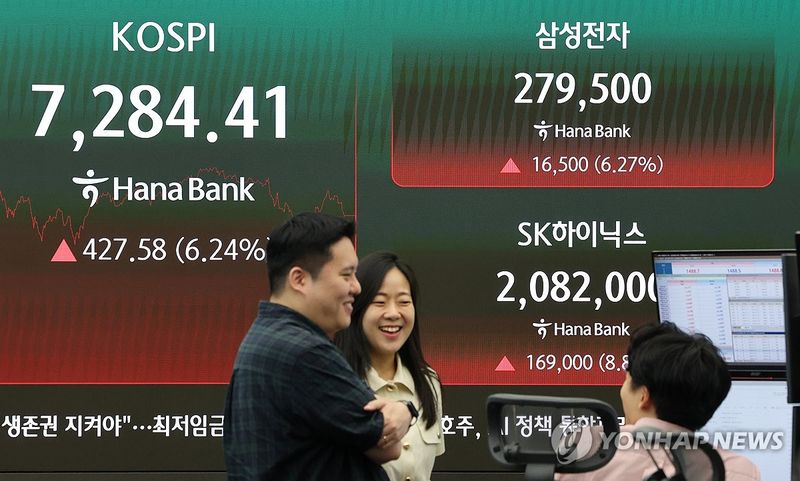
[Financial News] Semiconductor stocks, which had recently fallen sharply on the back of Samsung Electronics and SK hynix, have begun a short-term rebound. However, market leadership is expected to gradually spread to other sectors, analysts said. As semiconductor earnings momentum that had driven the stock market slows and the concentration of funds in single-stock leveraged exchange-traded funds (ETFs) eases, the market is more likely to enter a rotation phase by individual stocks rather than remain dominated by semiconductors.
Lee Sang-heon, a researcher at iM Securities, said on the 16th that the recent correction in semiconductor stocks was the result of a combination of concerns over slowing profit growth and easing fund concentration, rather than deteriorating earnings. He added that in the second half of the year, the market could shift from a semiconductor-led rally to a rotation among individual stocks.
Lee pointed to slowing earnings growth at semiconductor companies as the first reason for the correction. Since the second half of last year, sharp gains in DRAM and NAND flash memory prices have quickly raised expectations for Samsung Electronics and SK hynix, becoming a key driver of the KOSPI (Korea Composite Stock Price Index). In fact, supported by rising memory prices, profits at the two companies have continued to climb sharply since last year, and investors' earnings expectations have also risen steadily.
He said the situation could change going forward. Even if the memory market continues to improve, it will be difficult to expect the same steep earnings gains seen last year, so the market has begun to price in slowing growth first.
“This is not a phase of declining earnings, but one in which the pace of profit growth is slowing,” Lee said. “As expectations that had risen rapidly are adjusted, stock prices have also become more volatile.”
He also identified the supply-demand structure as another factor behind the increased volatility. Lee said the Single-Stock Leveraged ETFs for Samsung Electronics and SK hynix, which were listed at the end of May, further intensified the concentration in semiconductor stocks.
Single-Stock Leveraged ETFs generate additional trading near the close of the market as they adjust futures and cash positions to track twice the daily return of the underlying asset. As a result, they can amplify volatility by triggering additional buying when prices rise and additional selling when they fall.
“There is nothing inherently wrong with leveraged ETFs themselves,” Lee said. “But because funds have concentrated in Samsung Electronics and SK hynix, whose market-cap weights are enormous, the overall market concentration has become stronger than before.”
He added that the recent listing of SK hynix American Depositary Receipts (ADRs) in the U.S. could help ease that concentration to some extent.
Lee said U.S. investors can now access SK hynix more easily through ADRs, which could divert some demand that had been concentrated in the domestic market to overseas markets. He explained that because the U.S. market is much larger than Korea’s and fund concentration in a single stock is relatively more limited, this could help reduce volatility in the local stock market.
He also drew a line under the idea that a sharp rise in the ADR price would automatically translate into the same move in the domestic shares. Although ADRs and the underlying shares are based on the same asset, they are not freely convertible, and there are constraints such as issuance limits and administrative procedures. In addition, factors such as trading access, the launch of options trading, and expectations of future inclusion in major indexes can be reflected as premiums in ADR prices, meaning the two prices do not always move in lockstep.
Macroeconomic conditions were also cited as a burden for the semiconductor sector. Lee pointed to the possibility of another rate hike by the Bank of Korea and the chance that the Federal Reserve System (the Fed) will maintain its tightening stance for longer. He said a high-interest-rate environment could affect the pace of investment in AI infrastructure and data centers to some extent. He added that higher bond issuance costs could also increase the burden of large-scale investment.
Looking ahead, he expected market interest to broaden across sectors rather than remain concentrated in semiconductors. “Semiconductor stocks may see a technical rebound because their short-term losses were large, but it will not be easy for them to lead the market on their own as they did before,” Lee said. “Since customer deposits remain above 100 trillion won, abundant liquidity is likely to move into sectors other than semiconductors, increasing the chances of rotation among individual stocks.”
He added, “As semiconductor earnings momentum slows and fund concentration eases, the market is likely to stay range-bound for now, with sector-by-sector differentiation.”
[email protected] Park Ji-yeon Reporter