KCTU launches general strike, calls for direct bargaining with parent companies and recognition of special-type workers
- Input
- 2026-07-15 16:02:52
- Updated
- 2026-07-15 16:02:52
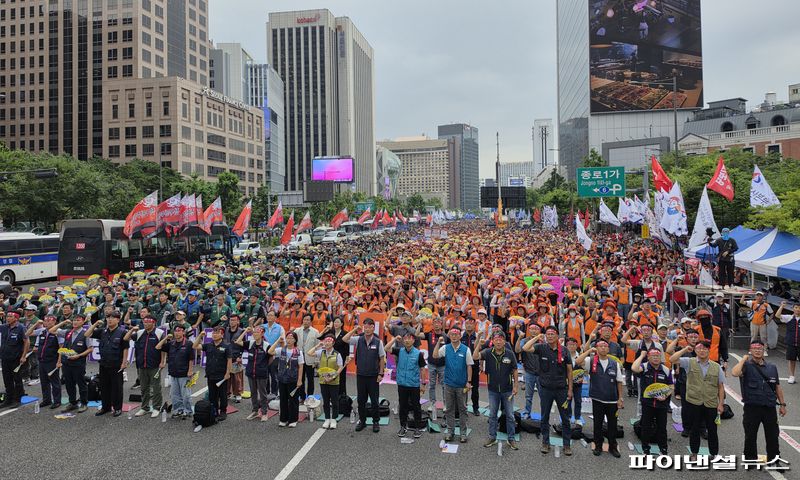
At around 3 p.m. on the 15th, KCTU held the '7/15 General Strike Rally for the First Year of Parent-Company Bargaining and Cross-Enterprise Bargaining, and for Winning the Fundamental Labor Rights of All Workers' in front of Dongwha Duty Free Shop in Jongno District, Seoul. The organizers estimated that about 10,000 people attended.
The general strike was held to demand that parent companies engage in sincere bargaining in line with the purpose of the revised labor union law, known as the Yellow Envelope Act, which took effect on March 10, and to call for minimum wage coverage and recognition of worker status for special-type and platform workers.
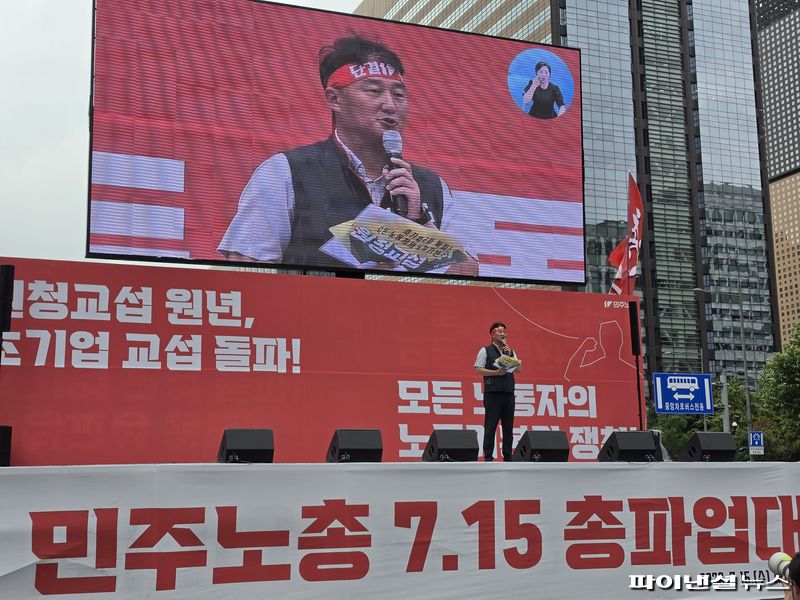
KCTU Chair Yang Kyung-soo said, "Since the revised union law took effect, countless subcontracted irregular workers have demanded bargaining, but parent companies are still refusing to respond and focusing only on avoiding responsibility." He added, "The time for patience is over. We will open the first year of parent-company bargaining through a powerful struggle."
He continued, "When regular workers demand performance bonuses, companies say investment must come first. When irregular workers demand a minimum wage increase, they put forward self-employed workers." He added, "To change this uncomfortable and unfair reality, where only workers are forced to make concessions, parent companies must sit down at the bargaining table, and we must move beyond individual workplaces toward cross-enterprise bargaining."
KCTU said the public sector, including the government and local governments, is denying employer status based on enforcement decrees and interpretive guidelines without fulfilling its responsibility as a model employer. According to KCTU, bargaining requests have been made to about 440 parent companies since the Yellow Envelope Act took effect, but only about 96 have recognized employer status. It said many of the cases that could not even proceed to correction procedures involved parent-company bargaining with the public sector.
Lee Young-hoon, emergency committee chair of the Korean Democratic Federation of General Trade Unions, criticized the Lee Jae Myung administration, saying, "I cannot understand the contradictory behavior of an administration that says it will fulfill its responsibilities and duties as a model employer, while at the same time claiming it is not an employer." He added, "This is deception that recognizes the procedure but not the substance. It is as if they are granting only the right to bargain while leaving workers to solve discrimination and inequality on their own."
KCTU argued that special-type and platform workers, who fall outside the scope of labor laws such as the minimum wage system, must be protected institutionally. The union said delivery riders, designated drivers, parcel delivery workers, and private tutors are effectively working under the control of platform companies or business owners, yet are not recognized as employees under the Labor Standards Act.
Hong Chang-ui, senior vice chair of the Korean Federation of Service Workers' Unions, said, "The International Labour Organization (ILO) recently adopted the Convention on Decent Work in the Platform Economy by an overwhelming majority, and the Seoul High Court also ruled that a delivery worker should be recognized as a worker." He added, "Now that the principle that reality, not contractual form, determines employment has become clear, the government must introduce a worker presumption system as soon as possible."
Before the main rally, the Seoul branch of the Metal Workers' Union and call center workers held a preliminary rally in front of the Seoul Regional Employment and Labor Office, while the Mart Workers Union of the Korean Federation of Service Workers' Unions staged a protest in front of Cheong Wa Dae calling for Homeplus to be normalized. The National Care Workers Union designated the day as a "day of pause" and suspended work.
KCTU said regional general strike rallies were also held across the country, including in Jeju and North Gyeongsang Province, bringing the nationwide total of strike participants to more than 100,000.
[email protected] Park Seong-hyeon Reporter