From Soccer to Stocks: When Did South Korea Become So Obsessed with 'Possible Scenarios'?
- Input
- 2026-07-16 07:00:00
- Updated
- 2026-07-16 07:00:00

[Financial News] South Koreans once again found themselves calculating uncomfortable "possible scenarios" after four years. This time, it was about the 2026 FIFA World Cup. The math class that came around every four years has now become part of everyday life, through SK hynix, which drives stock market volatility.
Why do people apply a mathematical formula of "possible scenarios" to soccer and stocks?
In a phone interview with Financial News on the 15th, Professor Kim Yoon-tae of Korea University’s Department of Sociology explained, "Human beings have an instinctive psychological desire to know the cause when something happens."
The 32-team scenarios on and off the field
In June, when the World Cup group stage was in full swing, online communities and social media were swept up in an unexpected bingo craze. The so-called "32-team scenario bingo board" laid out every possible path for the South Korea national football team, which had lost to South Africa, to advance to the round of 32.
At least three of the nine conditions had to be met for the bingo to be completed, but the result was dismal. Only one condition came true, and the national team suffered a painful exit from the round of 32. It was the moment South Korea's World Cup run, which had arrived after four years, came to a disappointing end.
That was not the end of it. People in South Korea created another bingo board based on different scenarios and enjoyed a World Cup without South Korea. As countries that had either hindered or failed to help South Korea reach the round of 32 were knocked out one after another in the tournament, users called it a "reverse bingo board" and the "curse of the bingo," turning it into a new meme.
Spain, which was credited with being the only team to have helped South Korea in the 32-team scenario, defeated France 2-0 in the semifinal on the 15th local time and advanced to the final, prompting people to cheer at the uncanny coincidence.
What is interesting is that the "scenario bingo board" meme has spread beyond soccer and into the stock market. As SK hynix shares plunged amid a recent correction in tech stocks, investors quickly began circulating a parody bingo board called the "SK hynix 3 million scenario," modeled after the round-of-32 version.
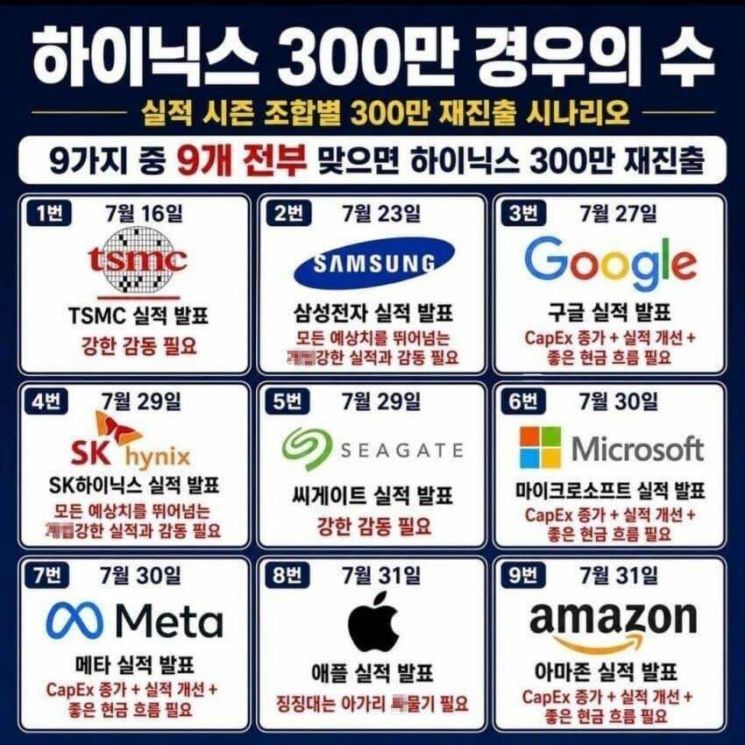
The bingo board carried the subtitle, "3 million won reentry scenarios by earnings-season combinations." The conditions, however, were brutal. While only three of the World Cup conditions had to be met for the round of 32, the SK hynix board required all nine conditions to be satisfied for a return to 3 million won.
The board listed earnings-related conditions for global semiconductor and big tech companies. These included TSMC's earnings release on the 16th, which required "strong emotional impact," Google's report on the 27th, which needed "higher capital expenditures (CAPEX), improved earnings, and strong cash flow," and a joint earnings surprise from SK hynix and Seagate on the 29th.
Why are we so obsessed with "possible scenarios"?
The term "possible scenarios" originally refers to the number of possible outcomes in mathematics and probability theory.
But for South Koreans, it became a familiar term through the FIFA World Cup, which comes around every four years. Since the 1986 Mexico tournament, the media has calculated and reported the scenarios needed for South Korea to reach the finals or the round of 16, and the public has consumed them in a familiar way. The calculations became even more sophisticated through the 1994 World Cup in the United States and the 2002 FIFA World Cup.
At the outset, it was a concept unnecessary for the strong. Weaker teams that could not win decisively through skill alone calculated variables and weighed possible scenarios. In other words, it was a concept that spread because of uncertainty.
The perspective of people investing in SK hynix shares was no different. In the market, individual investors are relatively the "weaker team," swayed by the moves of foreign and institutional investors.
Professor Kim said, "Stocks, like sports, can use possible scenarios as a way to predict an uncertain future." He added, "When that combines with the social desire for others' reactions and empathy, as well as the cultural desire to enjoy possible scenarios like a game, it can be consumed online as a cultural phenomenon."
[email protected] Kim Hee-seon Reporter