Youth Employment Crisis Persists Despite Semiconductor Boom; Youth Jobs Fall by 200,000
- Input
- 2026-07-15 09:21:18
- Updated
- 2026-07-15 09:21:18
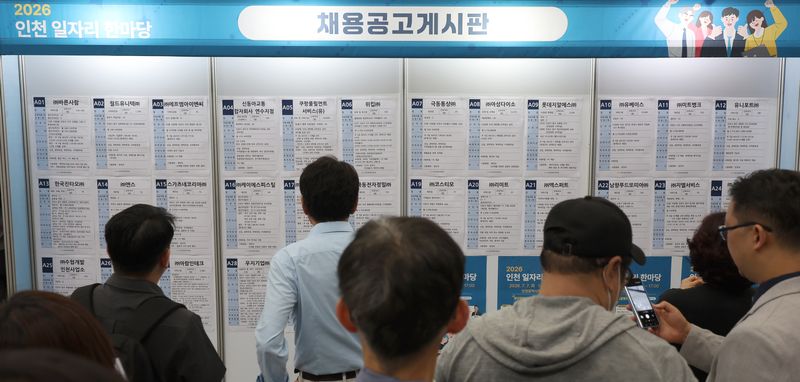
[Financial News] Despite a historic semiconductor boom and the government's aggressive fiscal spending, the frozen labor market is showing little sign of recovery. In particular, job losses in manufacturing and among young people, both of which are seen as indicators of relatively high-quality jobs and economic dynamism, are becoming entrenched. At the same time, public-sector non-regular jobs, which are mostly held by older workers, are increasing, while quality wage-paying jobs for young and middle-aged workers are shrinking, widening the employment gap between generations.
On the 15th, the Ministry of Data and Statistics said the number of employed people aged 15 and older reached 29.154 million in June, up 63,000 from the same month last year.
Employment rose by 100,000 to 200,000 in the first three months of the year, but the increase slowed sharply to the 70,000 range in April as the impact of the Middle East war began to be felt in earnest. In May, the labor market worsened further, with employment falling by 40,000.
Most of the increase came from people aged 60 and older, largely in health care and social welfare services.
Binhyeonjun, director-general of the Social Statistics Bureau at the Ministry of Data and Statistics, said, "Compared with population growth of 250,000, the increase in employment is not large." He added, "Among that, the population aged 15 to 64, or the working-age population, fell by 340,000, so the rise in the employment rate itself appeared relatively modest."
The employment rate has now fallen for three consecutive months. June's overall employment rate stood at 63.4%, down 0.2 percentage points from a year earlier. The employment rate for those aged 15 to 64 was 70.2%, down 0.1 percentage point from the same month last year.
By age group, employment conditions for young people are worsening.
The employment rate for young people aged 15 to 29 fell to 43.9%, down 1.7 percentage points from a year earlier. It has declined for 26 consecutive months. The number of employed young people also fell by 197,000.
The youth unemployment rate also rose 0.9 percentage points to 7.0%, marking the sharpest increase since March last year, when it rose by 1.0 percentage point.
By industry, manufacturing employment fell by 97,000, or 2.2%. Although the pace of decline eased from May's 140,000 drop, the sector has now been on a downward trend for 24 straight months.
Within manufacturing, the semiconductor industry is enjoying an all-time boom, but because it is a capital-intensive sector, its job-creation effect is limited and employment has not increased significantly.
Construction employment also fell by 67,000, extending its decline to 26 consecutive months. The drop was the largest since November last year, when it fell by 131,000.
The slump in the construction labor market is also reflected in the decline in temporary and day laborers. Last month, among wage workers, temporary workers fell by 51,000 and day laborers by 45,000.
Wholesale and retail employment, a key indicator of domestic demand, also fell by 44,000.
By contrast, employment in health care and social welfare services rose by 214,000, or 6.6%, posting the largest increase last month. Arts, sports and leisure services added 55,000 jobs, up 10.0%, while transportation and warehousing gained 48,000 jobs, up 2.8%.
The gains are believed to reflect stronger demand after support payments for damage caused by high oil prices were distributed.
The overall unemployment rate was 2.8%, unchanged from a year earlier. The total number of unemployed people stood at 834,000, up 10,000 from the same month last year.
[email protected] Jung Sang-gyun Reporter