"The bottom may be in, but there is no money to buy"... Deposits down by 27 trillion won, will this block a KOSPI rebound? [Why is the market moving?]
- Input
- 2026-07-15 06:00:00
- Updated
- 2026-07-15 06:00:00
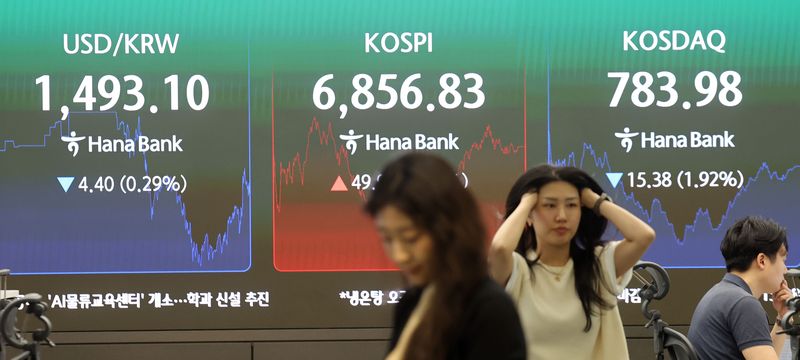
[Financial News] South Korea's stock market has undergone a correction on a scale not seen since COVID-19, leading some to say that price burdens have largely eased. But new money that could lift the market again has been drying up quickly. Investor deposits have fallen by more than 27 trillion won in less than a month, prompting brokerage firms to conclude that "supply and demand is a bigger problem than prices."
According to the Korea Financial Investment Association on the 15th, investor deposits fell by about 27.82 trillion won, from 136.8313 trillion won on June 23, when the KOSPI dropped below the 9,000 level, to 109.0115 trillion won on July 13. During the same period, the KOSPI tumbled to the 6,000 range, and as volatility widened around Samsung Electronics and SK hynix, waiting funds for the stock market also shrank rapidly.
Investor deposits are funds that individual investors leave in brokerage accounts to invest in stocks. A decline in these deposits is interpreted as a sign that waiting money for new purchases is shrinking. In periods of heightened market volatility like the current one, it is especially seen as a signal that there is not enough firepower to support a rebound.
In fact, investor deposits have shown a step-by-step decline over a relatively short period. Deposits stood at 120.0836 trillion won on the 1st, fell to 118.2594 trillion won on the 3rd, then dropped further to 112.2082 trillion won on the 6th, 110.8744 trillion won on the 8th, and 105.5758 trillion won on the 10th. Although some bargain hunting emerged during the sharp selloff, the decline in deposits continued, and waiting funds have yet to recover.
By contrast, the scale of the stock price decline alone suggests the market has already approached historic bear-market levels.
Heo Jae-hwan, a researcher at Eugene Investment & Securities, said, "SK hynix has fallen about 40% from its peak, and the KOSPI about 27%, marking declines comparable to major correction phases since COVID-19." He added, "If the market were functioning normally, it would not be easy to fall much further from here."
He also said, "Even if stock prices no longer fall, it will not be easy for new investment money to come in." He added that, in a period of such high volatility, long-term funds such as retirement assets are more likely to favor overseas markets over the domestic market.
The domestic stock market has recently seen daily trading value of around 50 trillion won, but Samsung Electronics and SK hynix alone accounted for 24 trillion to 25 trillion won of that total. On some days, trading in leveraged exchange-traded funds (ETFs) tied to the two stocks approached 15 trillion won. The assessment is that excessive concentration of funds in a few names, followed by a sharp pullback, has also shaken the overall balance of supply and demand in the market.
Heo said, "Looking only at the stock price decline, it is excessive, but the balance of supply and demand has been damaged." He added, "Before stocks can rise again, a period of energy accumulation is needed." He also noted, "Even if the decline stops, investors may still face a very difficult stretch."
[email protected] Choi Du-seon Reporter