"It's not that I'm angry because an idol bought a home"...Loan restrictions and real estate create a new 'class ladder'
- Input
- 2026-07-15 07:00:00
- Updated
- 2026-07-15 07:00:00

[Financial News] After it became known that An Yu-jin, a member of the group IVE, had won a general sale lottery for The H Bangbae in Bangbae-dong, Seocho District, Seoul, online users posted self-deprecating reactions that reflected the relative deprivation felt by young people.
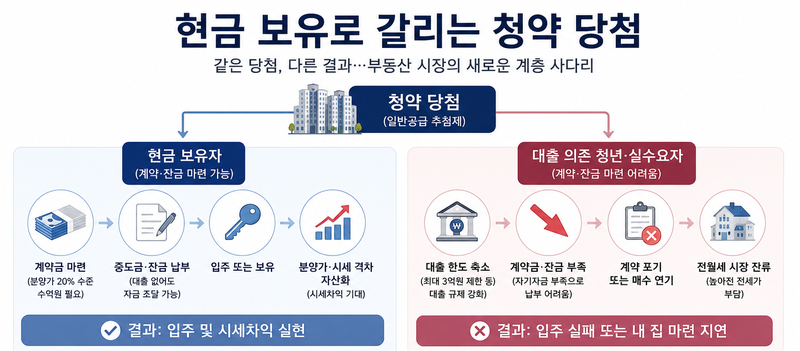
For many young people, the issue was not that a popular celebrity of a similar age had secured an expensive apartment. Their anger was directed at a system in which anyone can apply, but only those who can cover the down payment and final balance in cash can ultimately enjoy the benefits of winning, especially as loan barriers have risen.
On real estate and workplace communities, negative reactions continued, including comments such as, "The problem is the subscription system, not An Yu-jin," "Young people without cash can't sign even if they win," and "The price cap system has turned into a scheme that funnels capital gains to cash-rich buyers."
On the 14th, real estate experts unanimously said that a separate housing policy for younger generations is needed ahead of the president's 'National Real Estate Forum.'
Even if you win, the down payment runs into hundreds of millions of won... subscription lotteries have become 'cash lotteries'
The H Bangbae is a reconstruction complex in Bangbae District 5 subject to the price cap system. At the time of its 2024 sale, the highest presale price for the 84-square-meter unit was 2.243 billion won. The same-sized unit changed hands in April for 3.69295 billion won, creating a gap of more than 1.4 billion won between the presale price and the actual transaction price. Market asking prices were reportedly set at around 4 billion won.
However, some argued that winning a subscription lottery does not necessarily mean winning the lottery. If the down payment is assumed to be 20% of the presale price, an 84-square-meter unit would require about 450 million won at the contract stage alone. Additional funds are needed to cover interim payment interest and the final balance.
As loan limits are reduced, young renters without assets are more likely to give up even if they win a subscription lottery. By contrast, winners with enough cash can cover everything from the down payment to the final balance and secure not only the presale price but also the capital gains as assets.
That is why young people are directing their frustration at the system rather than at An Yu-jin herself. The lottery system was expanded to give young people with low subscription scores a chance, but in the high-priced presale market, even if winners are chosen by lottery, cash on hand ultimately becomes the deciding factor again.
"If it had been a few days later, I might not have been able to buy a home."
The phenomenon in which cash determines whether someone can buy a home has not been limited to Gangnam-area 'lottery subscriptions.'
A salaried worker identified as A, who recently bought an older apartment in Nowon District, Seoul, breathed a sigh of relief after completing the purchase. He had used as much borrowing as possible to secure the final payment, only to hear a few days later that banks would sharply lower home purchase loan limits.
By contrast, B, who had been living in jeonse housing in Dobong District, Seoul, considered buying an apartment after the landlord decided to sell, but gave up as bank lending standards tightened. B now has to look for rental housing while coping with higher jeonse prices.
KB Kookmin Bank has capped home purchase loans at 300 million won from the 10th until further notice. The previous maximum of 600 million won for homes priced at 1.5 billion won or less in the Capital Region and regulated areas was cut in half, and the same 300 million won cap was also applied to non-regulated areas, which had previously had no separate ceiling.
For example, a buyer in a regulated area of the Capital Region who could previously borrow 480 million won from KB Kookmin Bank to buy a 1.2 billion won home, based on the loan-to-value ratio, can now receive only up to 300 million won.
Hana Bank also stopped accepting applications through loan brokers from the same day for mortgage loans and jeonse loans scheduled to be executed in September, while Shinhan Bank closed its loan broker application channel on the 8th.
How to eliminate the 'real estate class ladder' created by cash

Concerns were raised that applying uniform loan cuts to end users without homes, who have limited assets but stable labor income and repayment capacity, is excessive.
Kim Hak-ryeol, head of Smarttube Real Estate Research Institute, said, "Right now, not only young people but also people who own homes and those who do not are all angry." He added, "In the past, if you worked at a major company like Samsung Electronics or SK hynix and had a certain amount of seed money, you could buy a home in Seoul. But now, even with sufficient income, limited loans make it hard to enter the market at all."
He added, "Young people without homes are struggling with a shortage of supply in the jeonse and monthly rental markets, and loan regulations have also made homeownership difficult. A structure is being created in which people cannot buy a home and also cannot rent easily."
As a solution for young people, he proposed maintaining support for first-time homebuyers while expanding long-term mortgages.
Kim said, "For young people, what is needed is not lower borrowing, but a longer repayment period." He added, "If 40- to 50-year long-term mortgages are activated, as in the United States, the monthly repayment burden could fall sharply, and end users would have a better chance of buying a home."
Konkuk University professor emeritus of real estate Son Jae-young said loan regulations and the price cap system are producing contradictory results.
Professor Son said, "The government is suppressing loans to rein in home prices, while at the same time providing lottery-like benefits to some winners through the price cap system." He added, "We need to examine what public-interest effect a structure has when huge gains go only to people with cash."
He also stressed that instead of choosing between loosening or tightening loans outright, real estate policy should be applied more precisely according to repayment ability and whether the buyer is a genuine end user.
Kim said, "Rather than uniformly lowering loan limits for young people, we need to consider ways to reduce monthly principal and interest burdens by using 40- to 50-year long-term mortgages." He added, "Financial policy should give first-time buyers and end users without homes a chance to repay."
As a fundamental solution, Professor Son pointed to expanding housing supply. He suggested speeding up procedures so that redevelopment and reconstruction projects can move faster, and using green belt areas designated in the 1970s. He also said metropolitan transportation networks should be expanded so that central Seoul and the outer parts of the Capital Region can be connected more quickly.
Ahead of the announcement of a comprehensive real estate package, the government has begun collecting online public opinions on supply, finance and taxation. On the 23rd, it will hold a National Real Estate Forum attended by President Lee Jae-myung and plans to reflect opinions gathered from preliminary discussions and online submissions in its policy review.
[email protected] Seo Yoon-kyung Reporter