[Editorial] Announce a second-half economic strategy and boost jobs by nurturing new industries
- Input
- 2026-07-14 18:32:49
- Updated
- 2026-07-14 18:32:49
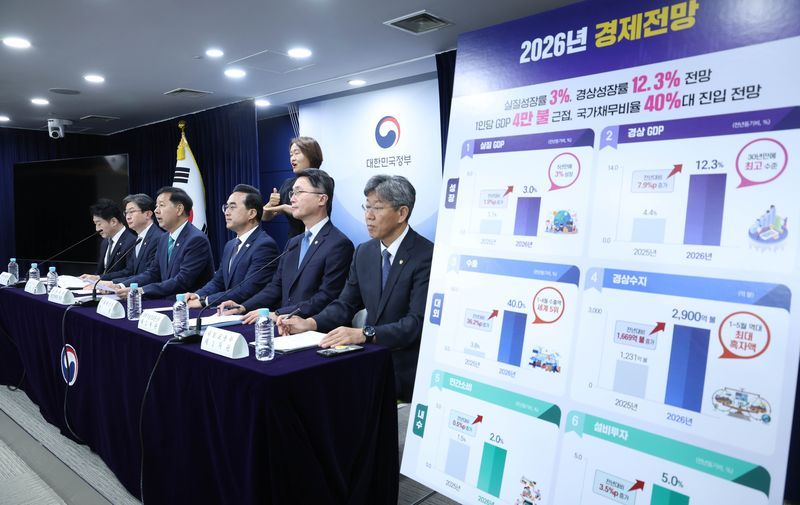
The government’s short-term economic goals are more ambitious than ever. A 3% growth rate would be the highest in five years, and a 3% potential growth rate is also a lofty target. The Organisation for Economic Co-operation and Development (OECD) estimates South Korea’s potential growth rate this year at 1.66%. A top-four export ranking is uncharted territory, and so is reaching $50,000 in per capita income.
Optimistic goals that ignore reality amount to a form of populism. Past administrations have inflated public expectations at the start of their terms with catchy numbers such as '747,' but they never delivered. Still, it is always better to set the bar a little higher. Even if it is not easy to achieve, a more ambitious target can lead to better results. As the government itself admitted, the '3-4-5 vision' will not be easy to realize within the Lee Jae Myung administration’s term. Even so, its determination to give everything it has to reach those goals is commendable.
The government’s announcement was relatively realistic and addressed the key issues. However, the 3% growth target depends too heavily on semiconductors. The semiconductor boom cannot last forever. Even if 3% growth is achieved, there is no guarantee it can be sustained next year and beyond. The strategy must not overlook balanced development across major manufacturing sectors, not just semiconductors.
To escape low growth and raise potential growth, the economy needs multiple new engines of growth, alongside semiconductors, to lead the way.
The government, which knows this well, has already announced several measures to foster advanced industries. They were included in Thursday’s briefing. Not only in the second half of this year, but continuously, the public and private sectors must join forces to develop new industries.
Under the banner of 'fostering ultra-innovative growth engines,' the government highlighted future industries such as the pharmaceutical and biotech industry, defense industry, aerospace, AI agents, and the blockchain economy. These are promising sectors that could become the next semiconductors. The key issue is momentum. The government must take the lead in opening and guiding the channels for major industries. The concrete development roadmaps it presented for each new industry on Thursday reflect a stronger resolve than ever. We hope these plans will help turn them into leading industries of the future.
What is still lacking, however, is any meaningful mention of structural reform. Aside from semiconductors, corporate conditions are far from healthy. Under pressure from China, established manufacturing sectors such as Petrochemicals, steel industry, and the car industry are facing serious difficulties. Regulations on employment and working hours need to be reformed and made more flexible so companies can breathe again.
The most troubling aspects of our economic reality are growth without jobs and widening polarization. No matter how high the growth rate rises, if it does not create jobs, it is all show and no substance.
Employment is not something the government can easily expand through artificial means. When industries develop and companies perform well, jobs naturally increase.
There is no shortcut to job creation. In the end, the best way to boost employment is to energize the entire industrial sector by discovering new industries, as mentioned above, and supporting existing ones. If there were just two or three semiconductor industries enjoying unprecedented prosperity, the economy would continue advancing without a hitch. Everyone must come together with the sense that this very moment is the golden time for a renewed leap forward in the South Korean economy.