"Implicit Agreement" vs. "No Consultation" — Courts Split Over the Same Case Involving Free Polling
- Input
- 2026-07-15 10:00:34
- Updated
- 2026-07-15 10:00:34
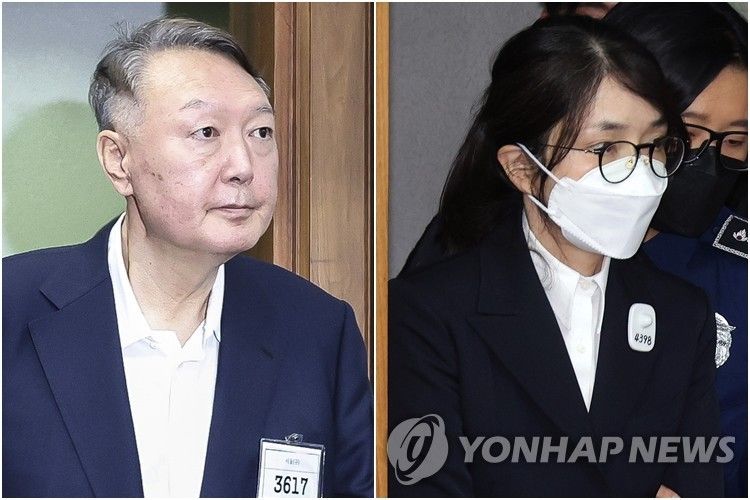
[Financial News] The courts reached different conclusions over the so-called "free polling" case, in which political broker Myeong Tae-gyun provided opinion polls free of charge to former President Yoon Suk Yeol and his wife. The panels handling Kim Keon-hee's case ruled that the matter was part of Myeong's "business activities" and acquitted her. But the panel handling Yoon's case found that the couple had reached an agreement for political purposes and convicted them. Because the same case produced conflicting rulings, attention is now focused on Kim's Supreme Court decision, scheduled for the 16th.
■ "No agreement proven" vs. "Tacit concurrence"
According to the ruling in Yoon's case obtained by Financial News on the 14th, Criminal Division 33 of the Seoul Central District Court, presided over by Judge Lee Jin-gwan, found that Yoon and his wife had conducted the polls under an implicit agreement with Myeong. Under current case law on the Political Funds Act, even if no formal contract for polling was made between the Yoons and Myeong, a request or consultation must still be proven. The court said, "It is reasonable to conclude that there was a sequential and tacit concurrence between former President Yoon, his wife, and Myeong regarding the provision of opinion polls," and fixed the date of that concurrence as June 2021.
However, the trial and appellate courts in Kim's case reached a different conclusion. They said that text messages exchanged between Yoon and Myeong alone were not enough to show that they had discussed conducting opinion polls. The courts viewed Myeong as having carried out the polls on his own, without a request from the Yoons. The appellate court stressed, "The text message Myeong sent to former President Yoon merely explained the sampling method for the opinion poll. It cannot be seen as a request for polling or as consultation about its implementation." In other words, the evidence submitted by the special counsel was not enough to show that the Yoons had agreed with Myeong on the polls.
The courts also differed on whether the cost of the opinion polls could be treated as political funds.
The panel in Yoon's case found that the Yoons benefited by about 27.9 million won in polling costs because they were exempted from paying them. But the panel in Kim's case did not recognize the charge, saying the Yoons gained no such benefit.
■ Split again over promise of Kim Young-sun nomination
The courts also differed on whether there was interference in the nomination of former People Power Party lawmaker Kim Young-sun.
The panel in Yoon's case found that the free polls received from Myeong led Yoon to exert some influence over Kim's nomination. It said Yoon called then-People Power Party nomination committee chair Yoon Sang-hyun and mentioned Kim, and also considered it influential that he received a call from Chang Je-won, who was then chief of staff to the president-elect.
The court said, "Myeong made considerable efforts, including asking the Yoons to secure Kim's nomination, and that may have had some influence on the nomination process." It added, "Yoon also appears to have made significant efforts to help Kim's nomination at Myeong's request." Although Myeong helped Yoon in many ways, including free polling, connecting him with political figures, and offering election advice, the court said the free polling was one of the reasons Yoon was found to have exerted influence over the nomination.
But the panels in Kim's case took a different view. They said that even if Myeong asked the Yoons to help secure Kim's nomination, that could not be taken as a promise. The court said, "Based on the evidence submitted by the special counsel alone, it cannot be concluded that the Yoons promised to nominate Kim in exchange for polling services provided by the Institute for Future Korea or by Myeong for former President Yoon." It continued, "It is only recognized that former President Yoon made considerable efforts to secure Kim's nomination. It is difficult to view this as a promise by the Yoons to nominate Kim in exchange for polling services. Whether the Yoons promised Kim's nomination is not an element of the charges at issue here, but merely a motive for Myeong's political support for Yoon or his political activities on his behalf."
The courts also disagreed on whether Kim Keon-hee should be regarded as a co-principal.
The panel in Yoon's case focused on the fact that Kim communicated directly with Myeong and repeatedly relayed those conversations to Yoon. It found that she controlled the process by coordinating or facilitating key developments to the point that she carried out her own intent. The court stressed, "Even if Kim Keon-hee does not fall under the category of a person engaged in political activity, she can still be recognized as having committed the crime through joint intent and functional control over the act, and therefore qualifies as a co-principal."
But the trial and appellate courts in Kim's case did not view her as a person engaged in political activity. The court explained, "Even if the defendant helped Yoon win the presidency, that fact alone does not mean she qualifies as a person engaged in political activity," and said she did not meet the standard for co-principal liability.
[email protected] Reporter Jeong Kyung-soo Reporter