Buying Coins and Testing Investment Strategies with an AI Assistant... Competition Heats Up in Crypto Infrastructure [Crypto Briefing]
- Input
- 2026-07-14 15:59:17
- Updated
- 2026-07-14 15:59:17
[Financial News] Global crypto companies are moving quickly to build infrastructure that connects conversational AI services with crypto payments, wallets, and trading data. While MoonPay and Coinbase are enabling AI agents to buy crypto and make stablecoin payments, Dunamu Inc. has introduced a backtesting tool that verifies trading strategies entered in natural language using Upbit’s historical price data. As the technical environment for AI agents to call external financial services spreads, competition over payment, data, wallet, and trading application programming interfaces (APIs) is also intensifying.
According to the industry on the 14th, MoonPay linked its fiat-based crypto on-ramp service to Anthropic’s AI assistant Claude. An on-ramp is a service that allows users to buy crypto using fiat payment methods such as cards or bank accounts.
MoonPay had already connected its crypto on-ramp function to other AI agents. The company said that, combined across Claude, ChatGPT, Grok, and Perplexity AI, it has created access to roughly 1 billion potential users. In supported environments, users of AI agents such as Claude can buy crypto with fiat currencies like the U.S. dollar through a conversational interface and transfer it to an existing wallet. However, the availability of the service and supported payment methods may vary depending on local regulations and customer verification requirements.
Coinbase is also building infrastructure that allows AI agents to pay for digital services using stablecoins through its in-house payment protocol, x402. When an AI agent calls a paid API, the service provider presents pricing and payment terms, and the agent pays from its wallet before receiving data or services. The system is designed so that AI agents can make machine-to-machine payments within preconfigured wallet permissions and command limits.
In this regard, Tiger Research divided the AI agent payment market into two broad categories: Agentic Commerce and Paper Call. Agentic Commerce refers to a model in which a person delegates the purchase of goods or services to AI, making it an extension of existing card payment networks. Paper Call is a structure in which an AI agent calls another agent’s or a service provider’s API, data, or computing resources and pays usage fees in stablecoins or other forms.
As Google, OpenAI, and Visa move to establish authorization checks and payment infrastructure for AI agents, Upbit operator Dunamu is expanding the scope of connections between AI agents and exchange data in South Korea.
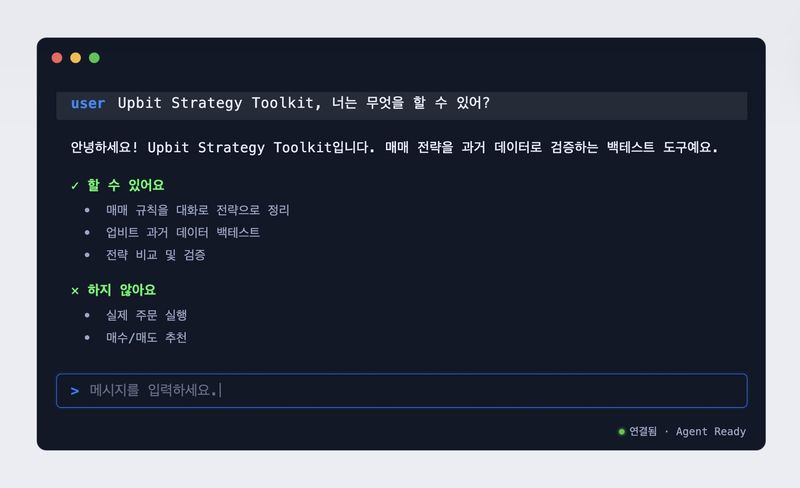
Dunamu has launched a beta version of the Upbit Strategy Toolkit, which allows users to test trading strategies entered in natural language against Upbit’s historical price data. If a user sets conditions such as "buy when the Relative Strength Index (RSI) falls below 30 and sell when it rises above 70," AI organizes the idea into computable strategy rules, and a separate backtesting engine calculates performance using historical data.
The toolkit supports 15 technical indicators, including RSI, Moving Average Convergence Divergence (MACD), and Bollinger Bands, as well as historical candlestick data ranging from one-second charts to monthly charts. Dunamu said it reduced the risk of hallucinations by separating generative AI from the performance calculation engine, preventing AI from generating arbitrary price data or applying inaccurate calculation methods. AI converts trading ideas expressed in natural language into strategy rules, while a separate engine handles performance calculations such as returns.
Industry observers say the spread of AI agent financial services will depend not only on technical convenience but also on how clearly companies design controls over trading permissions, customer verification (KYC), anti-money laundering (AML), and liability in the event of an incident. If AI moves funds on behalf of users, systems are needed to limit payment caps, permitted assets, counterparties, and the validity period of permissions, while also making transactions traceable.
A Web3 industry source said, "The competitive field for crypto businesses is expanding from exchange services to data and payment infrastructure connected with AI," adding, "Collaboration opportunities will likely grow between crypto specialists such as Dunamu, which has large-scale trading data and development infrastructure, and traditional financial firms and fintech companies."
[email protected] Kim Mi-hee Reporter