Seven of 13 Circuit Breakers Hit This Year as the 'Next-Day Rebound' Rule Also Faltered
- Input
- 2026-07-14 15:47:39
- Updated
- 2026-07-14 15:47:39
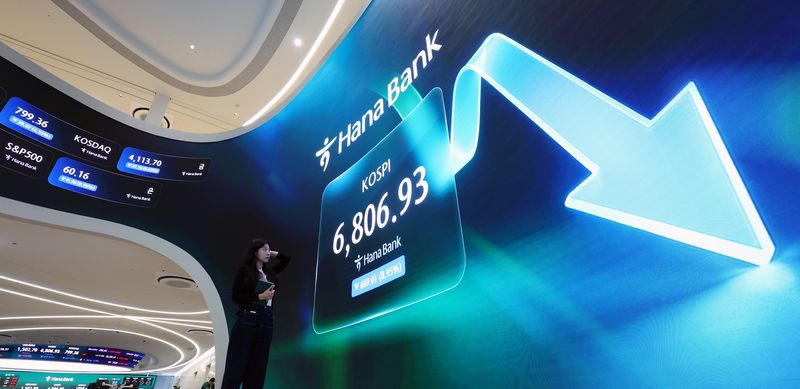
[Financial News] With the seventh KOSPI circuit breaker mechanism of the year being triggered, more than half of all such cases on record have occurred in the past seven months. In the past, sharp declines were often followed by a rebound on the next trading day, but recent sessions have seen further losses, shaking the long-held rule of a 'technical rebound after a plunge.'
According to the Korea Exchange on the 14th, KOSPI plunged more than 8% intraday the previous day as foreign investors and institutions sold in tandem, triggering a sell-side sidecar that temporarily suspended the validity of program sell orders. A circuit breaker mechanism was then activated, briefly halting program trading. Investor sentiment also deteriorated sharply as semiconductor heavyweights, including Samsung Electronics and SK hynix, tumbled.
Including this latest case, the KOSPI circuit breaker mechanism has been triggered 13 times since the system was introduced in 2000. Seven of those cases occurred this year, accounting for more than half of the total. Notably, five of the triggers came after the end of May, when leveraged exchange-traded funds (leveraged ETFs) tied to Samsung Electronics and SK hynix were listed.
Market participants are paying more attention to when the triggers occurred this year than to how many there were. Even during periods of major shocks such as the Global Financial Crisis (GFC) and the COVID-19 pandemic, circuit breaker mechanism activations were limited. Analysts say the repeated market shocks reflect a combination of U.S. tariff policy, geopolitical risks in the Middle East, foreign selling, and an even stronger concentration in domestic semiconductor heavyweights.
In the past, bargain hunting often emerged after a circuit breaker mechanism was triggered, leading to a rebound on the next trading day. Of the previous 12 cases, KOSPI rose the following day in nine, or 75%, of them. On April 17, 2000, it rebounded 5.6% the next day, and on March 4 this year it climbed 9.6%, showing that technical rebounds after a sharp drop were not uncommon.
Recently, however, that pattern appears to be losing force. When the circuit breaker mechanism was triggered on the 7th, KOSPI fell 4.9% that day and then dropped another 5.4% on the next trading day. It also slid more than 5% intraday on the 14th, extending the weak market. Rather than bargain hunting immediately after a plunge, analysts say selling pressure has persisted as investor sentiment worsens and margin calls add to the strain.
Brokerages say the unusually frequent circuit breaker mechanism activations this year reflect structural changes in the market as well as external uncertainty. They explain that the surge in trading of single-stock leveraged ETFs, along with margin trading, forced liquidations, and derivatives rebalancing, has made index volatility greater than before.
Lee Jae-won, a researcher at Yuanta Securities Korea, said, "The trigger for this decline was earnings and changes in investment ratings by overseas investment banks, but the actual drop was amplified by leveraged ETFs, derivatives positions, and foreign basket selling." He added, "As daily volatility in Samsung Electronics and SK hynix has widened, the movements of these two high-capitalization stocks are driving broader volatility in KOSPI."
The securities industry says a technical rebound centered on the 120-day moving average is still possible in the short term, but it expects volatility to remain elevated until foreign flows and margin-call pressure begin to ease. In particular, in a phase like this year, when circuit breaker mechanism activations are recurring, the key point is not whether a short-term rebound appears, but that market volatility itself has shifted to a higher level than before.
Kang Jin-hyuk, a senior researcher at Shinhan Investment & Securities, said, "With margin calls and panic selling concentrated recently, KOSPI is attempting a technical rebound near the 120-day moving average." He added, "It is necessary to confirm whether the combined net buying of 1 trillion won by foreigners in the spot and futures markets will continue, and if downward revisions to SK hynix's earnings estimates materialize, valuation concerns could resurface."
[email protected] Choi Du-seon Reporter