Trump Says, "The MOU Was Just a Test Run, and I’ll Collect the Strait of Hormuz Toll"
- Input
- 2026-07-14 12:59:44
- Updated
- 2026-07-14 12:59:44
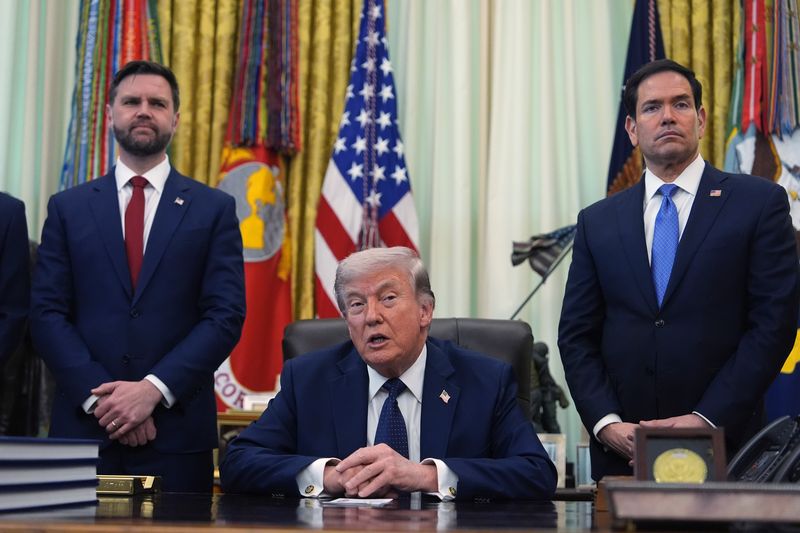
[Financial News] President of the United States Donald Trump said he would launch additional airstrikes against Iran, warning, "We’ll hit hard tonight and tomorrow, too." The United States is continuing its third day of strikes on Iran while also moving to resume a naval blockade of the Strait of Hormuz and charge passing vessels a fee equal to 20% of their cargo. Trump also said the previous memorandum of understanding (MOU) with Iran was only a test, effectively declaring it void. He has also formally notified Congress that military action has resumed. Concerns are growing that the confrontation between the United States and Iran could again spiral toward full-scale war.
Trump declares airstrikes and blockade in parallel
Appearing on the conservative radio program "The Hugh Hewitt Show" on the 13th, local time, Trump maintained a hard-line stance, saying, "There is nothing they can do. They’re just talking big."
When asked whether Iran’s top leadership could be eliminated, he answered, "Yes," but added, "I don’t want to talk about that issue. We are clearly watching." Trump then stressed, "Instead of eliminating them, we are striking them as an example."
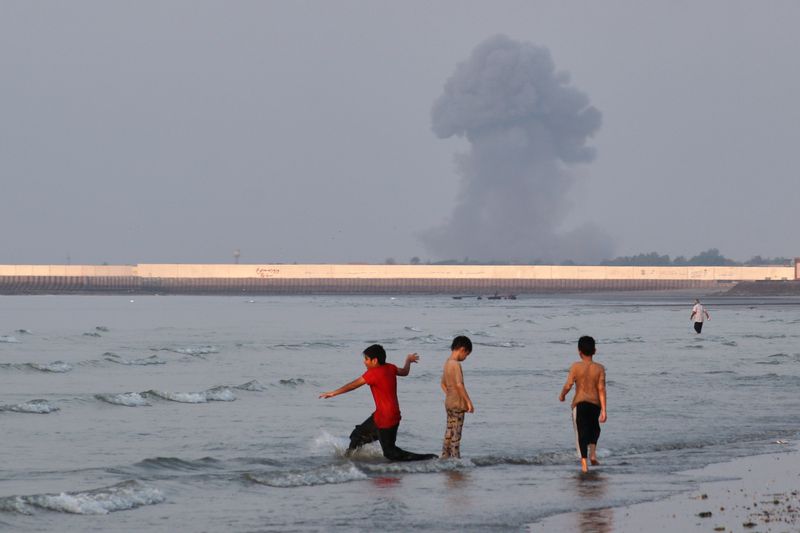
At the president’s direction, CENTCOM began a third straight night of airstrikes on the afternoon of the same day, which was 12:15 a.m. on the 14th in Iran local time. CENTCOM said the operation was intended to "deliver sustained blows to the Iranian military and weaken its ability to attack civilian vessels in the Strait of Hormuz."
Trump also dismissed the recently scrapped MOU with Iran, calling it "something made for testing." He said, "We originally wanted to go straight to a full agreement from the start, but the MOU was for trial purposes," and criticized Iran, saying, "They did not respect the test and never kept it once."
He claimed negotiations had been in the final stage until the previous day, but that the Iranian delegation abruptly walked away. Trump said, "They were at a point where it was 100% going to happen, then they got one phone call and everyone ran out of the room," adding, "For them, an agreement exists only to be broken." Still, he left room for diplomacy, saying, "I still think a deal is possible."
20% toll dispute ... clash with international law
Trump also formalized a plan to charge civilian vessels passing through the Strait of Hormuz a toll equal to 20% of their cargo in exchange for U.S. security guarantees.
He argued, "We are protecting the richest region in the world," and said, "There must be a price for the protection the United States provides." He also said, "A blockade may be more effective than a direct attack, but combining a blockade with attacks is the most effective approach."
But this directly contradicts the position the Trump administration has maintained until now. Vice President JD Vance said last month that "no toll should be imposed on international waterways," and Secretary of State Marco Rubio has also stressed that "international law says no country can collect tolls on international waterways."
The United Nations Convention on the Law of the Sea (UNCLOS) guarantees the right of transit passage through international straits and prohibits charging fees simply for passage. Costs may be collected only when actual services, such as pilotage or rescue operations, are provided. The United States has not ratified the convention, but the principle of freedom of navigation on the high seas is recognized as customary international law.
The New York Times (NYT) noted that the White House has not explained how Trump’s latest claim can be reconciled with the previous positions of advisers such as Vice President Vance and Secretary Rubio.
Controversy is also growing over the procedures surrounding the war. According to CBS and others, Trump formally notified Congress on the 10th that military action against Iran had resumed. The letter said Iran violated the ceasefire agreement by attacking three vessels in the Strait of Hormuz, and that the United States responded by striking missile bases, air defenses, and naval assets.
However, criticism is mounting in the U.S. Congress that Trump is sidestepping the War Powers Resolution’s 60-day limit by repeatedly alternating between ceasefire and renewed action. Representative Thomas Massie of the Republican Party said, "The war never stopped," adding, "He is evading the law by pretending the clock can be reset if you pause and then restart."
[email protected] Kim Kyung-min Reporter