I Put in 1 Gram of a Plastic Bottle and Got 1 Liter of Hydrogen [Unboxing Lab]
- Input
- 2026-07-14 05:56:00
- Updated
- 2026-07-14 05:56:00
Do you remember the excitement of opening a delivery box? Even now, university labs are producing remarkable discoveries that could change our lives. They are simply wrapped in the thick packaging of academic papers. In Unboxing Lab, we will skip the complex formulas and theories and focus on the essentials you actually want to know. So, shall we open the box? Today’s featured research is this one.
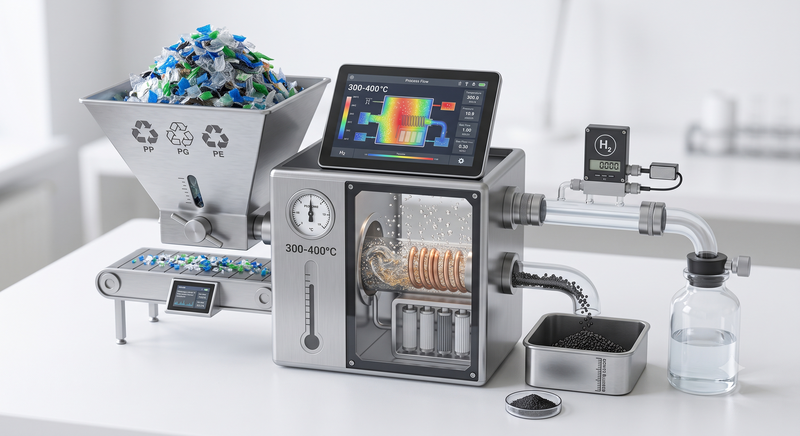
■ Clean hydrogen born from waste
The clean hydrogen produced with the team’s new technology does more than simply reduce waste and protect the environment. Experts say it could become a key feedstock and energy source that reshapes the entire future low-carbon industrial landscape that countries around the world are racing to build.
The first area to change is energy and mobility, which are closely tied to everyday life. Instead of smoke-emitting thermal power plants, it will make eco-friendly power generation possible by burning this clean hydrogen to produce electricity. On the road, it will supply clean and abundant fuel for next-generation transportation such as hydrogen cars, hydrogen buses, and hydrogen trucks, all of which emit only clean water.
It could also transform the massive manufacturing processes that form the backbone of industry into low-carbon systems. A prime example is eco-friendly direct reduction steelmaking, which uses hydrogen instead of burning huge amounts of coal and emits only water. The technology is also expected to play a central role in future key industries that require large volumes of clean hydrogen, such as producing sustainable aviation fuel, an urgent task for the aviation sector under stricter carbon regulations, and manufacturing petrochemical products in a low-carbon, eco-friendly way.
■ Breaking down plastics with alkaline heat treatment
About 400 million tons of plastic waste are generated worldwide each year, but only 9% is recycled into resources. Most of the rest is buried or burned. In particular, plastics other than clear beverage PET bottles have been difficult to sort by type, so they have mostly been treated by incineration or thermal recovery. That process has long caused a persistent problem: the release of large amounts of carbon dioxide.
Conventional plastic gasification technology required extremely high temperatures of 800 to 1,000 degrees Celsius, making it highly energy-intensive. Instead of that high-temperature approach, the research team focused on an alkaline heat-treatment technique that breaks down plastics using sodium hydroxide at much lower temperatures of 300 to 400 degrees Celsius and under normal atmospheric pressure.
First, the team sought to apply hydrogen production technology it had previously studied for seaweed and waste wood to plastics. To do this, it devised a pretreatment process that thermally oxidizes plastic components such as polyethylene and polypropylene, which are not very reactive and do not easily convert into hydrogen, in the air. Through this process, the team succeeded in adding oxygen to the plastic molecular chains and turning them into a state that readily supports hydrogen production reactions.
Finally, the researchers conducted experiments in which pretreated plastics were fed into the alkaline heat-treatment process as mixed waste plastics containing PET, polyethylene, and polypropylene, without any elaborate prior sorting, to extract hydrogen.
■ Turning a major greenhouse gas culprit into an energy fuel
The team became the first in the world to prove the possibility of directly producing clean hydrogen from unsorted mixed waste plastics. This provides a key solution to the huge sorting costs and complex process issues that have been the biggest obstacles at actual waste treatment sites.
The amount of hydrogen that can be obtained from 1 gram of plastic through the team’s process, converted into standard-state gas volume, is as follows. In the experiments, about 1 liter of hydrogen was extracted from 1 gram of PET, about 1.2 liters from 1 gram of polyethylene, and about 0.7 liters from 1 gram of polypropylene. The hydrogen purity was also excellent. The team confirmed that high-purity clean hydrogen exceeding 94% could be obtained from individually pretreated polyethylene, and more than 91% from polypropylene.
A key advantage of this process is that it greatly suppresses the direct release of carbon components produced during plastic decomposition into the air as greenhouse gas carbon dioxide. Some of the carbon reacts with sodium hydroxide and is converted into solid sodium carbonate, where it becomes trapped. Although about half of the decomposed carbon remains as liquid tar or wax, the process is significant because it sharply reduces the amount of gaseous carbon released into the atmosphere.
According to the paper, this solid sodium carbonate can also be converted into calcium carbonate through additional downstream processing, giving it potential for use as an industrial raw material for cement, paper, and paint.
Simulation results assessing the environmental impact of the production process were also positive. Based on PET, conventional gasification emitted 20.7 kg of carbon dioxide to produce 1 kg of hydrogen, while the alkaline heat-treatment technology developed by the team emitted only 10.9 kg, cutting emissions by nearly half. In the case of polyethylene, carbon dioxide emissions fell to as low as 4.83 kg, which is even lower than the 8 kg to 10 kg emitted by the steam methane reforming process, the hydrogen production method widely used in industry today. This shows that the new technology has competitiveness comparable to existing commercial technologies in the future eco-friendly energy market.
[email protected] Kim Man-ki Reporter