[Editorial] Weigh the Pros and Cons of the Commercial Act Revision and Remove Obstacles to Management
- Input
- 2026-07-13 18:13:09
- Updated
- 2026-07-13 18:13:09
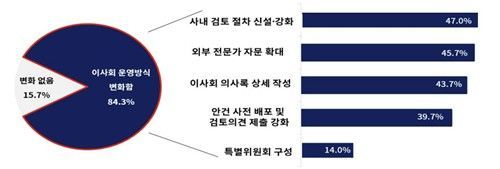
First, it is worth asking whether the changes have gone no further than formal improvements, and whether companies are facing real difficulties on the ground. According to the survey, respondents said accountability in decision-making and transparency in governance have improved. On the other hand, more than half of the companies surveyed, or 53.7 percent, said they were more concerned about lawsuits, including shareholder derivative suits and damages claims. Another 21.7 percent said that stronger legal review has delayed, suspended, or even canceled major decisions such as investment and business restructuring. Among these, new business and mergers and acquisitions accounted for the largest share at 30.8 percent, a point that cannot be overlooked. Boards may have become more transparent procedurally, but there is concern that companies are increasingly hesitating when faced with new business opportunities. The purpose of improving governance is to protect shareholder interests and support corporate management. Yet it raises the question of whether such rules are instead functioning as restraints and oversight that weaken management. If transparency has improved but managerial dynamism has declined, the cause must be examined.
The cost burden on companies and their response to the Commercial Act revision are also becoming more difficult. In particular, the burden borne by large companies and small and medium-sized firms differs greatly. Large companies can respond with dedicated teams and budgets, but smaller listed firms with limited staff and resources are likely to feel the strengthened fiduciary duties and litigation risks much more heavily. After the revision takes effect, policymakers should listen carefully to companies’ complaints, while paying even closer attention to the difficulties faced by small and medium-sized firms.
Another round of regulatory changes is also approaching. Starting in January next year, mandatory electronic shareholder meetings and a higher ratio of independent directors will take effect. However, only a limited number of companies subject to electronic shareholder meetings have completed the necessary operating systems. It is also said that only about half of companies are in the process of selecting candidates for independent directors. With so little time left before these rules take effect, companies are expected to face major difficulties in preparing in a hurry. Rather than scrambling after implementation, it would be far more efficient to identify possible side effects in advance and prepare support measures now.
The purpose of introducing the Commercial Act revision is to make governance more transparent so that both companies and shareholders can benefit in the long run. To create a business-friendly environment, the government should conduct a thorough midterm review.