[Exclusive] Non-prosecution and warrant rejection rates are soaring... Is the last link in prosecutors’ investigative control about to be cut?
- Input
- 2026-07-13 16:29:23
- Updated
- 2026-07-13 16:29:23
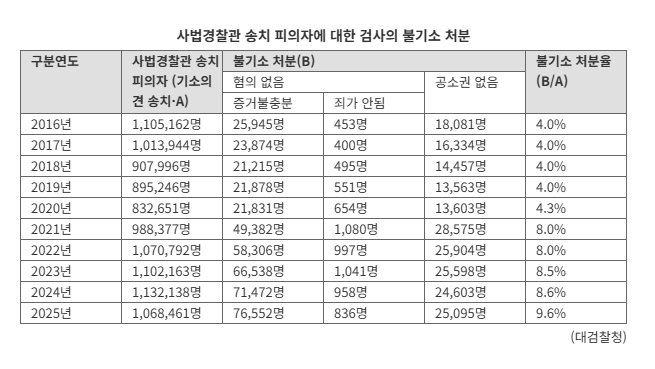
[Financial News] A revision to the Criminal Procedure Act of the Republic of Korea, which seeks to fully abolish the right to supplementary investigation, has been introduced in the National Assembly, putting prosecutors’ investigative control function on the verge of disappearing entirely. In particular, since 2021, when prosecutors lost their investigative directive authority, the non-prosecution rate and the rejection rate for warrant requests have surged, raising concerns about possible abuse of investigative powers by law enforcement agencies. The recent case involving the suspect in the "Gwangju high school girl murder case," Jang Yoon-gi, also revealed through a supplementary investigation by prosecutors that his father, a former police officer, may have been involved in organized destruction of evidence. That has fueled concern over a bill that would completely eliminate prosecutors’ investigative control function.
According to data received by Financial News from the Supreme Prosecutors' Office of the Republic of Korea (SPO) on the 13th, over the past 10 years (2016-2025), the share of suspects referred by judicial police officers and then not indicted by prosecutors for three reasons — insufficient evidence, no crime, and no right to prosecute — has risen since 2021, when the revised Criminal Procedure Act of the Republic of Korea, which removed prosecutors’ directive authority, took effect. Specifically, the rate had stayed around 4.1% from 2016 to 2020, but it rose to 8.0% in 2021, nearly doubling in a year, and climbed further to 9.6% last year.
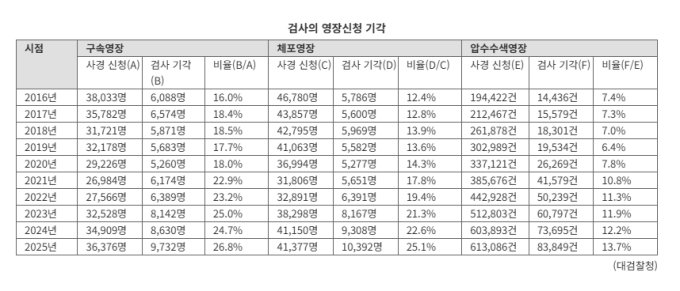
The rejection rate for warrant requests also rose sharply after prosecutors lost their investigative directive authority. For detention warrants requested by judicial police officers, the rate at which prosecutors rejected the request stayed around 17.7% from 2016 to 2020, but increased to 22.9% in 2021 and reached 26.8% last year. For arrest warrants, the rate remained around 13.4% from 2016 to 2020, rose to 17.8% in 2021, and climbed to 25.1% last year. Search and seizure warrants also showed an upward trend, moving from around 7.2% in 2016-2020 to 10.8% in 2021 and then to 13.7% last year.
Jung Young-hwan, CEO of the law firm TLBS, a former research judge at the Supreme Court of Korea and former 15th president of the Korean Association of Law Professors, said, "A warrant is a powerful investigative tool that allows the state to deprive people of even the most basic human right, physical liberty." He added, "The fact that the warrant rejection rate has risen since 2021, when investigative directive authority and other powers disappeared, shows that investigative agencies have been overusing warrant applications and that their power has grown excessively."
There are also cases showing prosecutors correcting overly aggressive investigations initiated by the police. According to this paper’s reporting, the Criminal Division 1 of the Seoul Central District Prosecutors' Office, led at the time by Chief Prosecutor Shin Do-uk, decided on March 26 not to indict A, who had been referred by the Gyeongnam Provincial Police Agency on charges of false accusation, on the grounds of no charges. Police had initiated the case after determining that A falsely accused the spouse at fault in a divorce lawsuit of child abuse. Through a supplementary investigation, prosecutors found that A had no motive to make a false statement and brought the investigation under control.
Inside and outside the legal community, there are concerns that if this revision to the Criminal Procedure Act removes even the right to supplementary investigation, the minimum level of investigative oversight will disappear and abuse of investigative powers by law enforcement agencies will increase. The bill introduced by Rep. Kim Han-kyu of the DPK, a member of the Legislation and Judiciary Committee, would abolish even the right to supplementary investigation, which serves as a substitute for directive authority, making it impossible for prosecutors to fully exercise investigative powers consisting of the authority to initiate investigations, direct investigations, and conclude investigations. Instead, it recognizes only the right to request supplementary investigation from judicial police officers.
A prosecutor at a local district prosecutors' office said, "Since the strong investigative control provided by directive authority disappeared, judicial police officers, including staff at the National Police Agency's National Investigation Headquarters, have not properly responded to prosecutors’ requests for supplementary investigation. As a result, prosecutors have had to conduct supplementary investigations themselves, even though direct investigations increase their workload." The prosecutor added, "Even with the right to supplementary investigation still in place, this is the situation. If only a weaker right to request supplementary investigation is granted, I do not know what prosecutors will be able to do in terms of controlling investigative agencies."
Legal scholars worry that the prosecutor’s unique role in controlling investigative agencies will fade under the banner of prosecution reform. Park Chan-un, a professor at Hanyang University School of Law who served as chair of the advisory committee for the Prosecution Reform Task Force under the Office for Government Policy Coordination and as a standing commissioner at the NHRCK, said, "According to the traditional explanation in legal scholarship, prosecutors were conceived in 19th-century France and Germany as watchdogs of human rights under the law. In the criminal justice system, they were given the role of checking abuse of investigative powers by police and other agencies and protecting defendants." He added, "Prosecution reform is necessary because prosecutors have combined direct investigative powers with indictment authority and carried out targeted investigations, excessive investigations, and so-called fishing expeditions. But putting prosecutors’ core functions on the reform table and demanding that those powers be stripped away is overkill."
[email protected] Kim Dong-gyu Reporter