Jung Cheong-rae to seek another term.."I will not run for president"
- Input
- 2026-07-13 15:15:57
- Updated
- 2026-07-13 15:15:57
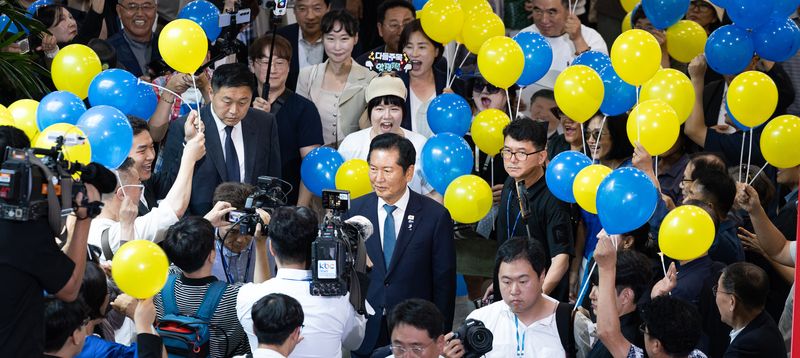
Jung held a press conference at the National Assembly Communication Center that day and declared his candidacy for party leader at the DPK convention on Aug. 17.
He said, "For the stable governance of the Lee Jae Myung administration and for a change of government, I will set everything aside and devote myself fully." He added, "I will not use the party leader position for personal gain. I will not use it to run in the South Korean presidential election."
Political observers had expected that the DPK leader elected this time would naturally emerge as a potential next presidential contender, given control over nomination power for the general election. Jung appears to have made a bold bet by declaring that he will not run for president and instead focusing all his efforts on the party convention.
Jung then described himself as a "reform-minded party leader" and stressed that he would complete the reform tasks he had not finished during his one-year term. He also said he would use only legally collected donations during the convention period and would not rent a separate campaign office. He promised a competition centered on policy and vision.
He also presented 10 policy and vision pledges he would pursue if he wins another term.
The pledges include party-level support for the Lee Jae Myung administration's key economic policies; support for the government's peace policy on the Korean Peninsula; promotion of broad democratic and progressive unity and solidarity, including a merger with the Rebuilding Korea Party (RKP); unification of supporters of the four presidents from the DPK; stronger party-member sovereignty and nomination reform through a system overhaul; greater transparency for party members through live broadcasts of the floor meeting; cyber "cleansing of insurrection" online; continuation of bodies launched during his previous term, including the Honam Development Special Committee; fulfillment of DPK pledges during the local election period; and support from the central party for local committee heads outside the National Assembly.
After wrapping up his candidacy announcement, Jung outlined his positions on the abolition of supplementary investigation authority and the preferential voting system, both of which have recently become the center of internal party controversy.
First, Jung said, "The party was unable to intervene after the prosecution reform task force under the prime minister was created." He added, "They say former Prime Minister Kim conveyed it to the party through various channels, but why were the party leader and the floor leader excluded? If they wanted it handled in May, they should have brought a completed bill and asked the party leader."
He also dismissed concerns about possible side effects from abolishing supplementary investigation authority. Jung said, "I studied these issues more than anyone else." He argued, "If prosecutors are given the right to confirm and interview victims and perpetrators within the scope of an investigation, many of the partial problems can be resolved."
On whether to introduce the preferential voting system, he said, "Right after the decision was made, I said I would respect and accept the party's decision." He added, "But after that, new facts emerged showing that it violated the party constitution and rules. If this issue is properly resolved, I will follow whatever decision the party makes."
With Jung's declaration of candidacy, the race for the DPK leadership is expected to become a five-way contest. The candidates include Jung, former Prime Minister Kim, lawmaker Song Young-gil, lawmaker Ko Min-jung, and former Gangjin County Council chair Kim Bo-mi. The DPK will accept candidate registrations for party leader until the 17th.
[email protected] Kim Hyeong-gu Reporter