Nasdaq ADR Soars 12%, but SK hynix Shares in Korea Plunge More Than 10%
- Input
- 2026-07-13 11:16:30
- Updated
- 2026-07-13 11:16:30
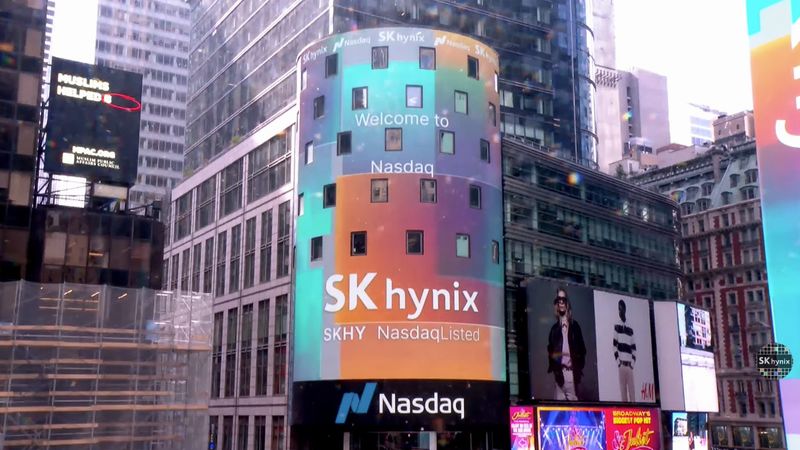
[Financial News] SK hynix, which listed its American Depositary Receipt (ADR) on Nasdaq in the United States, posted a double-digit gain in its first trading session, but its domestic shares fell more than 10%. Market watchers said foreign selling and profit-taking dragged the stock lower in the short term, but they expect the U.S. listing to trigger a revaluation of the company over the long run.
According to the Korea Exchange on the 13th, SK hynix was trading at 1.95 million won as of 11:09 a.m., down 10.55% from the previous session. The listing-related boost failed to lift the stock as some foreign institutions proposed a strategy of buying the ADR and shorting the domestic shares, while broader risk-off sentiment in the local market and profit-taking also weighed on the stock.
The company's American Depositary Shares (ADS), which were listed on Nasdaq on the 10th local time, closed their first session at $168.01, up 12.76% from the offering price of $149. One ADS represents one-tenth of a domestic common share, which puts the implied value about 15.8% above the domestic closing price of 2.18 million won.
The market sees this as a case of a so-called reverse kimchi premium, similar to TSMC in Taiwan, where U.S.-listed shares trade at a higher price than the underlying shares in Korea. Analysts said the premium is likely to persist for some time and that the value of the domestic shares will also be re-evaluated over time.
Kim Soo-hyun, head of research at DS Investment & Securities, said, "Even without regard to industry conditions, the ADR listing event alone could lift the domestic shares by at least 8% to 18%." He added, "SK hynix has long traded at a discount to U.S. rival Micron on a forward 12-month price-to-earnings basis, but the U.S. listing is likely to narrow that valuation gap."
He also pointed to TSMC as a precedent. Kim said, "When ChatGPT 3.5 was launched, TSMC's U.S. ADR rose first, and the domestic shares followed later with a time lag. The gain in the domestic shares was about three-quarters of the ADR's rise," adding that "SK hynix could follow a similar pattern."
Kim Min-gyu, a researcher at KB Securities, said, "Compared with Micron, the global peer, conditions are improving for the valuation discount that the domestic semiconductor sector has faced to narrow." He added, "Given the market power and profitability of Korean semiconductor companies, they could move beyond simply closing the discount and even enter premium territory."
Key points to watch going forward are whether the stock will be added to major U.S. indexes and whether arbitrage opportunities will emerge between the domestic shares and the ADR. Analysts believe inclusion in the Philadelphia Semiconductor Index (SOX) is likely, given the size of the listing. However, because the stock must meet at least three months of trading history and six months of liquidity requirements, the expected inclusion timing is September 2027. They also said near-term inclusion in the Nasdaq-100 Index is unlikely, given the market capitalization of current constituents.
In the long term, there is still room for the conversion volume to expand. According to the depositary receipt (F-6) filing submitted by SK hynix to the United States Securities and Exchange Commission (SEC), the ADS depositary limit is about 1.78 billion shares, roughly 10 times the size of this offering. That equals about 25% of total outstanding shares, leaving room for an additional 22.5% of issuance even after excluding this offering.
Kim said, "TSMC also gradually increased the ADR share from 2.9% at the time of listing to 20.5% today, which helped moderate the ADR premium." He added, "SK hynix could also create a virtuous cycle in which both the domestic shares and the ADR are revalued as the ADR share expands."
[email protected] Choi Du-seon Reporter