They say there is a basement below the floor... Securities firms say the KOSPI has truly hit bottom
- Input
- 2026-07-13 08:34:42
- Updated
- 2026-07-13 08:34:42
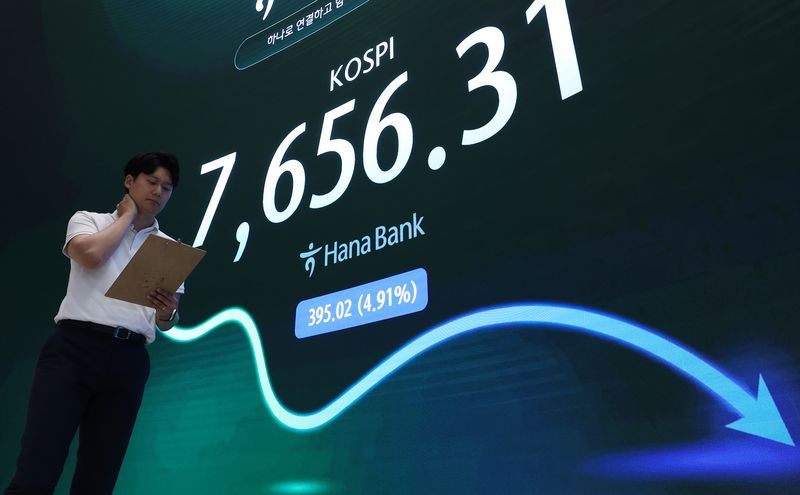
[Financial News] As the KOSPI has fallen more than 20% from its peak and entered a correction, analysts in the securities industry are increasingly saying that it has already passed the bottom. They argue that despite the steep selloff and funding shock, the index still has room to rebound because valuation measures have fallen to levels last seen during the Global Financial Crisis (GFC). Still, some caution that a period of consolidation may be unavoidable for now, rather than a quick V-shaped recovery, as the market works through its heavy concentration in semiconductors.
"The most undervalued range since the financial crisis"
According to the securities industry on the 13th, the main reason behind the bottoming-out view is the exceptionally low valuation, which is rare even by historical standards. The KOSPI's 12-month forward price-earnings ratio (PER) has fallen to around 6 to 7 times, the lowest level since the GFC. PER is calculated by dividing a stock price by earnings per share (EPS) and shows how many times a company's profits are reflected in its share price. The lower the number, the more undervalued the stock is considered to be.
Kim Yong-gu, a researcher at Yuanta Securities Korea, said the KOSPI's 12-month forward PER has fallen to 6.8 times, close to the statistical oversold zone of minus two standard deviations. That is the second-lowest level since October 2008, during the GFC. Kim explained, "A current PER of 6.8 times is a price level that is difficult to justify unless the global economy enters a recession or the worst systemic risk materializes." He added, "In past periods when PER fell below minus two standard deviations, the KOSPI posted positive returns after 4 weeks, 13 weeks, 26 weeks and 52 weeks."
Some analysts also say the scale of the decline itself was excessive. Since the end of last month, the KOSPI has fallen about 20%, reaching drawdown levels seen during major crisis periods such as the GFC, the U.S. credit rating downgrade and the China–United States trade war. Kim said, "The market's temporary and irrational overreaction is likely to calm around the 7,300 level on the KOSPI," calling that range the true bottom.
Heo Jae-hwan, a researcher at Eugene Investment & Securities, said, "The KOSPI fell 20.5% from an intraday high of 9,114.89 on the 19th of last month to 7,246.13 on the 8th of this month." He added that further downside should ease as the market has already reached the average correction seen after COVID-19. He also noted that the recent plunge was not caused by damage to the domestic economy or corporate fundamentals. Excluding domestic semiconductor stocks and the Philadelphia Semiconductor Index, no major correction has appeared across global markets.
As an investment strategy, he put AI and semiconductor leaders at the top of the list. Kim said, "In the process of passing through the true bottom of the current range-bound market, focusing on leading names in the AI and semiconductor value chain is the most effective strategy." He named Samsung Electronics, SK hynix, Samsung Electro-Mechanics, Doosan, Hanmi Semiconductor, LG Innotek, ISU Petasys and Daeduck Electronics as key stocks to watch.
vs "A rough consolidation period ahead"
However, a cautious view that the index may go through a longer consolidation period, rather than rebound quickly, is also gaining ground. The decline appears to have come as the market unwinds the concentration of funds in a small number of semiconductor stocks, which means it may take time before stability returns.
In fact, Samsung Electronics and SK hynix accounted for 78.3% of the KOSPI's gains in the first half of this year. That is far higher than TSMC's 38.9% contribution to Taiwan's stock market gains, the combined 36.8% contribution from Kioxia and SoftBank Group in Japan, and the 13.4% contribution from seven major U.S. technology stocks. At one point on the 25th of last month, the two semiconductor stocks made up as much as 58% of the KOSPI's market capitalization. The heavy dependence on a handful of stocks helped lift the index in the rally, but it also increased downside risk.
The Buffett Indicator, which measures market capitalization as a share of GDP, stood at 221% for the KOSPI last month, far above the 70.2% average from 2000 to 2025. The indicator is a macroeconomic gauge named after global investor Warren Buffett, who called it "probably the best single measure of where valuations stand at any given moment."
Heo said the KOSPI is more likely to move through a period of consolidation and ease the extreme concentration in semiconductors than quickly recover its previous high. Excluding Samsung Electronics and SK hynix, the KOSPI's forward PER has returned to 8.6 times, back to levels seen before April last year, while the two stocks' own forward PERs have also fallen to 4 to 5 times. He said this suggests that valuation appeal has improved not only in semiconductors but also in other sectors.
An improving macroeconomic environment was identified as the key variable that will shape the market's direction going forward. Kim said, "For the KOSPI to break above its previous high again, the U.S. needs to see stable inflation, the Federal Reserve System (Fed) needs to ease its tightening stance, and market interest rates need to fall." He pointed to U.S. inflation data due in August and September as the key factor. He added, "If inflation concerns ease and interest rates remain stable in the fourth quarter, the stock market could enter a Santa rally phase."
[email protected] Han Young-joon Reporter