A Debt-Fueled 'AI Tower of Babel'... Big Tech's Risky Bet [Global Report]
- Input
- 2026-07-12 18:40:37
- Updated
- 2026-07-12 18:40:37
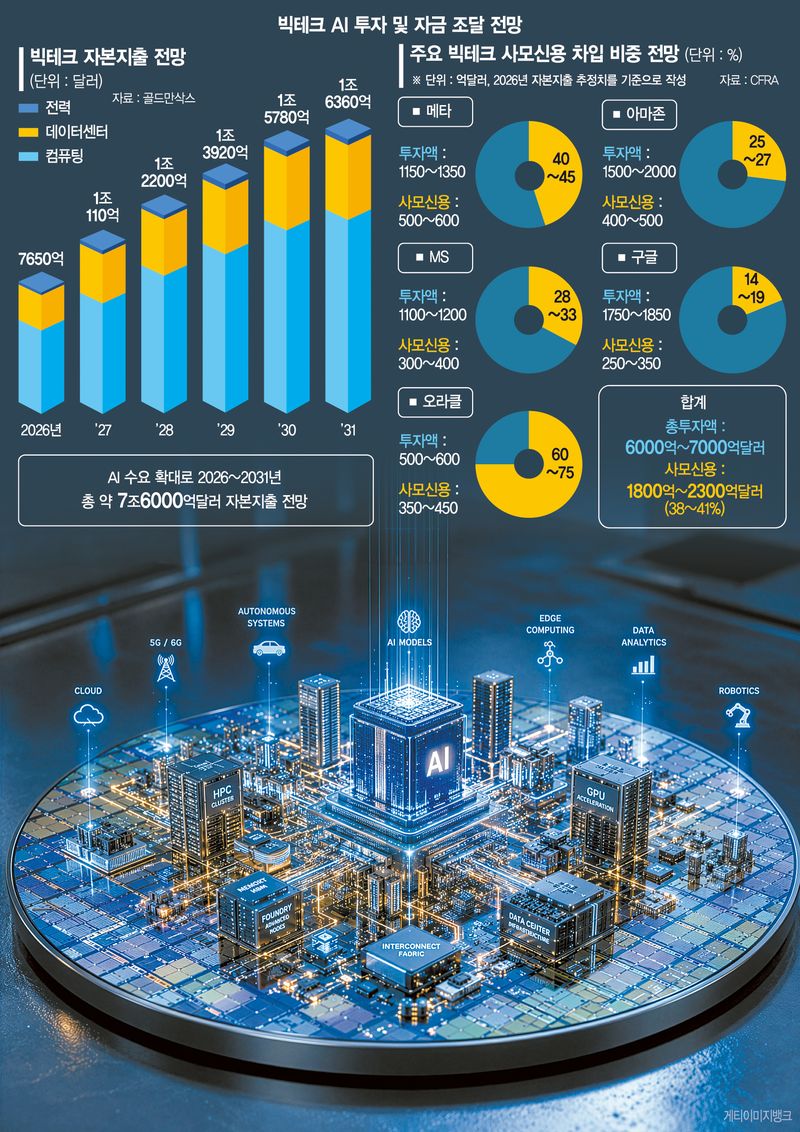
【Financial News, New York = Lee Byung-chul】 Concerns about overheated investment in Artificial Intelligence (AI) and its profitability have persisted, but the investment appetite of global Big Tech companies shows little sign of cooling. As enormous sums pour into building AI data centers, semiconductors, and power infrastructure, AI investment has become a "black hole" that is drawing liquidity out of the market. In particular, as the scale of investment has grown beyond what companies can cover with their own cash, financing methods are changing. Instead of retained earnings, the share of external funding through corporate bond issuance, Private Credit, and Project Financing (PF) is rising rapidly, creating a new financial market alongside AI investment. However, there are also growing concerns that if AI demand slows or profitability is delayed, the surge in borrowing could turn into credit risk.
■Why is AI investment still growing?
AI investment is likely to keep expanding for the time being. That is the result of two forces working together: explosive demand and rising construction costs.
On the demand side, the pace of data center expansion in the United States is steep. According to the Bank of Korea New York Office, 4,378 data centers are currently operating in the U.S., accounting for 37.5% of the global total, and another 2,700 are under construction or in the planning stage. Of the 1,360 cutting-edge data centers worldwide that can stably run cloud services and large-scale AI models, 580 were located in the U.S. as of the end of last year.
This expansion is being driven by actual growth in AI usage. As AI models become more advanced, and especially as agentic AI spreads, the number of tokens and the amount of computing AI must handle are surging. The Bank of Korea New York Office analyzed that "global weekly token usage, a key proxy for computing demand, reached 28 trillion tokens at the end of May this year, up 350% from early January." A token is the smallest unit of data processed by AI to generate responses, and higher usage means greater demand for computing power and memory.
Along with rising demand, data centers are also becoming larger. In November last year, the average investment size of a data center project was $597 million, far above the 2024 average of $374 million.
Reflecting this trend, Big Tech investment plans are expanding further. Morgan Stanley projected that AI investment by U.S. Big Tech companies will reach $814 billion this year and $1.126 trillion next year. Those figures are up 41.3% and 64.1%, respectively, from estimates made a year earlier. Globally, funding for computing, data centers, and power infrastructure from 2026 to 2031 is expected to total $7.6 trillion.
The problem is that construction costs are also rising quickly, not just demand. Running the latest AI models requires high-performance GPUs and AI servers, as well as liquid cooling systems, electrical grids, and power generation facilities. As a result, upfront investment costs are becoming incomparable with those of conventional data centers.
According to the Bank of Korea New York Office, the average construction cost per unit area of a data center, measured at 0.09 square meters, rose from $183 in 2020 to $415 this year, an average annual increase of 17.8%. It is expected to climb to $488 next year. For AI-only data centers, construction costs per unit area are projected to exceed $1,100.
There are three main reasons for the rising costs.
First, AI semiconductors and server prices account for 60% to 70% of data center construction costs. The price of NVIDIA's latest GPU servers has risen by as much as nearly double compared with the previous generation, and supply shortages of key components are adding to the burden. Second, liquid cooling systems and high-performance HVAC equipment, which are 25% to 40% more expensive than conventional air-cooling systems, have become essential. Third, there is the cost of securing power. As data center construction has surged, the prices of transformers and distribution equipment have risen by as much as 95% over the past six years, and delivery times for some ultra-large transformers have stretched to as long as four years. As a result, Big Tech companies are increasingly investing not only in power purchases but also in their own power generation facilities.
Moreover, AI infrastructure is not a one-time business once it is built, which further increases the investment burden. The economic life of AI semiconductors and servers is only two to three years, so continuous equipment replacement and upgrades are necessary. Data centers also require major renovations after 10 years of operation, and most are expected to need full-scale equipment replacement within 15 years.
■Building AI infrastructure with debt
As investment scales have grown beyond what companies can handle with internal cash alone, Big Tech firms are rapidly changing how they raise funds. The ratio of capital expenditure to operating cash flow among U.S. Big Tech companies had stayed around 30% through 2021, before the expansion of data center investment. This year, however, it has risen to about 70%, and it is projected to reach 100% next year. In other words, investment growth is outpacing the cash companies generate from operations.
In fact, Big Tech companies have been issuing large corporate bonds one after another this year to secure funding for AI investment. Meta Platforms and NVIDIA each issued $25 billion in corporate bonds, while Amazon raised $37 billion in March. Alphabet issued $20 billion in corporate bonds in the U.S. and then turned to Swiss franc bonds and even a 100-year corporate bond in the U.K. to secure long-term funding.
The Economist analyzed that the AI investment boom is spreading beyond the stock market into the bond market. Morgan Stanley projected that this year's U.S. AI-related investment-grade corporate bond issuance will reach between $350 billion and $400 billion. That would account for more than 15% of the expected total U.S. investment-grade corporate bond issuance this year.
Financing methods are also becoming more diverse. Instead of building data centers directly, Big Tech companies are securing the computing capacity they need by signing long-term lease agreements with special purpose vehicles (SPVs) under PF structures. This reduces the initial investment burden and also allows the debt to be treated off-balance sheet. Private Credit has emerged as a key source of funding for these projects and is quickly growing into one of the pillars of AI infrastructure finance. The Bank of Korea New York Office estimated that about 40% of Big Tech's AI capital expenditure this year will be financed through Private Credit.
■Rising investment... a new risk for financial markets
Still, concerns remain significant. The Bank for International Settlements (BIS) warned that if AI projects fail to generate sufficient profits, the rapidly increasing debt could become a new burden for companies.
The Economist also noted that "as the winners of the AI revolution are changing rapidly, it is becoming increasingly difficult to assess the risks of long-term bonds accurately," pointing to the possibility that the expansion of AI investment could evolve into a new risk for financial markets. Ultimately, whether AI investment becomes a future growth engine or the starting point of financial market risk will depend on whether companies can prove profitability that matches the scale of their massive spending.
[email protected] Lee Byung-chul Reporter