Samsung says first fab at Yongin semiconductor plant to begin operations in 2029, 1-2 years earlier than planned [Yongin semiconductor race accelerates]
- Input
- 2026-07-12 18:19:21
- Updated
- 2026-07-12 18:19:21
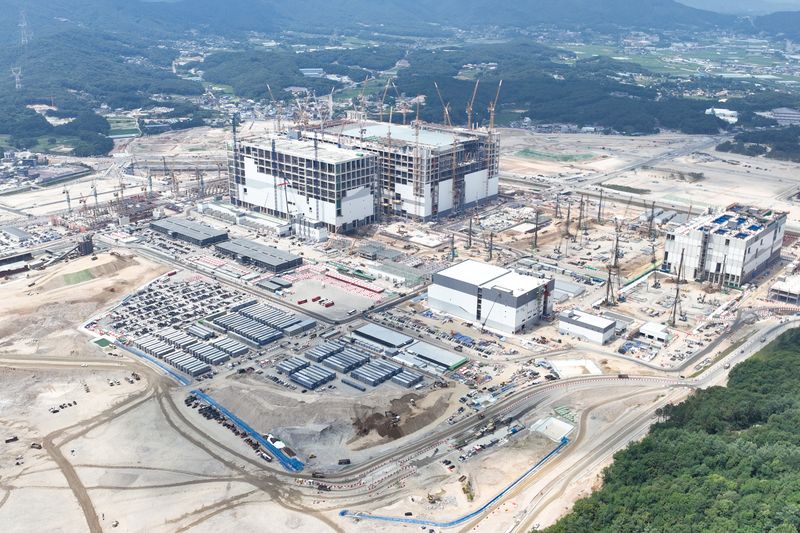
The global memory industry appears to be joining the race to expand capacity in order to secure a lead in the artificial intelligence (AI) semiconductor market.
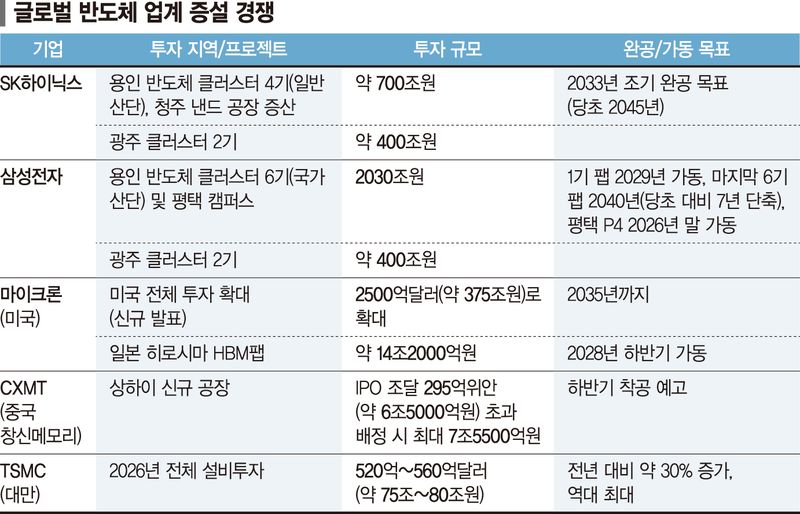
According to the semiconductor industry on the 12th, Samsung Electronics has reset the start of operations for the first fab among the six semiconductor plants planned for the Yongin national industrial complex from 2030-2031 to 2029. As rival companies such as Micron in the United States and CXMT in China have entered an accelerated expansion race, and as the government announced at a public briefing on the three major mega projects held at Cheong Wa Dae on the 29th of last month that it would bring forward the completion dates of the final fabs at Samsung Electronics' and SK hynix's Yongin semiconductor clusters by seven years and 12 years, respectively, the first fab at the Yongin cluster was also adjusted to open one to two years earlier. Industry observers say this will only be possible if land development and compensation, early construction of a 3-gigawatt LNG Power Plant, a shortened power supply schedule for phases 2 and 3, and earlier water supply by stage all proceed without setbacks.
It usually takes about two years to build a cutting-edge semiconductor plant. For the first fab to begin operations in 2029, site preparation would need to start no later than the second half of this year, followed by groundbreaking and full-scale structural work next year. With the government signaling that it will also accelerate the Honam Semiconductor Cluster along with the Yongin cluster, the industry expects the schedule for key infrastructure such as power and water at the Yongin industrial complex could also be moved up. Samsung Electronics also plans to speed up construction of lines 1 and 2 at its Pyeongtaek Campus P5, which is currently under construction.
Chey Tae-won, chairman of SK Group, said after the Nasdaq listing ceremony for SK hynix's American Depositary Receipt (ADR) in New York on the 10th local time that he dismissed concerns in Wall Street about demand for semiconductors and a peak-out in chip stocks. He noted, "Even after announcing that we would double production capacity within the next five years, all of our customers say, 'That is not enough. We need more.'" Chey plans to invest the roughly 40 trillion won raised through SK hynix's Nasdaq listing in the first fab at the Yongin semiconductor cluster and in the P&T7 back-end fab in Cheongju. He also suggested that the global semiconductor industry has effectively entered a period of expansion amid supply shortages, and said that in addition to domestic investment, "If we find a suitable site in the United States, we will invest in building a semiconductor fab there."
Micron, CXMT and TSMC also step up aggressive investment
On the 9th, Micron announced plans to expand its investment in the United States to $250 billion by 2035 and to produce 40% of its DRAM in the country. It had originally planned to invest $170 billion in the United States, but after the launch of the Trump administration, it raised that figure to $200 billion in June last year and has now added another $50 billion. Separately, Micron is also building a next-generation DRAM and High Bandwidth Memory plant in Hiroshima, Japan, with the goal of starting operations in the second half of 2028. The investment is valued at 1.5 trillion yen, or about 14.2 trillion won.
CXMT plans to raise 29.5 billion yuan, or about 6.5 trillion won, through an initial public offering (IPO) in mid-month and allocate 7.5 billion yuan to capacity expansion and upgrades, 13 billion yuan to DRAM technology upgrades, and 9 billion yuan to next-generation research and development. U.S. semiconductor analysis firm SemiAnalysis forecast that CXMT's production capacity will rise to 350,000 wafers per month by the end of this year, approaching Micron's 385,000 wafers per month over the same period. It also projected that by 2028, CXMT will reach 500,000 wafers per month, overtaking Micron and securing the world's No. 3 market share at about 17%, up from around 8% now. TSMC, the world's No. 1 foundry, has also said it will expand its investment in the United States from $100 billion to $165 billion and build six wafer plants, two packaging plants and one research and development center in the country.
[email protected] Jo Eun-hyo Reporter