Clashes Resume Over Control of the Strait of Hormuz as Iran Says It Will Impose an Indefinite Blockade
- Input
- 2026-07-12 18:16:32
- Updated
- 2026-07-12 18:16:32
■ U.S. strikes 140 targets... Iran retaliates
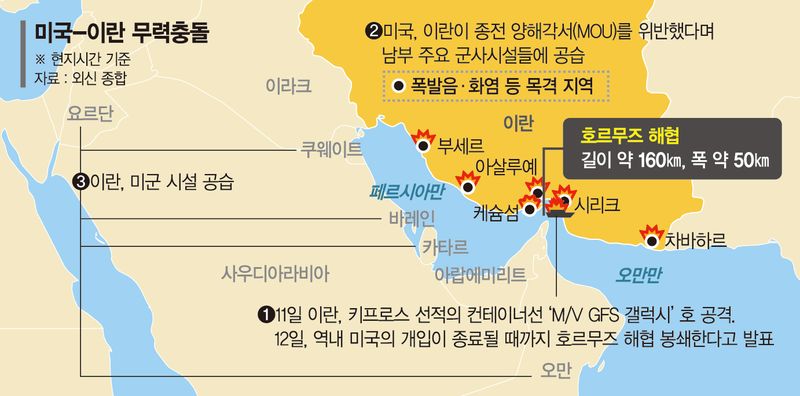
U.S. Central Command (CENTCOM), which oversees operations against Iran, said in a post on social media platform X on the 11th local time that at 7:15 p.m. Eastern Time on the 11th, the Islamic Revolutionary Guard Corps (IRGC) attacked the Cyprus-flagged container ship M/V GFS Galaxy as it was passing through the Strait of Hormuz. It then said that, under the order of the commander in chief, Donald Trump, units under CENTCOM launched the third airstrike of the week. A few hours later, CENTCOM issued a separate notice saying the strike had been completed and that about 140 military targets in Iran had been hit with fighter jets, drones, and precision-guided weapons.
This was already the third U.S. strike on Iran this month. After Iran attacked three merchant ships in the Strait of Hormuz on the 6th and 7th, the United States struck about 80 Iranian targets on the 7th and about 90 more on the 9th. According to Iranian media, explosions were confirmed on the 11th in Qeshm Island, Bandar Abbas, and Chabahar in southern Iran near the Strait of Hormuz. Explosions were also reported in those areas on the 7th and 8th. TASS Russian News Agency reported that sounds of explosions were also heard in Asaluyeh, home to Iran’s largest refinery, and in Bushehr, where a nuclear power plant is located.
Iran, which carried out retaliatory strikes on U.S. bases in Bahrain and Kuwait after the air raids on the 7th and 8th, did not stop this time either. The IRGC said through state media on the 12th that it had attacked the U.S. command and control center and an MQ-9 drone hangar at Prince Hassan Air Base in The Hashemite Kingdom of Jordan, a MIM-104 Patriot air-defense battery, an ammunition depot, and radar facilities at a U.S. base in Kuwait, and communications and radar facilities at the headquarters of the U.S. Navy's Fifth Fleet in Bahrain. Press TV, Iran's state broadcaster, also claimed that the IRGC had "strongly struck" a U.S. aircraft carrier refueling facility and military logistics site at Duqm Port in Oman.
Separately from the IRGC, Iran's regular army claimed that it fired several ballistic missiles at fighter maintenance and repair facilities and a command-and-control room inside the U.S. Al Udeid Air Base in Qatar. Iranian military spokesman Akrami Nia stressed that "the U.S. military must comply with the provisions of the previous memorandum of understanding" and that "the Iranian military will firmly defend the Iranian people's sovereignty over the Strait of Hormuz."
■ Full closure of the Strait of Hormuz
As in the previous case, the latest clash was again about control of the Strait of Hormuz. On the 17th of last month, the United States and Iran signed an armistice memorandum of understanding and agreed to maintain a ceasefire and ensure safe passage through the strait for the next 60 days. Iran, however, insisted that passing vessels must use the northern route closer to its coastline. The United States, by contrast, established a new route to the south, off the coast of Oman.
In a statement on the 11th, the IRGC said one ship had "turned off its systems and endangered maritime security" in order to use an unauthorized route through the Strait of Hormuz, and that it was stopped after warning shots were fired. CENTCOM said that as a result of the Iranian attack, one civilian crew member aboard the M/V GFS Galaxy was missing and the vessel was also disabled by fire. Announcing the attack, the IRGC said, "Because instability has been caused by illegal intervention, the Strait of Hormuz is fully closed until further notice and until U.S. intervention in the region ends."
U.S. Defense Secretary Pete Hegseth said on X shortly after the announcement of the third airstrike on the 11th that "Iran made a terrible choice" and that "now they will pay the price." Mohammad Bagher Ghalibaf, speaker of Iran's parliament and the man who led Iran's previous negotiating team, posted on X on the 12th that "the era of one-sided agreements is over." He added, "We told you, 'If you do not keep your promise, you will pay the price.' Reality is knocking at the door."
[email protected] Park Jong-won Reporter