"If You Think About Employment, Korea" ... Vietnamese Talents Set Out on Their Dream Study-Abroad Journey
- Input
- 2026-07-12 18:13:52
- Updated
- 2026-07-12 18:13:52
■ Even Vietnam’s top science student chose admission to KAIST
According to local Vietnamese media on the 12th, Hoang Huong Giang, a math student at Hanoi National University of Education High School for the Gifted, chose to attend Korea Advanced Institute of Science and Technology (KAIST) in Korea rather than a top university in Vietnam or the English-speaking world. She had scored a perfect 1600 on the SAT and later achieved the highest score in the science track, 29.75 points, on Vietnam’s high school graduation exam held in June. She receives a Samsung Electronics scholarship and plans to major in computer engineering starting in September.
In an interview with this paper on the 9th, Giang said, "KAIST is located in Daejeon, which is often called Korea’s Silicon Valley, and its strong industry-academia cooperation was the biggest attraction because I could apply what I learned directly in the industrial field." She also received scholarship offers from Seoul National University and Vingroup-affiliated VinUniversity, but explained that she chose KAIST because "the level of cooperation between universities and companies is high, the cultural distance between Korea and Vietnam is small, and safety is also a decisive factor."
Kim Yong-hyun, dean of admissions at KAIST, told this paper, "Since last year, we have been actively working to attract outstanding students from Vietnam," adding, "We plan to continue securing talented students from Southeast Asia and other countries around the world."
An official at a domestic science and technology institute said, "Vietnamese students have a strong foundation in math and physics, and their academic performance is generally high," adding, "We are expanding efforts to attract outstanding students, especially through local gifted schools and science high schools."
■ "They think about employment after studying abroad" ... Korean study abroad becomes more serious
The education industry says the purpose of Vietnamese students studying in Korea is clearly changing. In the past, many chose Korea to earn a degree while working part-time, but recently they are prioritizing university competitiveness and the possibility of finding a job after graduation. Preferred universities are also shifting rapidly, from regional private universities with generous scholarships to major universities in Seoul. Majors are moving away from Korean language and business toward advanced industry fields such as computer engineering, electrical engineering, health care, and medicine.
Nguyen Van Thu, who runs the "Teacher Thu Study Abroad Agency" in Hanoi, said, "In the past, many students only met the TOPIK requirement right before admission, but now the number of students preparing one or two years in advance and earning level 6 has increased significantly," adding, "Their attitude toward studying abroad has become much more serious."
Tran Tien Van, head of Zila Education, said, "In the past, most students studied Korean language first and then entered undergraduate programs, but recently the share of those applying directly to undergraduate or graduate programs from the start has exceeded 30%." He added, "Interest in English-track programs at prestigious Seoul universities has also risen sharply." He noted that "students are increasingly choosing majors based on fields with higher future career value rather than departments that are simply easy to enter."
Kang Byung-woo, head of the Vietnam representative office for Sunmoon University at SOS International Group, said, "Students are showing interest in majors linked to Korea’s industries, such as semiconductors, artificial intelligence, and future mobility." He added, "As access to information has improved, more students are preparing for study abroad with realistic career plans rather than vague expectations."
■ Vietnam overtakes China to become Korea’s largest source of foreign students
According to the 7th issue of "Reading Korean Education through Data," published last month by the Ministry of Education of the Republic of Korea and the Korean Educational Development Institute (KEDI), the number of foreign students in Korea stood at 253,512 as of April last year. Among them, Vietnamese students numbered 75,198, surpassing China with 74,820 and ranking first.
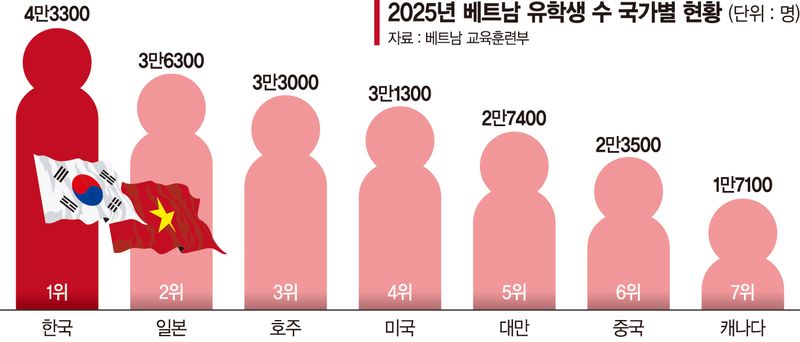
Statistics from Vietnam’s Ministry of Education and Training also showed that among about 250,000 students studying abroad, 116,000 were studying in Korea, the largest number. Japan, Taiwan, Australia, and the United States followed. Locally, the spread of the Korean Wave, expanded exchanges between the two countries, and lower tuition and scholarship systems than those in the English-speaking world are cited as reasons behind the increase in study abroad in Korea.
Competition to attract talented students is also intensifying. The Hanoi Korean Education Center operates a study-abroad support center and holds outreach information sessions. Last year, it held a briefing at Chu Van An High School, one of Hanoi’s prestigious schools, drawing strong interest from students and parents.
Kim Hyun-dong, director of the Hanoi Korean Education Center, said, "We will continue to provide accurate information about studying in Korea and actively support Vietnamese students so they can prepare for study abroad safely and successfully."
[email protected] Reporter