Kim Yong-beom: "Semiconductor production capacity is the new national power... It is only a matter of time before the state supplies it"
- Input
- 2026-07-12 11:56:25
- Updated
- 2026-07-12 11:56:25
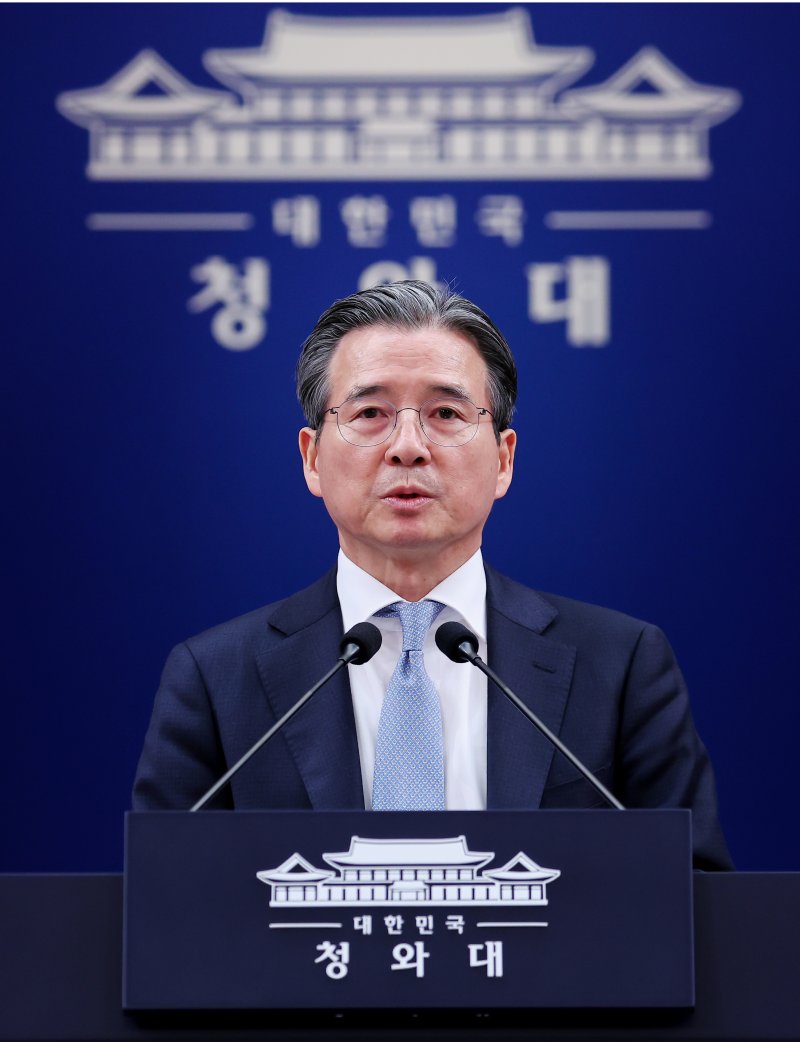
[Financial News] Kim Yong-beom, Chief Presidential Secretary for Policy at the Blue House, said advanced semiconductor production capacity is the key to national competitiveness in the era of Artificial Intelligence (AI), calling it "the new national power." He stressed that the state must remove bottlenecks in industrial infrastructure, including power, water, transmission networks, and permits, so companies can secure production capacity quickly. "What the state must supply first and foremost is time," he added.
In a Facebook post late on the 11th titled "Production capacity is the new national power," Kim wrote that "the AI revolution is not just a technological innovation" and described it as "another production revolution that amplifies human knowledge and judgment."
Kim said national competitiveness is no longer determined only by who develops technology first. "What matters more now is how quickly that technology can be turned into large-scale production power," he said.
He said the competition in AI is becoming a competition in semiconductors, and that semiconductor competition is in turn becoming a competition in production capacity. "AI is not completed by software alone," Kim explained. "The spread of AI data centers, autonomous vehicles, humanoid robots, AI home appliances, and industrial AI is highly likely to structurally increase demand for high-performance computing devices and advanced memory."
Kim said production capacity is not simply a matter of owning more factories or making more semiconductors. He defined it as "comprehensive industrial capability to stably supply advanced semiconductors in sufficient volume when needed." He added that advanced fabs, process technology, high yields, advanced packaging, supply chains for materials, parts and equipment, skilled workers, and infrastructure such as power and water must all be in place in an integrated way.
"Technology and production capacity do not replace each other; they complete each other," he said. "Competitiveness in the AI era is only achieved when the quality of technology and the quantity of production capacity come together."
Kim said major countries around the world are already in a race to secure advanced semiconductor production capacity. "The world's leading countries no longer see semiconductors as just one industry," he noted. "They are now strategic assets that determine economic security, industrial sovereignty, military strength, and future growth potential."
"The United States is attracting advanced semiconductor manufacturing facilities with financial support and tax incentives, while China is expanding its production capacity and technology accumulation on the back of state support, financing, and a huge domestic market," Kim said. "Japan is pursuing the reconstruction of its semiconductor industry at the national level, and Taiwan is maintaining its key position in the global supply chain with world-leading foundry production capacity."
Kim said the rise in memory demand driven by the AI revolution presents a major opportunity for the Republic of Korea's memory industry. However, if production capacity is not secured in time, he warned, that demand growth could paradoxically create new competitors.
"When supply shortages deepen, customers change the criteria they use to choose suppliers," he said. "Products that can be delivered reliably when needed become more important than the best products on paper." He added, "If an existing supplier cannot provide the required volume on time, customers have an incentive to choose another supplier, even if its performance and quality are somewhat behind."
He also raised the possibility of Chinese memory companies catching up. Kim said China has made semiconductor self-reliance a core industrial policy goal and continues long-term investment and technology accumulation with state support and a vast domestic market. He said this environment can allow companies to endure much longer investment periods than ordinary private firms.
"Today's supply shortage breeds tomorrow's competitors," Kim said. "Technological superiority is sustained only when it is linked to market dominance through production capacity secured at the right time." He also said the so-called "chicken game" competition strategy that once worked in the memory industry is unlikely to be as effective in the AI era.
Kim described the Republic of Korea's fab expansion as a national project. "The Republic of Korea is one of the few countries that has both world-class memory technology and production capacity," he said. "In particular, the competitiveness of High Bandwidth Memory, a core memory technology in the AI era, goes beyond the performance of a single company. It is a key asset that allows the Republic of Korea to maintain a strategic position in the global AI supply chain."
"The Yongin Semiconductor Cluster, the expansion of the Pyeongtaek advanced fab, and the 800 trillion won investment plan for the second Honam cluster cannot be seen as mere corporate facility investment," he said. "They are closer to a national project and a massive investment in production infrastructure rarely seen in the industrial history of the Republic of Korea, aimed at securing future production capacity."
"What the state must protect is not any specific company, but the Republic of Korea's advanced semiconductor production base and its competitiveness," Kim said. "Semiconductor production capacity is a corporate asset, but it is also a national strategic asset."
[email protected] Choi Jong-geun Reporter