"Retail Investors Have Changed": They Absorbed a Wipeout of Foreign Selling, Then Turned Net Sellers for a Third Straight Day... Even the 100 Trillion Won Cash Pool Looks at Risk
- Input
- 2026-07-11 15:00:00
- Updated
- 2026-07-11 15:00:00
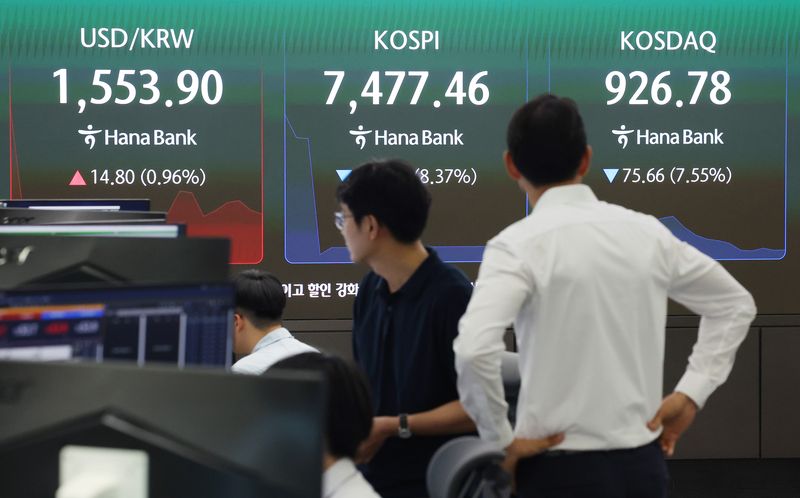
[Financial News] As KOSPI volatility has recently intensified, with the index at one point sliding to the 7,000 level, investor deposits, which serve as standby funds for the stock market, have fallen to their lowest level in five months.
Investor deposits at 107 trillion won... Lowest level in five months
According to Yonhap News Agency on the 11th, investor deposits stood at 107.1279 trillion won on the 9th, the lowest level since 104.1291 trillion won on Feb. 20. Notably, the figure has fallen for eight consecutive trading days since reaching 132.4697 trillion won on the 29th of last month.
The decline appears to reflect individual investors either buying on dips amid KOSPI's swings or withdrawing funds altogether. After closing at a record high of 9,114.55 on a closing basis on the 22nd of last month, KOSPI has repeatedly plunged and rebounded, at one point dropping as low as 7,063.76 intraday.
Investor deposits are a kind of standby fund, referring to cash held in securities accounts after being deposited for stock purchases. A decline in these deposits can also be interpreted as a sign that the ammunition available to absorb selling by foreigners and others is running low.
Foreign investors have been net sellers except for two days since the 19th of last month
From the 1st to the 10th of this month, foreign investors net sold 12.3246 trillion won on the Korea Exchange Main Board, while individual investors net bought 9.3669 trillion won, helping support the market's lower bound. However, on the 8th, individuals also turned net sellers, offloading 35.8 billion won, and they continued to sell for three straight trading days through the 10th.
Foreign investors had maintained a net selling streak since the 19th of last month, briefly turned net buyers on the 8th and 9th, but returned to net selling on the 10th with a 322.6 billion won selling advantage.
Yuanta Securities Korea Co., Ltd. analyst Kim Yong-gu said, "Individual investors are supporting the market, but considering the Bank of Korea's interest rate hikes, the government's lending restrictions and the decline in investor deposits, I believe there is a limit to how much additional net buying power individuals can sustain indefinitely."
The balance of securities lending transactions, a bet on falling stock prices, stood at 161.8808 trillion won on the 9th, up slightly from 159.3416 trillion won the previous day. The amount had fallen for two consecutive trading days after reaching 175.3808 trillion won on the 6th, before rebounding.
Margin loan balances, a key gauge of leveraged investing, or so-called "debt investing," also fell to 36.6336 trillion won on the 9th, the lowest since 36.2548 trillion won on May 26. Margin loans refer to the amount investors have borrowed from securities firms to invest in stocks and have not yet repaid, indicating that many individual investors are using borrowed money to trade.
Cautious at home, aggressive abroad
What stands out is that while individual investors are taking a more cautious stance in the domestic stock market than they did during previous rallies, they are still showing an aggressive investment appetite in overseas markets. According to Save-ro, the securities information portal run by Korea Securities Depository (KSD), 155.383 million dollars, or about 233.63 billion won, was settled over the past week (based on the inquiry period from the 3rd to the 9th) in the so-called "SOXL" (DIREXION DAILY SEMICONDUCTORS BULL 3X SHS), which tracks the Philadelphia Semiconductor Index on a three-times long basis.
Net settlement for "KORU" (DIREXION SHARES ETF TRUST DAILY MSCI SOUTH KOREA BULL), which tracks the performance of the South Korean stock market three times, also reached 13.891 million dollars, or about 2.088 billion won. Combined, the net purchase settlement amount for these two overseas exchange-traded funds (ETFs) exceeded 250 billion won.
[email protected] Kim Hee-sun Reporter