Chey Tae-won Says AI Has Changed the Semiconductor Cycle, With Demand Set to Surge Until AGI
- Input
- 2026-07-11 02:00:00
- Updated
- 2026-07-11 02:00:00
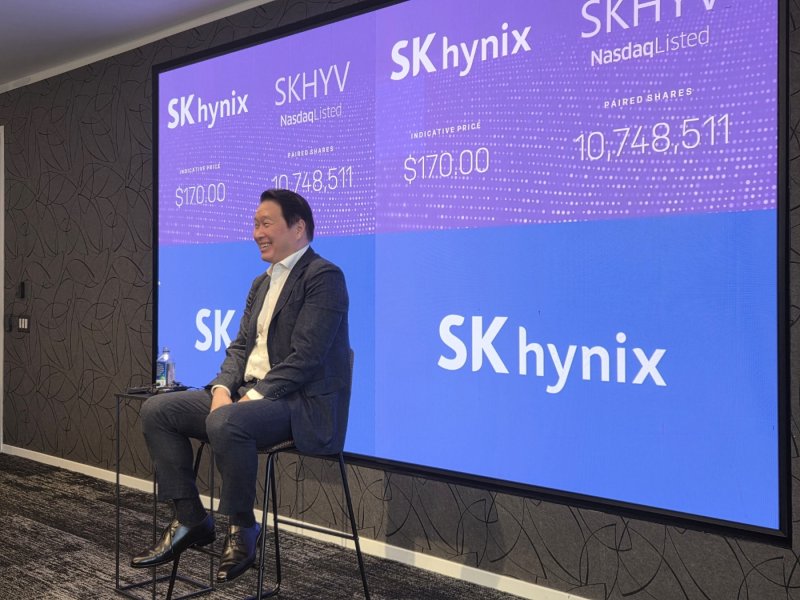
At a press briefing in New York on the 10th local time to mark SK hynix's Nasdaq listing, Chey said, "Structural change has already happened," and added, "It is now clear that the semiconductor industry no longer moves in the same cycle as before."
He explained that while the semiconductor industry used to rise and fall repeatedly depending on the balance between supply and demand, the market now works differently in the AI era. Demand for AI is growing much faster than production capacity, and even if companies try to expand chip factories, supply cannot be increased quickly because of constraints such as power, water and land.
Chey also said that as AI services spread and token usage surges, the size of KV cache, which stores data, is growing rapidly. "An increase in token usage ultimately means a larger KV cache that must be stored," he said. "With the arrival of the AI era, demand for memory storage itself is structurally increasing."
He repeatedly stressed that AI is still only at an early stage of growth. "Today's AI is like a 4- or 5-year-old child," he said. "It is still hard to call it a fully developed AI." He added, "Until AGI is reached, an enormous amount of learning will continue and new applications will keep emerging. Just as a child has more to remember as it grows, AI will also need to store more and more data, which means memory demand will inevitably keep rising."
"High Bandwidth Memory, DRAM, next-generation storage technologies and compression technologies will continue to advance," Chey said. "But no matter what technological innovation emerges, it will be difficult to stop the overall trend of rising memory capacity that must be stored." He forecast that demand for memory is likely to keep expanding for quite some time until the AGI era arrives.
He said memory supply was also the main topic in meetings with major customers in Silicon Valley. "What customers ask most often is how much more memory we can supply," he said. "They are asking for supply plans not only for this year's volume, but also based on the assumption that AI demand will surge in the years ahead." He added, "In the AI era, decisions and investments need to be made 10 times faster than before."
To respond to that demand, he left open the possibility of investment in the United States. "If the conditions are in place, such as power, water and land, it is natural to consider investment in the U.S. or any other country," Chey said. "This is not a zero-sum game in which production in Korea is reduced. It is a strategy to expand global supply capacity." He added, "This is not about moving production bases from one country to another. It is a time when the world's semiconductor supply capacity itself must be expanded."
On the stock price after the Nasdaq listing, he said the top priority is to raise corporate value. "The goal is not to artificially push up the stock price, but to run the business well and increase corporate value," he said. "It is management's role to turn growth potential into actual results so that the IPO price of $149 can be maintained."
On the possibility of a stock split for SK hynix, he said, "It could be considered if investor demand grows and the company conducts an internal review," but added that "it has not been specifically reviewed so far."
[email protected] Reporter Lee Byung-chul Reporter