Retail investors absorbed 11 trillion won in foreign selling as deposits plunge by 14 trillion won
- Input
- 2026-07-10 15:48:17
- Updated
- 2026-07-10 15:48:17
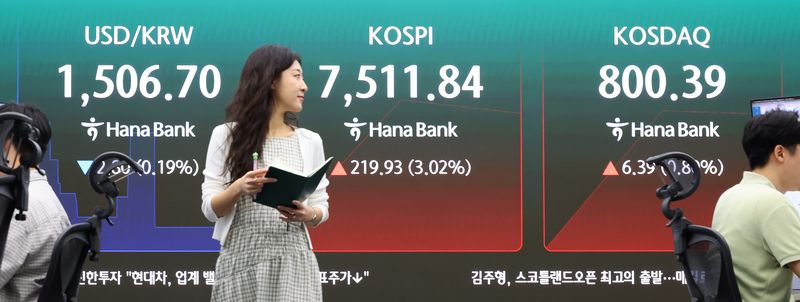
According to the Korea Financial Investment Association on the 10th, investor deposits stood at 107.1278 trillion won as of the 9th. That is down 32.5668 trillion won from the all-time high of 139.6947 trillion won recorded on the 4th of last month, a little over a month earlier. Compared with the end of last month, the figure has also fallen by 14.506 trillion won since the start of this month.
Over the same period, individual investors made large net purchases in the domestic stock market. From the 1st to the 9th, individuals bought a net 10.0043 trillion won in domestic stocks. Foreign investors, by contrast, sold a net 11.3311 trillion won during the same period. As foreign selling intensified, retail investors appear to have viewed the plunge as a buying opportunity, which coincided with the decline in investor deposits, the cash-like standby funds.
The sharp drop in deposits has also raised concerns in some parts of the market that retail investors' future investment capacity could weaken. The average daily trading value in the domestic stock market from the 1st to the 9th of this month was 48.4595 trillion won, down 19.7% from 60.3607 trillion won last month. Although individuals stepped in with large net buying during the selloff, the simultaneous decline in standby funds and trading volume suggests that buying momentum could fade.
Margin loan balances also remain at a high level. Margin loans totaled 37.3393 trillion won on the 1st and fell only 1.9% to 36.6336 trillion won on the 9th. Unlike investor deposits, which plunged 11.9% over the same period, funds borrowed to buy stocks are still stuck in the 36 trillion won range.
Still, some analysts say it is too early to conclude that the recent correction marks the start of a full downtrend. They argue that the recent plunge was driven less by deteriorating corporate earnings than by a supply-demand shock caused by concentration in semiconductors and the unwinding of leveraged positions.
Lee Kyung-min, a researcher at Daishin Securities, said, "Despite the sharp fall in KOSPI, forward earnings per share (EPS) continue to rise, and medium- to long-term earnings forecasts for Samsung Electronics and SK hynix are also being revised upward." He added, "KOSPI is in a historically undervalued range, so we see it as an index that could reverse sharply even on a small positive catalyst." He also advised a cautious approach, noting that leverage has not been reduced enough despite the price decline. Noh Dong-gil, a researcher at Shinhan Investment Corp., said, "As of the 6th, margin balances for Samsung Electronics and SK hynix had increased 13% and 19%, respectively, from the 22nd of last month, so leverage has not decreased despite the price drop." He added, "It is necessary to take a phased approach, reducing leverage while maintaining core cash holdings and accepting the possibility of retesting the lows."
[email protected] Bae Han-geul Reporter