Na Hong-jin's film 'Hope': Even if you didn't know what it was, it stood out as an evolution of Korean genre cinema despite mixed reactions
- Input
- 2026-07-11 00:35:03
- Updated
- 2026-07-11 00:35:03
[Financial News] Na Hong-jin's film 'Hope,' the only Korean movie to compete at this year's Cannes Film Festival, has drawn similarly divided reactions in Korea.
Some praised it as "an absolute blast, with the thrill of genre filmmaking firing on all cylinders" and called it "100% fresh." Others said it was "not a film where the abyss feels deeper, but one that has simply become more expansive in motion, leaving Na Hong-jin as expected and the Na Hong-jin that arrived on screen feeling different," while some described it as "an unsettling blockbuster for entertainment" with "a baffling ending that feels unfinished."
There is also room for disagreement among domestic audiences over the quality of the alien CGI, which was also criticized at Cannes. Still, the film is significant for raising the scale and polish of Korean genre cinema through its fluid visuals, fresh action sequences, and meticulously crafted sound design.
Set for release on the 15th, 'Hope' shares a premise similar to Na's earlier film 'The Wailing' (2016), in that a mysterious being brings terror to a village. But unlike 'The Wailing,' which unfolded through eerie energy and endless mystery, 'Hope' aims for more direct genre pleasure through the form of a sci-fi action thriller.
Religious motifs remain central. Na said, "The Holy Bible is the text that has influenced me the most," adding, "There are parts where I find myself more convinced by His word than by human words. When I think about what kind of story to tell, I always end up going in that direction."
Meanwhile, 'Hope' will open in North America on Sept. 9. It was pre-sold to more than 200 countries and regions worldwide at the highest price ever for a Korean film.
The coexistence of familiarity and strangeness
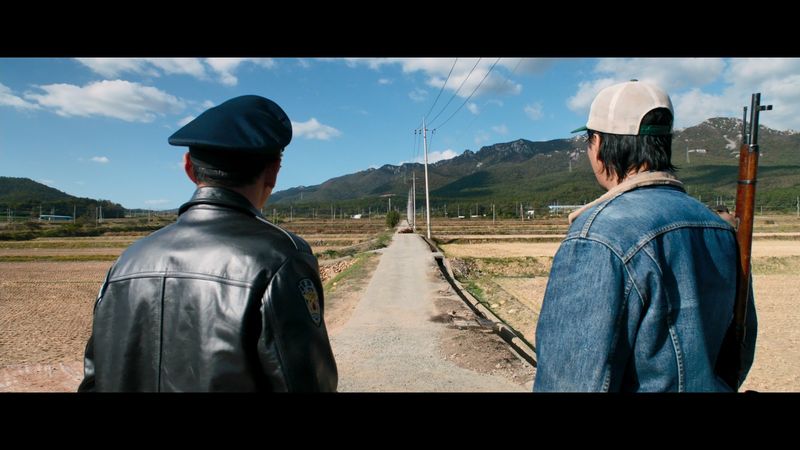
The film is set in a mountain village in Korea in the 1970s and 1980s. It follows the villagers and their leader Seong-gi (Zo In-sung), along with Beom-seok (Hwang Jung-min), the head of a local branch office and Seong-gi's sixth cousin, as they track down a mysterious being after discovering a mutilated cow near Hope Harbor, close to the Demilitarized Zone. Beom-seok fights to protect a village inhabited only by the elderly with help from his junior officer, policewoman Seong-ae (Jung Ho-yeon), while Seong-gi's group, which heads into the mountains to hunt the creature, ends up becoming its prey. In Hollywood terms, it is as if an alien life form, like an Avatar turned villain or a Predator sent to hunt humans, tears through a rural village.
The film reveals its own identity through the clash between humans and aliens, and through the coexistence of familiarity and strangeness. The landscapes of a Korean countryside village feel familiar, yet somehow foreign. Beom-seok and Seong-ae have a subtly stylish look, but their behavior and speech are rough and plain.
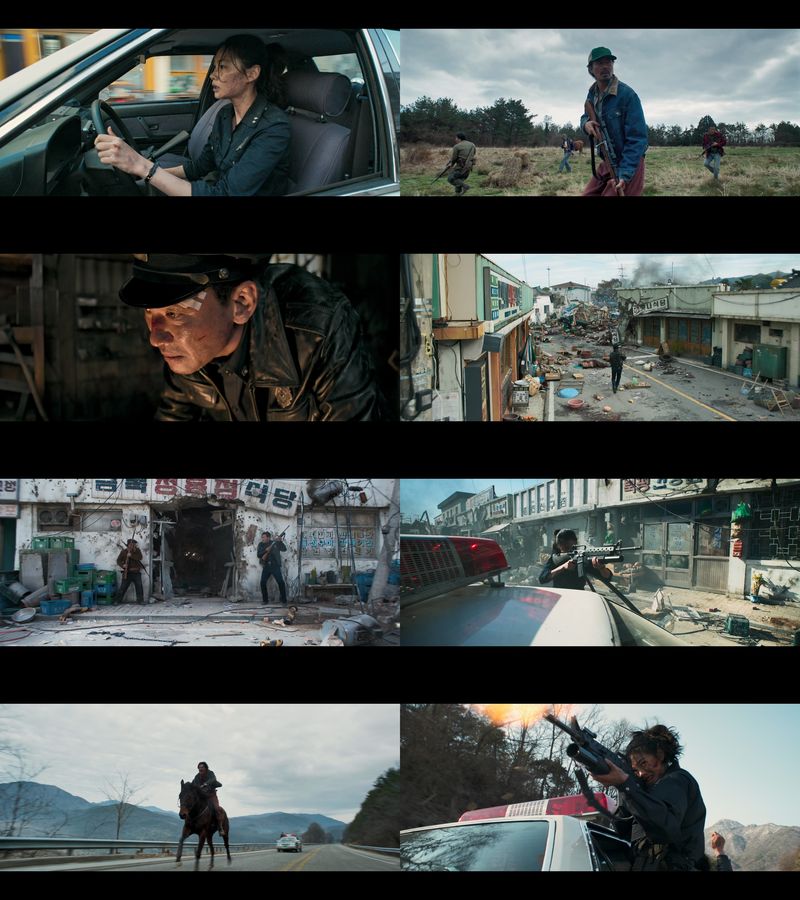
Neither of them fits the mold of a typical hero. Beom-seok fears the disaster in front of him, yet keeps moving forward. At times, he stumbles in panic and unexpectedly brings laughter. Seong-ae is a polite junior officer who keeps using honorifics even in the middle of chaos, but she also has the spirit of a warrior, fearlessly handling rough and daring action such as car chases, drifting, and grenade launchers.
Zo In-sung's transformation, complete with a mustache, is also striking. In the horse-chase scene filmed in an actual forest in Romania, and in the late highway car chase where he hangs from a car window, he fully displays the action skills that have long been one of his strengths.
Cannes as a spoiler
The film's invitation to Cannes was both a blessing and a burden. Because it was unveiled through a world premiere, and because the trailer revealed the alien's existence, audiences learned in advance the identity of the mysterious being that attacks the village. As a result, the tension in the first half, where Beom-seok searches the village with a hunting rifle, is somewhat reduced. Even so, knowing the secret does not diminish the humor that erupts in unexpected moments or the curiosity about what comes next. Still, the spoiler effect makes the first half feel somewhat long.
According to Na Hong-jin, the invitation to the Cannes Film Festival competition section came before the film was completed. In a roundtable interview at a cafe in Samcheong-dong on the 7th, he recalled, "We were racing toward a July release, but we decided to put that aside and send it to Cannes first." He added, "The post-production was not finished, but being invited to the Cannes competition section was a great honor."
Even after the press screening, the team has continued refining the sound and CGI to improve the film's overall quality. Na said, "It is disappointing that the identity of the unknown being has been revealed through articles and promotion."
Cinematographer Hong Kyung-pyo, who worked with Na Hong-jin again after 'The Wailing,' used wide-angle lenses to bring the camera closer to the characters and created Hope's distinctive visual style through camera movements that maximize cinematic excitement. In particular, the film has no night scenes at all, so he made the most of natural light to capture subtle changes in brightness.
Music is also a key element in heightening the thrill of the action. Michael Abels, who composed the scores for 'Get Out,' 'Us,' and 'Nope,' took part in the project. The sweeping score, recorded by more than 70 musicians at the Synchron Stage in Vienna, Austria, adds richness to the atmosphere of 'Hope,' which moves across genre boundaries.
The Hope Harbor village set was built by remodeling part of Namchang-ri in Bukpyeong-myeon, Haenam County, South Jeolla Province, where actual residents live. The forest entrance was filmed in Sumang-ri, Jeju, while the highlight action sequence, in which Beom-seok, Seong-ae, Seong-gi, and the alien Mabeiyo engage in a chase, was shot around Seonggi Bridge in Hapcheon, South Gyeongsang Province. Coincidentally, that is the same name as the character Seong-gi played by Zo In-sung.
"All tragedy begins with perspective"
Na explained his directorial intent by saying, "All tragedy begins with perspective." The meaning can be read as tragedy starting when one fails to understand another person's point of view. In the film, a village youth named Yang-dae, who unknowingly becomes the source of tragedy because of his unusual tastes, appears. Just as humans bear original sin after eating the fruit of knowledge, his actions, born of ignorance and fear, drive the entire community into tragedy.
After the first half, in which Beom-seok confronts the mysterious being, the film moves into a battle between Seong-gi's group and another alien in a dense conifer forest, followed by action scenes in which the three main characters race side by side on cars and horseback along a highway while resisting the alien's pursuit. Between Beom-seok and the alien, and between Seong-gi and the alien, the secret behind the small but consequential act unintentionally committed by the village youth Yang-dae is revealed.
The domestic release version runs about four to five minutes shorter than the Cannes screening version, but scenes featuring Yang-dae have actually increased. That can be read as a sign of how symbolic this character is. At the same time, the space where Yang-dae lives evokes memories of a crime case that once dominated the news and creates a sense of unease. Yet the character himself is portrayed as someone without malicious intent.
Na said, "At first, the audience follows Beom-seok's perspective without any information, and only later comes to understand the situation," adding that this was "a way of planting a sense of guilt in the audience." He continued, "I was curious to see how viewers would look at the same or similar situations while holding different positions." About the village youth Yang-dae, he said, "He is the one who caused all the trouble," and added, "Wrongdoing does not necessarily require malicious intent to exist."
Na described the new film not simply as a sci-fi movie, but as a work that explores "how tragedy begins and how it expands." He said, "What mattered was how people view and feel about a phenomenon." He explained, "In 'The Wailing,' I used supernatural elements such as local gods and wandering spirits. This time, I thought about what a deeper perspective might be, and that led me to think of the universe. I chose aliens as the beings to express it."
"I wanted the design to make people think, 'What is this? What on earth is it?' My goal was for it not to look obviously like an alien at first glance," he added.
From a directing standpoint, the goal was to raise the density of Korean genre cinema to a new level. He said, "I wanted to realize the genre's density more faithfully as an action thriller." He added, "Following one man for the first 50 minutes of the film without showing the monster was an extremely difficult challenge. I wanted audiences to experience the excitement directly in theaters through sound and visuals."
jashin@fnnews.com Shin Jin-a Reporter