"Three Homes and Sleepless Nights": Could It Become a Nightmare? ... What Assets Look Like for a 50-Something Conglomerate Executive Kim [Real Estate A to Z]
- Input
- 2026-07-11 15:00:00
- Updated
- 2026-07-11 15:00:00
[Financial News] A research report analyzing homes owned by multi-home owners has drawn attention. It is the study titled "A Study on the Housing Ownership Characteristics of Multi-Home Owners," published by the Housing Industry Research Institute. The main finding is that the homes owned by multi-home owners are concentrated in regional areas and non-apartment housing.
The report was written based on an analysis of the government's housing ownership statistics. The statistics cover only homes owned by individuals, excluding corporate, foreign, and public ownership. The scope includes detached houses, multi-family homes, row houses, apartments, and homes inside non-residential buildings. Even partial ownership is counted as one ownership case.
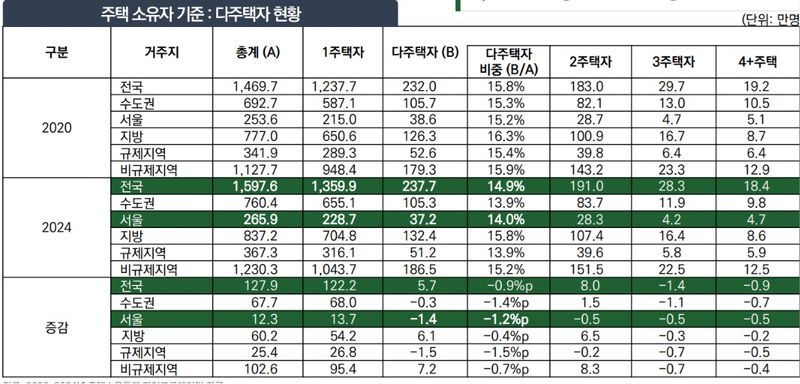
The number of multi-home owners is falling... 14.9% nationwide, 14.0% in Seoul
The report shows that the share of multi-home owners is on a downward trend. Nationwide, the proportion fell from 15.8% in 2020 to 14.9% in 2024. In Seoul, it declined from 15.2% to 14.0% over the same period. As of 2024, 2.37 million of the 15.97 million people were multi-home owners.
So what does the housing ownership profile of these multi-home owners look like?
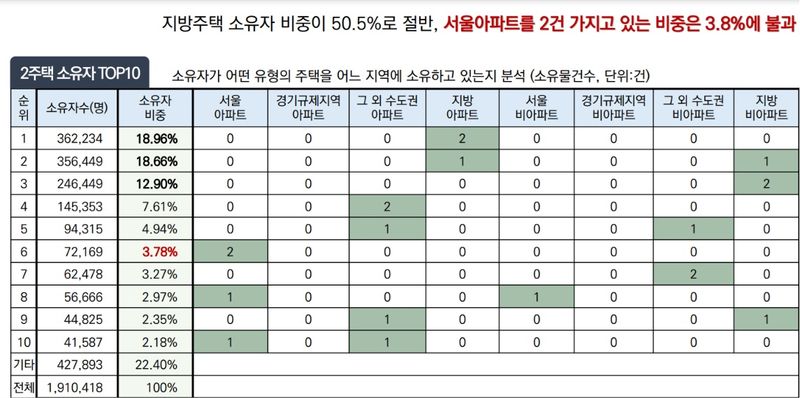
First, looking at two-home owners, 18.96% owned two regional apartments. Another 18.66% owned one regional apartment and one regional non-apartment home. Those owning two regional non-apartment homes accounted for 12.90%.
In other words, the share of two-home owners with regional homes exceeded half at 50.5%. By contrast, those owning two Seoul apartments accounted for just 3.78%. The share for those owning one Seoul apartment and one Seoul non-apartment home was 2.97%.
"Careful policy design that reflects these characteristics is needed"
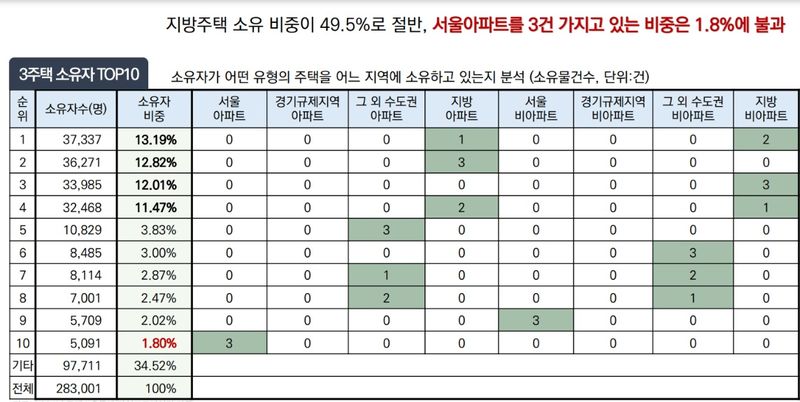
The housing ownership pattern for three-home owners is similar to that of two-home owners. The share of regional homes is 49.5%, close to half.
In detail, the largest share, at 13.19%, was for those owning one regional apartment and two regional non-apartment homes. The share of those owning three apartments in Seoul was 1.8%. For owners of four or more homes, the high shares were also mainly in regional homes or non-apartment homes in Seoul.
The report also separately analyzed homes owned by multi-home owners. As of 2024, multi-home owners held 5.05 million of the 17.05 million households. The share stood at 29.6%, down from 31.2% in 2020. Seoul also saw a slight decline. As the number of multi-home owners fell, the homes they owned also decreased, the report said.
Now, let's look at the ownership status of homes in Seoul by number of properties, which has drawn attention.
Among the 850,000 homes in Seoul owned by multi-home owners, 460,000, or 54.8%, were non-apartments. Of the 300,000 homes owned by owners with four or more properties, 240,000, or 80.2%, were non-apartments. Looking at the share of Seoul homes owned by multi-home owners, the proportion of non-apartments is fairly high.
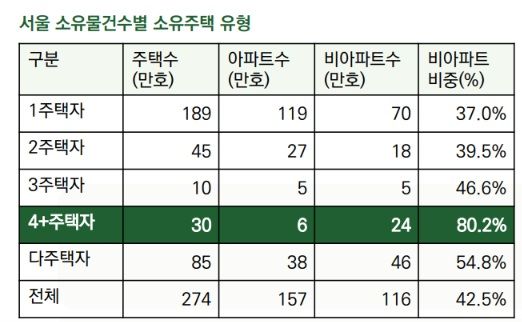
The analysis found that among two- to three-home owners, the share of owners who held only apartments in Seoul was around 1% to 3%. Roughly 50% were found to own only regional apartments or regional non-apartment homes.
Looking only at homes in Seoul, one- to two-home owners had a high share of apartment ownership. But among those with four or more homes, the share of non-apartment ownership was also high, along with ownership of small, low-priced homes with officially assessed values of around 100 million to 200 million won, the report said.
Kim Deok-rye, head of the Housing Industry Research Institute, emphasized, "The homes owned by multi-home owners are more often regional homes or non-apartments than Seoul apartments," adding, "Policy design that takes this into account is necessary."
[email protected] Lee Jong-bae Reporter