"It Felt Like Combining Our Salaries Would Solve Everything"... The Dilemma Facing an Engaged Couple Taking Home 6.4 Million Won [Money Planning Office]
- Input
- 2026-07-11 15:00:00
- Updated
- 2026-07-11 15:00:00

Couples preparing for marriage need a shared goal. Combining two bank accounts does not, by itself, complete a couple’s money management. Unless they agree on when, where, and how much to spend, they may be looking at the same assets while imagining very different futures.
Net assets of 90 million won, but the wedding fund is still a question mark
A 33-year-old man identified as Lee Jun-hyuk and a 31-year-old woman identified as Park So-yeon, both living in Suwon, are set to marry at the end of this year. Their combined monthly take-home pay is about 6.4 million won, which is not far from enough to start a household.The problem is that they have managed money in very different ways. Jun-hyuk has invested in U.S. exchange-traded funds, individual stocks, and crypto. So-yeon has steadily saved through time deposits and installment savings products.
Their concern is one that many engaged couples ask before marriage."Should we combine all of our salaries after marriage, or would it be better to manage them separately?"The couple’s net assets so far total 90 million won. Jo Hyung-geun, the financial planner advising them, asked how much of that was set aside for wedding expenses, how much would go toward the deposit for their newlywed home, how much should remain as emergency savings and childbirth funds, and how much should be allocated to long-term investments.
Neither of them could answer right away. They had several accounts, but no clear purpose for the money. They had deposits, installment savings, stocks, and a subscription savings account, but the role of each fund had not been clearly defined.
As a result, the two were operating on completely different timelines even though they were dealing with the same pool of money. Jun-hyuk was focused on growing assets over 10 years or more through investments. So-yeon, by contrast, was worried about wedding costs due at the end of this year and the money needed for childbirth two to three years later. One was looking 10 years ahead, while the other was focused on the next few months.
Jo said, "Engaged couples often start by thinking about combining salaries or bank accounts, but first they need to check whether they are managing assets based on the same goals and timeline." He added, "Without a shared standard, you cannot help but feel uneasy even if you have assets."
Money also needs a label
Jo advised them to put a label on every won. The way money is managed should depend on its purpose. Funds that must be used soon, such as wedding savings or childbirth money, should be protected from loss, while only surplus money that will not be needed for a long time should be used for long-term investing.He stressed that choosing financial products comes later. Once the goal and time frame are set, you can decide whether to place the money in deposits, installment savings, subscription savings, retirement savings, or ETFs.
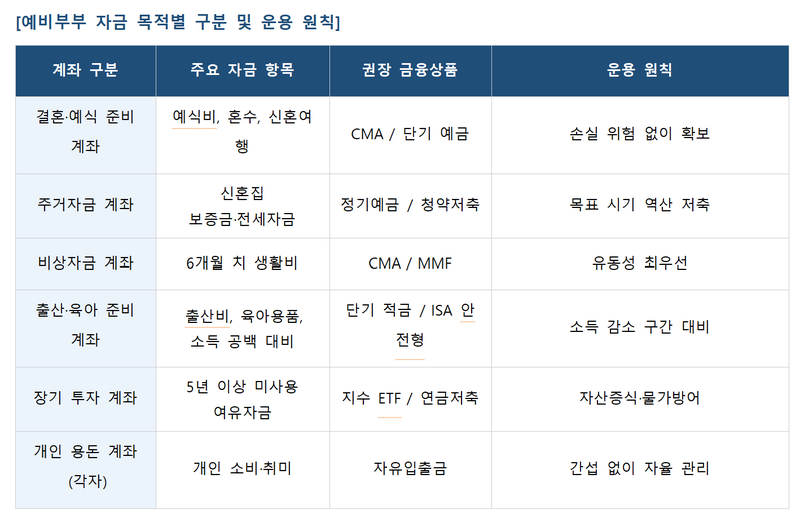
If childbirth funds are left in the stock market, family plans become hostage to market conditions. That is why most of the assets should not be used as investment money. Funds that will definitely be needed in the near future must be separated from long-term investment money from the start.
Once marriage begins, a household budget suddenly fills with items that were not visible during dating. Before the wedding, engaged couples should review their fixed monthly expenses after marriage. Once two people run one household, shared spending includes not only rent or loan interest for the newlywed home, maintenance fees, food, transportation, mobile bills, and insurance premiums, but also allowances for parents and money for weddings and funerals.
A plan to save whatever is left usually ends with the conclusion that there is nothing left. Saving only after buying what you need does not prepare you for a newlywed home, childbirth, or retirement. You need a structure that first divides monthly income into shared living expenses, shared savings, long-term investment money, and personal spending money.
Once they divided the purpose of the money, the vague 90 million won finally had a place. After the consultation, Jun-hyuk and So-yeon separated their wedding fund into a dedicated account and set aside the money for the newlywed home deposit in another account. They earmarked at least six months of living expenses as emergency savings and opened a separate account for childbirth and childcare, taking future plans into account. After organizing everything this way, they classified only the money they would not need for the long term as investment funds.
If you put off money talks, conflict grows like interest
Money conversations before marriage are uncomfortable because they reveal each person’s habits so clearly. Differences in income, spending habits, and investment preferences inevitably come to the surface.A conversation delayed because of emotional discomfort comes back later at a much higher cost. Once housing costs, living expenses, and childbirth expenses actually begin, it becomes even harder to adjust to each other’s approach.
Talking about assets before marriage is not a settlement over who earned more. It is a process of deciding what kind of life the two people want to build and how to arrange money in the right order to support that life.
What engaged couples need is not a complicated investing trick, but financial rules they can follow together. It starts with separating wedding funds, housing funds, emergency savings, childbirth funds, and long-term investment money, then assigning a portion of each salary to shared goals first.
Jo said, "The first step is to align goals, not money." He added, "Otherwise, even if you combine your bank accounts into one, the conflict will remain."
Earning, spending, and saving money are lifelong tasks, but financial planning is always pushed to the back burner. Yet money has its own age and does not wait. If you do not choose at each stage, it gets neglected. If you do not set a direction, it slips away. That is why we need to design the flow of money across our entire lives.[Money Planning Office]supports life planning together with the Korea Financial Planning Association (IFPK), the AFPK certification body.
[email protected] Lee Hyun-jung Kim Tae-il Reporter