"Why Is My Account the Only One in the Red?" What Is 'Overtrading'?[In Chi-beom's Stock Investing Boot Camp]
- Input
- 2026-07-11 09:00:00
- Updated
- 2026-07-11 09:00:00
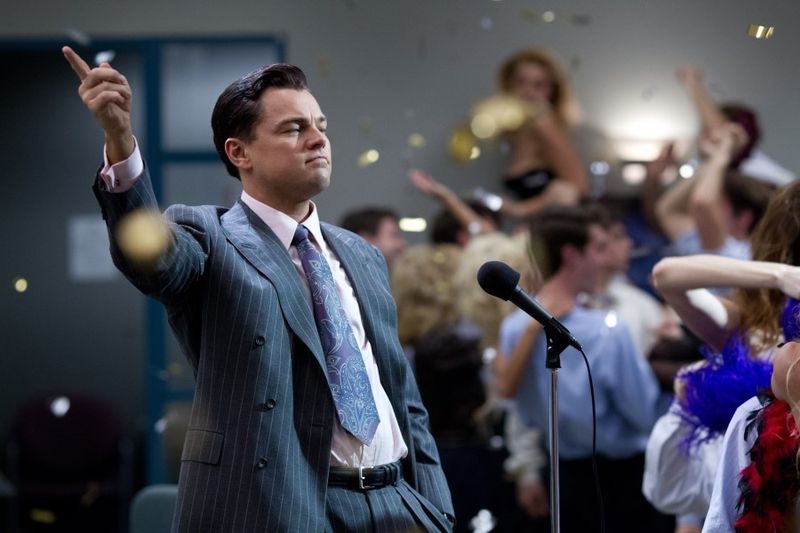
" That is what Mark Hanna, a securities firm executive played by Matthew McConaughey, tells rookie employee Jordan Belfort, played by Leonardo DiCaprio, in The Wolf of Wall Street. Unfortunately, that is also true in real life.Most people do not know whether a stock will rise or fall today. Knowing that, why do we still end up trading stocks so often? Today, let’s look at the issue of frequent trading that investors in their 20s should think about.Gamification of stock apps: You keep doing things without even realizing it Some mobile securities apps popular among younger users are easy, convenient, and fun to use. They are very different from traditional stock apps packed with menus.Thanks to simple and intuitive UI/UX, even beginners can trade without much difficulty. More than half of users of these financial apps are in their 20s and 30s, according to Economic News 2025.
Why is that? Gamification. This so-called game-like design combines game mechanisms and rules with non-game services to encourage user participation and immersion.
Still from the film The Wolf of Wall Street.
A common example of Gamification is PBL: points, badges, and leaderboards. These are among the most powerful, widely used, and easiest-to-implement ideas across industries.
P, or points, are numerical rewards given immediately for actions such as attendance checks or mission completion. These may include one share of stock, KRW 20,000 in cash, or an OTT subscription pass.B, or badges, are visual awards given when a specific goal is achieved. They stimulate a sense of accomplishment.L, or leaderboards, show your score compared with others. They appeal to competitiveness and the desire for recognition.Now imagine investors in their 20s who are trying to start investing in stocks. They open a conventional stock app recommended by parents, friends, or acquaintances, and quickly feel overwhelmed.
First, it is hard to understand the meaning of each of the more than 15 order types shown in the order window. On top of that, the explanations are insufficient.
Still from the film The Wolf of Wall Street.
Users check in on the app every day to earn rewards and complete missions to collect badges. Before long, they are also part of a community and receive information about stocks they are interested in.
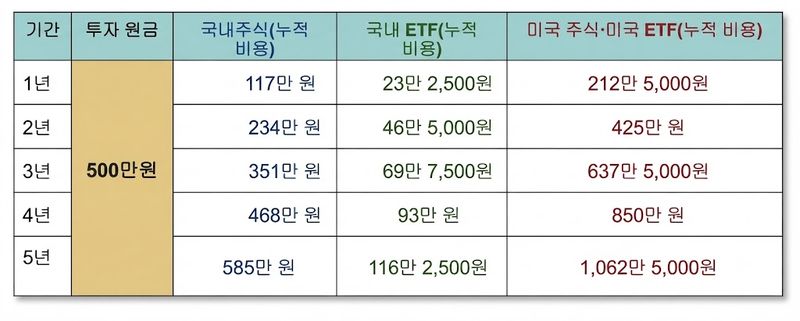
Becoming familiar with investing through quests, just like in a game, is a positive outcome. But there are concerns as well.People who keep checking stock screens so often can become trapped by the compulsion that they must always be doing something. That is because gamified UI/UX can further stimulate human nature.Add FOMO, or fear of missing out, and the anxiety that only I might miss an opportunity intensifies the feeling. In behavioral economics, this is called Action Bias.It is the tendency to believe that doing something, even if it is not the best move, is more productive than doing nothing. If you check in every day and wander through the app like a game, won’t you end up pressing the trade button more often without realizing it? Example of cumulative costs.Image generated by Gemini Money leaking out every time you press the trade button 1: transaction costs (fees + related institution charges + taxes) Many investors think, "What’s the big deal about trading a little more often? Fees and taxes are tiny. Let’s ignore them.Still from the film The Wolf of Wall Street.
" But even if you trade only once every two days, after five years the transaction costs you thought would be "small change piled on small change" become "small change piled on losses. " I ran the numbers.
Assuming an initial investment of KRW 5 million in the first year and trading once every two days, meaning buying and then selling the full amount each time, the costs are far from trivial. 95% of principal per month, or KRW 97,500.
4% of the original KRW 5 million, disappears from the account. In particular, after just five years, cumulative costs exceed the initial investment of KRW 5 million in the case of domestic stocks, U.
S. stocks, and U.
S. ETFs, excluding domestic ETFs.
As trading becomes more frequent, "dust-like crumbs" can accumulate into a "mountain-like burden. 0372% (no Securities Transaction Tax)S. stocks and U.
S. 10% currency exchange spread), excluding SEC Fee.
34%. " Example of slippage.
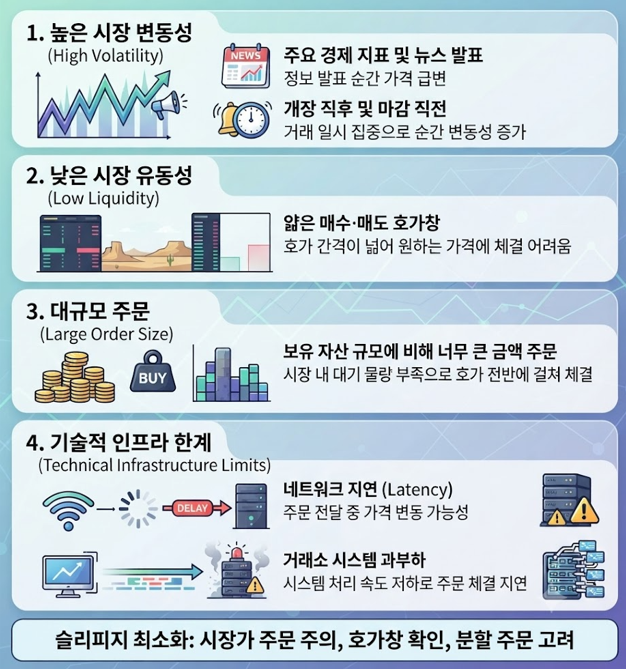
Image generated by Gemini Money leaking out every time you press the button 2: Slippage, here negative slippage There is also an invisible thief called slippage. Slippage refers to the difference between the price expected when an order is placed and the actual execution price.
In other words, the order slipped from the hoped-for buy or sell price and was executed elsewhere. Negative slippage is the problem.
It means the order was executed at an unfavorable price. You bought the stock at a higher price than intended, or sold it at a lower price.
That creates an invisible loss. Global financial education platforms often point to high volatility, low liquidity, and large order size as major causes of slippage.
In particular, if the habit of placing market orders out of impatience to trade quickly keeps piling up, losses can exceed the fees and taxes mentioned above. Whenever possible, it is better to place limit orders.
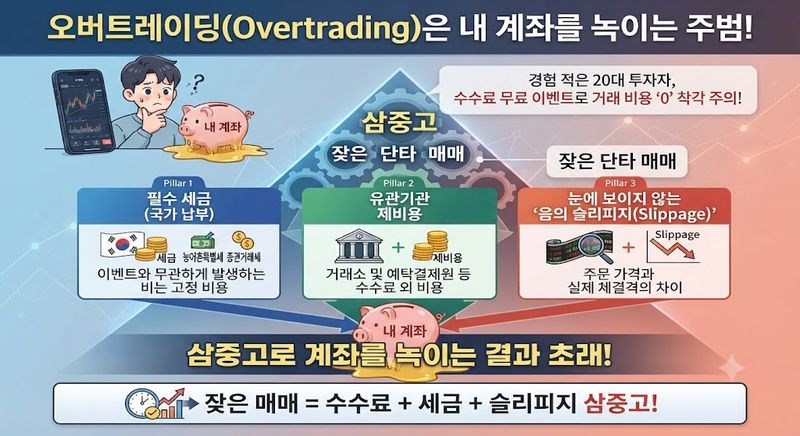
Why you should be wary of overtrading. Image generated by Gemini Overtrading is the main culprit that drains your account! Less experienced investors in their 20s may be confused by brokerage promotions that waive fees and mistakenly think trading costs nothing at all.
Still from the film The Wolf of Wall Street.Assuming an initial investment of KRW 5 million in the first year and trading once every two days, meaning buying and then selling the full amount each time, the costs are far from trivial. 95% of principal per month, or KRW 97,500.
4% of the original KRW 5 million, disappears from the account. In particular, after just five years, cumulative costs exceed the initial investment of KRW 5 million in the case of domestic stocks, U.
S. stocks, and U.
S. ETFs, excluding domestic ETFs.
As trading becomes more frequent, "dust-like crumbs" can accumulate into a "mountain-like burden. 0372% (no Securities Transaction Tax)
S. 10% currency exchange spread), excluding SEC Fee.
34%. " Example of slippage.
Image generated by Gemini Money leaking out every time you press the button 2: Slippage, here negative slippage There is also an invisible thief called slippage. Slippage refers to the difference between the price expected when an order is placed and the actual execution price.
In other words, the order slipped from the hoped-for buy or sell price and was executed elsewhere. Negative slippage is the problem.
It means the order was executed at an unfavorable price. You bought the stock at a higher price than intended, or sold it at a lower price.
That creates an invisible loss. Global financial education platforms often point to high volatility, low liquidity, and large order size as major causes of slippage.
In particular, if the habit of placing market orders out of impatience to trade quickly keeps piling up, losses can exceed the fees and taxes mentioned above. Whenever possible, it is better to place limit orders.
Why you should be wary of overtrading. Image generated by Gemini Overtrading is the main culprit that drains your account! Less experienced investors in their 20s may be confused by brokerage promotions that waive fees and mistakenly think trading costs nothing at all.
You should remember that frequent short-term trading drains accounts through the triple burden of fees, taxes, and slippage.
In the end, Overtrading wears down your account before it grows your profits.In fact, behavioral finance studies have repeatedly found that the higher the trading frequency, the lower the average return for individual investors tends to be.
Still from the film The Wolf of Wall Street.
A good investor is not someone who trades every day, but someone who trades only when there is a real reason to do so.
[About the author] Senior Managing Director In Chi-beom worked for 30 years in corporate communications, consistently serving as the person in charge of PR, IR, ESG, and CSR in finance (Samsung Life Insurance), IT (AhnLab, Inc., Hancom, SK Communications), and retail (Samsung Tesco).
He is currently focusing on writing books about investing and corporate communications at KPI Investment Advisory.
He believes that successful stock investing begins above all with the process of automating the right habits for handling money.
Still from the film The Wolf of Wall Street.

[email protected] Kim Seong-hwan Reporter