President Lee says Korea and Mongolia reach principle agreement on CEPA, aim for $100 billion in trade by 2030
- Input
- 2026-07-09 19:42:44
- Updated
- 2026-07-09 19:42:44
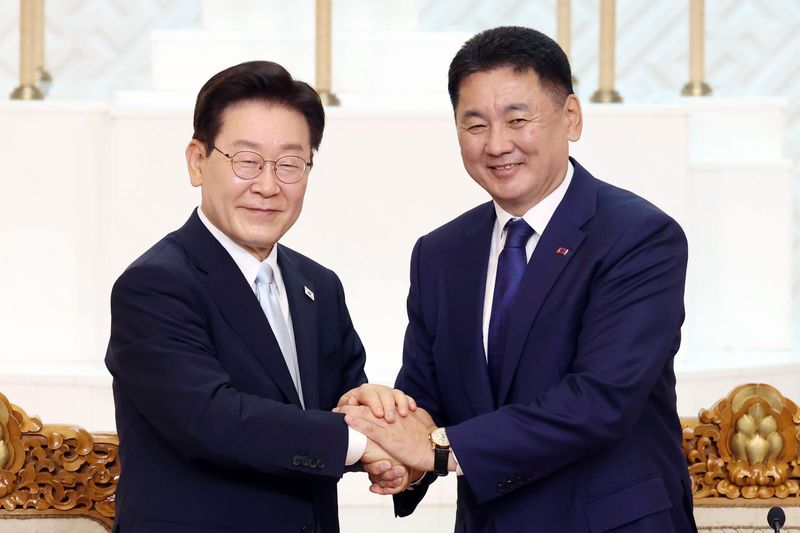
At a joint press statement after the summit, Lee said the two countries had further solidified political and diplomatic trust and agreed to deepen their strategic partnership. A South Korean president's state visit to Mongolia comes for the first time in 15 years since 2011.
Lee emphasized that the biggest outcome of the summit was that the two leaders confirmed a shared vision of opening a "golden era" in Korea-Mongolia relations and adopted a joint declaration outlining the direction of future ties. He said the declaration would serve as an important milestone for turning the next decades into a golden era for bilateral relations, built on more than 30 years of friendship and trust.
The CEPA, which Lee said had reached a principle agreement, is a trade pact that, like a Free Trade Agreement (FTA), includes market opening measures such as tariff elimination, while also aiming for broader economic cooperation in areas such as technology collaboration, people-to-people exchanges, and investment promotion. South Korea and Mongolia have been in talks on the agreement since 2023.
Lee said the two countries would expand cooperation in economy, trade, and investment, while strengthening ties in supply chains and critical minerals. In an earlier interview with Mongolia's state news agency Montsame, he described critical minerals as a strategic asset that supports industry, technology, and national security, adding that Mongolia and South Korea could become important partners in supply chain cooperation.
He also stressed that the two sides would broaden mutually beneficial and sustainable cooperation in areas including Artificial Intelligence (AI) and digital transformation, advanced science and technology, logistics and infrastructure, agriculture and livestock, health care, and development cooperation.
The joint declaration also included plans to expand people-to-people exchanges. In his interview with Montsame, Lee had said he would propose reaching 500,000 exchanges between the two countries by 2030, the 40th anniversary of diplomatic ties.
The two governments also exchanged a total of 21 agreements and memorandums of understanding, covering the dispatch and recruitment of workers under the employment permit system, distribution and logistics cooperation, and the construction of Mongolia's Second National Cancer Center, among others.
Lee also won support from the Mongolian side on peace on the Korean Peninsula. He told President Khurelsukh, "I would like to once again express my gratitude to the president for saying that you will always support our government's efforts to establish peace on the Korean Peninsula."
[email protected] Seong Seok-woo Choi Jong-geun Reporter