Discussion on Ways to Offset Wages Cut by AI, with Basic Income Also Raised [Industrial Transition Employment Stability Plan]
- Input
- 2026-07-09 18:28:14
- Updated
- 2026-07-09 18:28:14
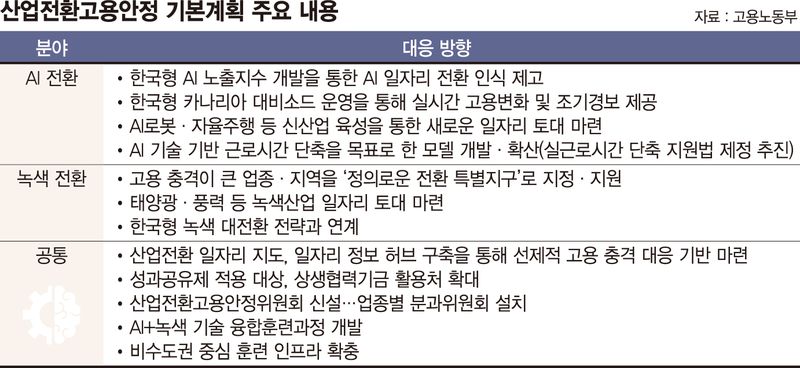
On the 9th, the Ministry of Employment and Labor (MOEL) said, "It is difficult to present a short-term solution for wage compensation for workers affected by industrial transition, but we will begin social dialogue to find a solution for sustainable growth in our society."
The government said the main topics for social dialogue include wage compensation for workers in transition, reinvestment of transition gains, and measures to ensure broader income security in the era of Artificial Intelligence (AI).
The government believes there is a need to socially compensate workers for wage losses during the transition period. It sees a need to cover temporary income gaps and wage declines for workers who must change jobs or relocate during industrial restructuring.
MOEL cited examples from Denmark and Germany. In Denmark, authorities are discussing an insurance-based system that would cover 30% to 50% of wage losses after a job change.
Germany supports the incomes of workers who cannot avoid early retirement or layoffs while carrying out carbon neutrality policies. The federal government provides employment adjustment subsidies to workers in the coal industry and thermal power companies who lose their jobs as a result of the coal phaseout policy, offsetting income losses. It also pays compensation if pensions are reduced because of early retirement. The German government estimates that up to 40,000 unemployed workers could emerge in the coal-fired power sector by 2038, the target year for the coal phaseout. A MOEL official said the wage compensation discussion is meant to open up all options, from whether compensation is needed at all to what form it should take, whether private or public, and how it should be implemented, so that society can find an answer together.
The government also plans to pursue social dialogue on how to share the gains from industrial transition with future generations and on ways to guarantee basic income in the era of AI and automation. MOEL added that the discussion should cover how to protect people's livelihoods regardless of labor participation, as well as consistency with existing social security systems, funding sources, and public acceptance.