[Editorial] Korea-Mongolia summit after 15 years should deepen resource development cooperation
- Input
- 2026-07-09 18:25:37
- Updated
- 2026-07-09 18:25:37
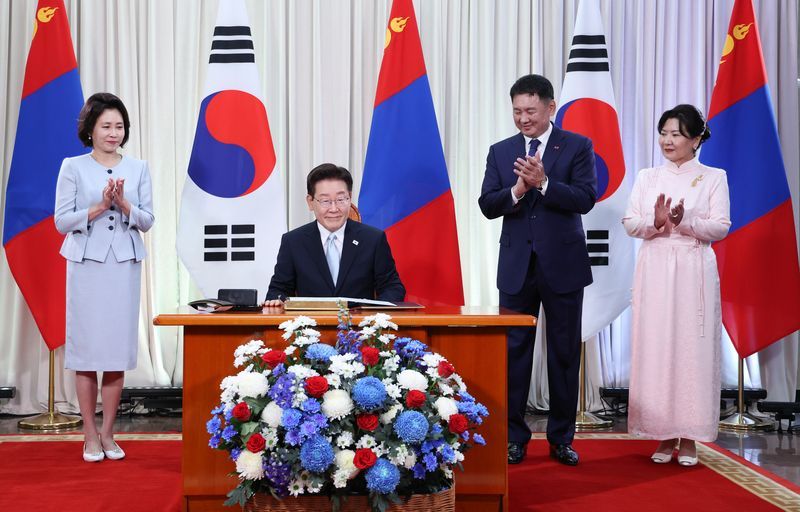
One point that stands out in this visit is that Mongolia is a major global resource-rich country. It is a land of opportunity, with more than 80 kinds of minerals, including copper, lithium and tungsten, and about 31 million tons of rare earth reserves, or roughly 16 percent of the world total. Rare earths are strategic resources essential for semiconductors and military equipment. Their strategic value is so high that China has used export controls as a bargaining chip in response to U.S. sanctions on Chinese goods.
Mongolia is believed to hold the world's second-largest rare earth reserves. Its copper deposits and molybdenum reserves, a next-generation semiconductor material, are also among the largest in the world. However, Mongolia lacks the beneficiation technology needed to process and separate ore, and as a result has struggled to develop mining into a high value-added industry. If Korean technology is combined with Mongolian resources, the two sides could create a true win-win outcome.
In a written interview with Mongolia's state news agency MonTSAME, Lee said, "Mongolia, with its rich mineral resources and growth potential, and Korea, with its mineral exploration and development technology and manufacturing innovation capabilities, can become important partners in supply chain cooperation." National Security Adviser Wi Sung-lac also said the visit would serve as an opportunity to strengthen cooperation on rare earth supply chains. Last December, the government opened the Korea-Mongolia Rare Metals Cooperation Center in Ulaanbaatar and has since been conducting joint research on adding value to rare metals.
The two countries will also hold broad discussions on food security, responses to yellow dust, and cooperation in health care and science and technology. The Korea-Mongolia Business Forum was also held with more than 300 business leaders from both countries, including POSCO Holdings Chairman Chang In-hwa and MCS Group Chairman Odjargal. Private-sector economic cooperation is also expected to expand across energy, distribution, consumer goods and digital industries.
From a security perspective, Mongolia is also a strategic hub linking Northeast Asia and Europe. Mongolia has maintained long-standing diplomatic ties with North Korea and was the North's second country to establish diplomatic relations after the former Soviet Union, making it an important partner for peace on the Korean Peninsula. The two leaders also discussed peace and stability on the peninsula, ways to ease regional tensions, confidence-building measures and feasible steps to resume dialogue with North Korea.
Since establishing diplomatic relations in 1990, South Korea and Mongolia have steadily maintained friendly ties. In recent years, the spread of K-culture has also boosted demand for Korean products such as food, beauty items and household goods. In Ulaanbaatar, Korean retail chains such as CU Convenience Store (CU), GS25 and E-Mart operate more than 800 stores, showing how deeply Korean culture has become part of everyday life. The term "Mongtan" has even emerged, combining Mongolia and Dongtan. Demand for learning Korean has also risen sharply, and the popularity of K-pop and dramas continues to grow. Cultural and emotional ties between the two countries are therefore quite deep.
Taking this visit as an opportunity, the two countries should expand the scope of economic cooperation by building a mutually beneficial supply chain model based on cultural and people-to-people exchanges, including mining resource development. At the same time, since Mongolia maintains diplomatic relations with North Korea, it should continue diplomatic and security cooperation so that it can discuss the situation on the Korean Peninsula together for peace in Northeast Asia and serve as a bridge for the resumption of dialogue with North Korea.