"Card Payments Unavailable": Bankruptcy of Japanese Payment Processor Leaves 200,000 Merchants in Panic
- Input
- 2026-07-09 16:10:47
- Updated
- 2026-07-09 16:10:47
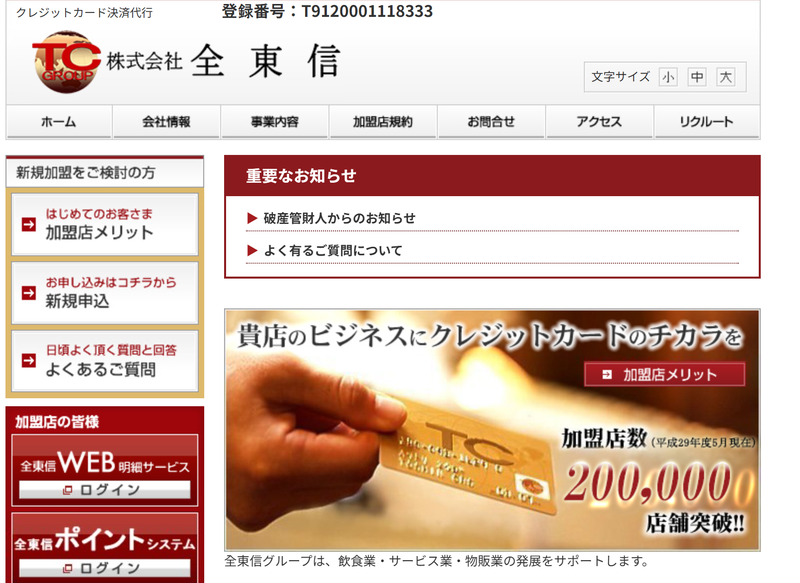
[Financial News, Tokyo = Reporter Seo Hye-jin]"Due to the bankruptcy of Zentoshin, credit card payment terminals are currently unavailable. Recovery is expected to take a considerable amount of time, so please use cash or QR code payments such as PayPay for the time being."That message was posted recently on social media by a restaurant in Yamaguchi Prefecture. Following the bankruptcy of Japanese card payment processor Zentoshin, card payment systems at restaurants across the country have been shutting down one after another. As card sales remain frozen, small business owners are reporting severe cash shortages, and the damage is spreading to the financial sector, including regional banks.
According to reports from The Asahi Shimbun, Yomiuri Shimbun, Nikkei, Inc., and Tokyo Shoko Research on the 9th, the fallout from the bankruptcy of credit card payment processor Zentoshin is rapidly spreading to restaurants nationwide and regional financial institutions.
As card sales proceeds remain unpaid, restaurants are suspending card payments or switching to cash and QR code payments. Concerns are growing over a chain of bankruptcies, especially among individual restaurant owners with weak finances, while regional banks and credit unions are also facing the risk of loan defaults.■ Payment network for 200,000 merchants has stalledFounded in 1987 as the Osaka Minami Food Business Cooperative Association, Zentoshin began nationwide operations in 1999. It grew by offering early settlement services, paying merchants before card companies did when consumers paid by credit card.
It focused on small restaurants and entertainment venues that had difficulty signing direct contracts with major card companies. By 2018, its merchant base had surpassed 200,000. At one point, it secured more than 2,000 new contracts a month, making it one of the best-known card payment processors in the food service industry.
However, on the 6th, Zentoshin was ordered by the Osaka District Court to begin bankruptcy proceedings. According to Teikoku Databank Ltd., its liabilities totaled 115.164 billion yen, or about 107.1 billion won, making it the largest corporate bankruptcy in Japan this year.
The bankruptcy trustee said card sales proceeds had not been paid to at least 20,000 merchants, with unpaid amounts reaching about 5.3 billion yen, or roughly 49.3 billion won.
Zentoshin's collapse hit the restaurant industry hard because it was more than a simple payment processor. For small restaurants, it functioned as a source of working capital. In general, card companies pay merchants twice a month, but Zentoshin advanced the funds before the card companies did, helping businesses turn cash over more quickly. That made it especially important for individual restaurant owners with tight cash flow.■ "My rent is gone": Panic spreads through restaurantsThe damage is already being felt. According to The Asahi Shimbun, Kazuhiro Sato, who runs a Chinese restaurant in Osaka's Kitashinchi district, has used Zentoshin since he opened his business 20 years ago. Because card sales were deposited six times a month, every five days, he was able to manage his finances steadily. But the card sales he has not yet received, including those from a nearby sister restaurant, amount to about 600,000 yen, or roughly 5.58 million won. He said, "I never thought this company would go under" and added that it felt "like falling into a trap."
A woman in her 70s who runs a lounge in the same neighborhood said she feared some businesses might have to close because operating funds were no longer circulating. She said that when she asked a business she knew about its unpaid receivables, she was told the amount was "more than 10 million yen."
A French restaurant owner in Osaka lamented, "It was a fairly well-known payment processor in the restaurant industry because its fees were low." He added, "I have effectively given up the revenue from four days of business this month. It's as if my rent money disappeared. I worked for free."
Confusion also continued in Tokyo. The Michelin one-star French restaurant Hiromichi has suspended card payments from the 7th to the 10th of this month and is accepting only cash and QR code payments. The restaurant explained that more than 90% of its customers normally pay by card, but this was an unavoidable measure until a new payment terminal is installed.
A fried skewer restaurant near JR Shimbashi Station also became unable to accept card payments from the night of the 6th. About 40% of all payments were made by card, and there is a growing possibility that 140,000 yen, or about 1.3 million won, in card sales will also go unpaid. The owner said, "Most new customers and foreign tourists pay by card," adding that the impact on operations is severe.
Japan's restaurant industry has urgently advised member companies to stop using Zentoshin terminals immediately and prepare alternative payment methods. It also instructed them to tally unpaid sales, preserve contracts and transaction records, and quickly file creditor claims with the bankruptcy trustee. The industry has also asked the government to apply Safety Net Guarantee No. 1, a program that supports companies harmed by a trading partner's bankruptcy.■ Early settlement model collapses as interest rates riseIndustry observers cite intensifying competition in the payment market, declining creditworthiness, and rising interest rates as the main reasons for Zentoshin's bankruptcy.
Teikoku Databank Ltd. said competition over fees became fierce as new payment providers offering early settlement services, such as PayPay, entered the market. In addition, the company's credibility fell after an employee's fraudulent contract case in 2024, making it harder to borrow from financial institutions.
The decisive blow was rising interest rates. Zentoshin financed most of the funds needed for early settlement through borrowing from financial institutions. With most of its liabilities consisting of debt, its net profit for the fiscal year ending March 2026 was only about 1 billion yen, or roughly 9.3 billion won.
By contrast, its borrowings exceeded 100 billion yen, or about 93 billion won. Because a rise of just 1 percentage point in interest rates would increase annual interest expenses by more than 1 billion yen, analysts say the business model that grew under a low-interest environment could not withstand the era of higher rates.
After the bankruptcy, allegations also emerged that the company had engaged in accounting fraud for more than 20 years.
Tokyo Shoko Research said Zentoshin had inflated its deposit balance by at least 17 billion yen, or about 158.1 billion won, and had recorded 15.4 billion yen, or about 143.2 billion won, in fictitious receivables and 8.82 billion yen, or about 82 billion won, in goodwill with no real value as assets for at least 20 years.
It also failed to reflect 21.7 billion yen, or about 201.8 billion won, in unpaid settlement funds owed to merchants. On paper, its net assets for the fiscal year ending March 2026 showed a surplus of 2.48 billion yen, or about 23.1 billion won. But if corrected, the company may actually have been in a capital deficit of about 60.5 billion yen, or roughly 562.6 billion won, the firm said.■ Shock spreads to regional banks, raising fears of a chain reactionThe fallout is also spreading through Japan's financial sector. According to the bankruptcy filing, Zentoshin has more than 60 creditors, including regional banks and credit unions.
Kinki Industrial Credit Union was the largest lender, with 21.9 billion yen, or about 203.7 billion won, in loans. Tokyo Star Bank and Towa Bank each lent 8 billion yen, or about 74.4 billion won. Towa Bank said it will book 5.886 billion yen, or about 54.7 billion won, in unsecured exposure as a provision in its fiscal year ending March 2027. Kochi Bank and Shimane Bank also said they would record losses.
Experts say the amount restaurants and financial institutions can actually recover will be limited, since taxes and employee wages are paid first in bankruptcy proceedings. Teikoku Databank said repayment rates for merchants and financial institutions are likely to be quite low, and that the possibility of a chain reaction of bankruptcies cannot be ruled out.
Japanese media noted that this case is more than the collapse of a single card payment processor. It is also an example of how an early settlement business model built on a low-interest environment has run into limits in a period of rising rates.
Because the damage is spreading beyond restaurant receivables to loan defaults at regional financial institutions and instability in payment infrastructure, the shock to Japan's restaurant industry and regional banking sector is expected to continue for some time.
[email protected] Seo Hye-jin Reporter