Samsung Electronics and SK hynix to Fall Further? The Market Was Already Looking Ahead [Why Stocks Move]
- Input
- 2026-07-09 06:00:00
- Updated
- 2026-07-09 06:00:00
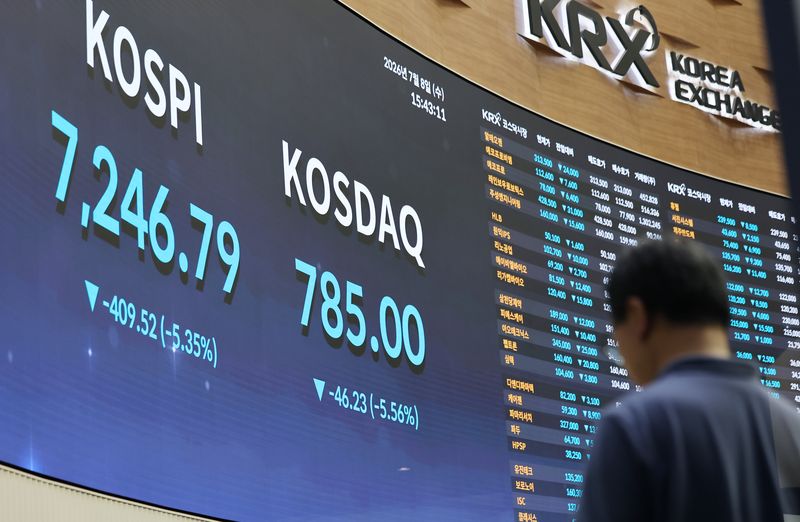
[Financial News] South Korea's stock market plunged for a second straight day, triggering a series of market-stabilization measures. Even so, signs of change are emerging in the exchange rate and foreign investor flows. With the won strengthening, foreign investors turning to net buying, and the possibility of easing pressure from NPS rebalancing, expectations are growing that supply-and-demand conditions could improve.■The exchange rate changed first... it fell below 1,500 wonAccording to the Seoul Foreign Exchange Market on the 9th, the won–dollar exchange rate closed the previous day at 1,498.5 won, down 29.7 won from 24 hours earlier, based on the 3:30 p.m. closing price. It was the first close below 1,500 won in 37 trading days, since 1,491.0 won on May 14.
A weaker dollar also supported the won's strength. As of 3:41 p.m. the previous day, the U.S. Dollar Index (DXY), which measures the dollar against six major currencies, stood at 101.00, slightly down from 101.02 a day earlier.
Expectations for dollar inflows from SK hynix's American Depositary Receipt (ADR) issuance also helped strengthen the won. Lee Kyung-min, a researcher at Daishin Securities, said, "As the dollar funds raised through SK hynix's ADR issuance are expected to be used as funding for domestic capital expenditures (CapEx), demand for dollar selling and won buying has increased."■Foreign investors turn to net buying after 14 trading daysOn the previous day, foreign investors bought a net 339 billion won worth of shares on the Korea Exchange Main Board, returning to net buying for the first time in 14 trading days. Institutions sold a net 355.2 billion won, while individuals sold a net 35.7 billion won.
Foreign investors had mostly been net sellers since the start of the year. In particular, they recorded net selling every day since the 19th of last month. Their return to net buying after 14 trading days marks a shift in that trend.
Byun Jun-ho, a researcher at IBK Investment & Securities, said, "As the recent KOSPI plunge has made valuations more attractive, selling pressure from foreign investors may gradually ease." He added, "Given the solid fundamentals of the semiconductor industry and earnings, the KOSPI is unlikely to enter a bear market with an additional drop of more than 20 percent from its peak, and the 7,300 level is likely to serve as short-term support."
A securities industry official said, "The fact that foreign investors have turned to net buying amid the market's sharp decline is itself a meaningful change." The official added, "However, for this to develop into a sustained improvement in supply and demand, a recovery in investment sentiment toward artificial intelligence (AI) and semiconductor stocks, as well as an inflow of domestic funds, must also be confirmed."■Samsung Electronics and SK hynix plunge, easing NPS pressureUntil now, market participants had pointed to the possibility that NPS could sell large amounts of domestic stocks to meet its target allocation as a major supply-and-demand burden. As KOSPI surged from the start of the year, concerns also grew that the domestic stock share may have exceeded the target, raising fears that NPS could sell tens of trillions of won worth of shares during rebalancing.
But with Samsung Electronics and SK hynix recently undergoing sharp corrections, those concerns appear to have eased somewhat.
Because NPS rebalancing is based on the valuation of domestic stocks, the recent correction in semiconductor stocks has emerged as a key variable. If the actual rebalancing scale turns out to be more limited than initially feared, it could help reduce downward pressure on the domestic market, especially alongside improving foreign investor flows.
A securities industry official said, "As Samsung Electronics and SK hynix have each corrected by around 30 percent recently, the burden on NPS's domestic stock allocation may have eased somewhat." The official added, "If the additional selling needed to meet the target allocation is smaller than expected, supply-and-demand pressure in the second half of the year could also be reduced accordingly."■Risks remain... easing volatility is the keySouth Korea's stock market has recently remained extremely volatile, with sell-side sidecars and circuit breaker mechanisms being triggered on two consecutive days. Market watchers say high volatility is discouraging new capital inflows and weighing on investor sentiment.
Lee Jae-won, a researcher at Yuanta Securities Korea Co., Ltd., said, "Since the introduction of single-stock leveraged exchange-traded funds (ETFs), volatility in the domestic market has expanded excessively compared with major Asian markets." He added, "As volatility rises, risk management and liquidity burdens increase, so institutional improvements that can reduce volatility are needed to stabilize the market."
He also noted that after a Financial Services Commission (FSC) official said that leveraged ETFs and market volatility are unrelated, investors may have assigned a lower probability to regulatory improvements, which could have had a negative effect on sentiment.
Still, Lee said excessive pessimism should be avoided at current price levels, as the KOSPI 12-month forward price-to-earnings ratio has fallen to 6.2 times, close to the level seen during the Global Financial Crisis (GFC). He stressed, "What matters now is not whether more semiconductor stocks need to be sold, but whether AI investment is actually slowing."
[email protected] Choi Du-seon Reporter