"Infrastructure Is Key to the Southwest Semiconductor Industry... Attracting International Schools and Contract Departments Too"
- Input
- 2026-07-08 18:23:04
- Updated
- 2026-07-08 18:23:04
■"Can It Be Done With Land Alone?"
At the policy forum for the success of the Southwest Semiconductor Cluster, held at the National Assembly on the 8th, participants agreed that the outcome of global semiconductor competition ultimately depends on speed. They said the industry must move away from the traditional approach of advancing individual projects one by one and instead push infrastructure, institutions, and workforce development in parallel.
Kim Sang-muk, head of the Korea Photonics Technology Institute, explained, "A semiconductor fab cannot be built just because a site is available." He added, "Power, water, wastewater treatment, roads, and gas infrastructure must all be in place at the time of investment."
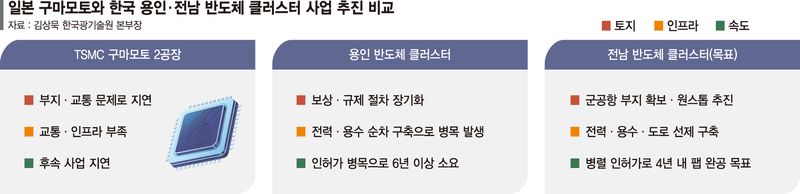
Kim also pointed to the Yongin Semiconductor Cluster as an example of the limits of a sequential approach. "If land, compensation, environmental reviews, power, and water are handled one after another like in Yongin, project delays are inevitable," he said. "Land, permits, and infrastructure must be pushed forward as one package, in parallel."
He also said the TSMC case in Kumamoto, Japan, should serve as a lesson. "The first plant in Kumamoto was completed 22 months after construction began, but the second plant is being delayed because of transportation and infrastructure issues," he noted. "Gwangju–South Jeolla region must build infrastructure from the start at a level that can support four fabs at once."
Building the power grid and securing water supplies were also cited as major tasks. Officials said a stable semiconductor production base will require an integrated system that includes investment in substations and transmission networks, connections to water supply systems using Dongbok Dam and Juam Dam, ultra-pure water production, and wastewater reuse systems.
■"International Schools and Housing Complexes Are Needed"
Cho Hyun-ho, head of the AI Semiconductor Division at the Jeonnam-Gwangju Integrated Metropolitan City, said, "We will begin preparing for fab construction starting this month, with mass production targeted for 2030." He added, "In global semiconductor competition, speed is what ultimately decides the outcome."
Cho outlined the conditions needed to attract companies, including large-scale land, fast permit approvals, dedicated substations, redundant power supply lines, an 8-gigawatt power supply system, and an ultra-pure water supply system capable of providing 400,000 tons per day. He also stressed that residential, medical, childcare, cultural, transportation, and education infrastructure must be built together to attract skilled workers from the Seoul metropolitan area.
He also raised the need for a special law for the Jeonnam-Gwangju Integrated Metropolitan City and revisions to the Special Act on Semiconductors. "Ordinances alone cannot guarantee stable support for companies," Cho said. "We need to establish a legal basis for a semiconductor strategy committee and a permanent support body through the special law for the Jeonnam-Gwangju Integrated Metropolitan City and revisions to the Special Act on Semiconductors, and we must legislate company-specific dedicated support and investment implementation systems."
Workforce recruitment also needs to be carried out systematically in both the short and long term. Each semiconductor fab requires about 3,000 workers. If four fabs are built, 12,000 workers will be needed. Even if semiconductor talent is eventually trained in the Honam region and deployed there, workers will have to relocate in the early stages. That is why there are calls to quickly establish international schools, gifted education specialized high schools, medical facilities, and housing complexes.
Professor Maeng Jong-seon of the Semiconductor Joint Research Institute at Chonnam National University said, "Since the Southwest Semiconductor Cluster is being pushed ahead quickly, workforce training must begin now as well." He added, "The Southwest lacks public infrastructure for full-process training, so a university consortium-style shared fab and the attraction of semiconductor contract departments are absolutely necessary." He also suggested that institutional support, such as military service exemptions, should be considered to ensure the stable operation of contract departments.
[email protected] Lee Dong-hyeok Reporter