Samsung Begins Mass Production of eSSD for Rubin, Expands AI Memory Portfolio
- Input
- 2026-07-08 18:10:22
- Updated
- 2026-07-08 18:10:22
■ Samsung to supply eSSD to NVIDIA
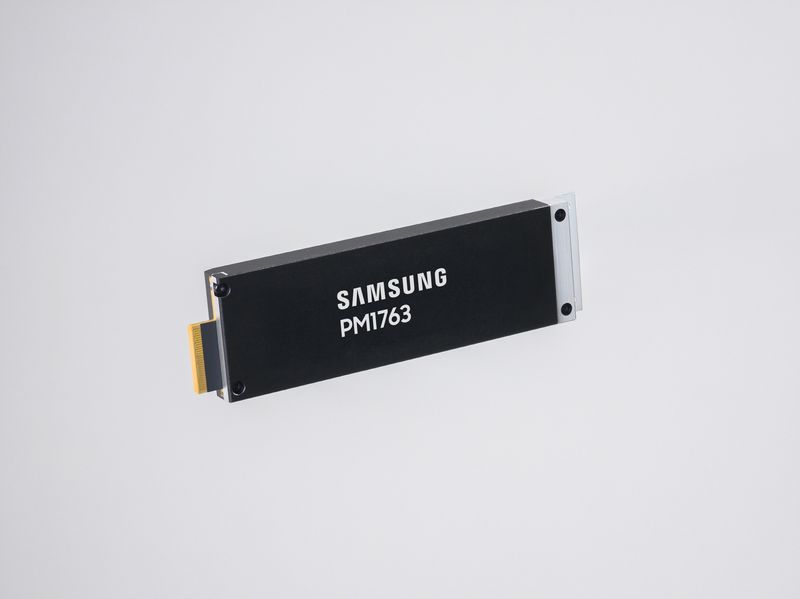
Samsung Electronics said on the 8th that it has started mass production of the PCIe 6.0-based eSSD 'PM1763,' optimized for AI infrastructure. The product is set to be installed in NVIDIA's next-generation AI accelerator, 'Rubin.' While HBM focuses on data processing speed, eSSD is designed to store large volumes of data. As the amount of data required for AI training and inference grows rapidly, eSSD is emerging as a key component of AI infrastructure.
Samsung Electronics currently holds a dominant No. 1 position in the global eSSD market. According to market research firm TrendForce, Samsung Electronics' eSSD market share in the first quarter of this year stood at 35.1%. During the same period, Samsung Electronics' eSSD revenue reached about $7 billion, or roughly 10.5 trillion won, up 92.8% from the previous quarter and far outpacing overall market growth.
Samsung Electronics is stepping up efforts to strengthen its leadership in the eSSD market by unveiling a new PCIe 6.0-based product aimed at next-generation AI platforms. The new PM1763 is equipped with 9th-generation V-NAND and a new 4-nanometer controller, significantly improving performance and power efficiency. It comes in three capacities — 4TB, 8TB, and 16TB — and the 16TB model delivers the industry's highest performance. Based on the 16TB version, sequential read and write speeds reach up to 28,400 megabytes per second and 21,900 megabytes per second, respectively, about twice as fast as the previous PM1753. That is fast enough to transfer a 40-gigabyte Large Language Model (LLM) in about 1.4 seconds.
PM1763 is optimized for liquid-cooling environments used in next-generation AI servers. By using direct-to-chip (D2C) cooling, which attaches a cold plate directly to the device, the product can maintain peak performance for long periods without degradation even under heavy workloads. Its power efficiency is also more than 1.8 times better than the previous model, helping reduce data center operating costs.
■ Accelerating mass shipments of next-generation AI memory
With this eSSD mass production, Samsung Electronics is seen as having strengthened its foundation for providing integrated core memory solutions needed for AI servers, beyond the competitiveness of individual products. Because AI servers rely on the organic combination of various memory products such as HBM, DRAM, and NAND-based eSSD, the ability to supply all major products directly translates into competitiveness.
In mid-February, Samsung Electronics became the first in the world to mass-ship HBM4, signaling its aggressive intent to capture the next-generation AI memory market. At the end of May, it also supplied HBM4E 12-layer samples to major customers. HBM4E is also expected to be installed in NVIDIA's next-generation AI accelerator, the 'NVIDIA Vera Rubin Ultra,' which is scheduled for release next year. The HBM4 now in mass production, like PM1763, is a product for NVIDIA's Rubin. It features an advanced 4-nanometer process applied to the base die, securing both performance and mass-production stability. HBM4 is also translating into real sales. At the end of last month, cumulative HBM4 revenue surpassed $1.2 billion, or about 1.8 trillion won, for the first time in the industry.
[email protected] Lim Su-bin Reporter